

 Nov 25, 2025
 7 min read
Sun, Moon and Child: How Different Cultures Imagined the Two Great Lights
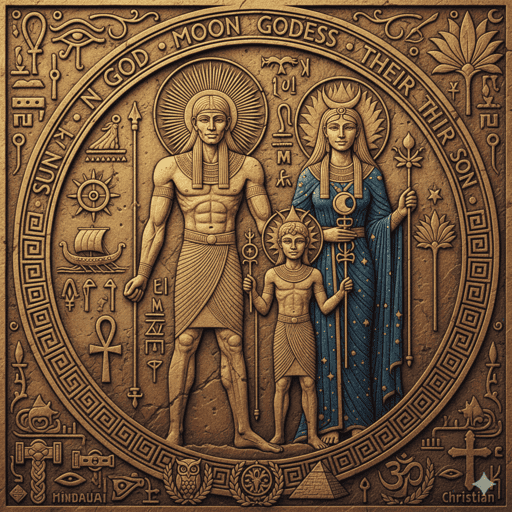
In German the sun is feminine (die Sonne) and the moon masculine (der Mond). In French and Spanish it is the other way round. That grammatical accident reflects something older. Every culture has had to make sense of the only two objects in the sky that show a visible disc, and they have answered very differently. The sun is a god in some traditions and a goddess in others. Sun and moon are married in some, siblings in others, and in some they are the parents of children who matter to the story. In others they are not gods at all. Here is how a range of traditions imagined the two great lights and the families around them.
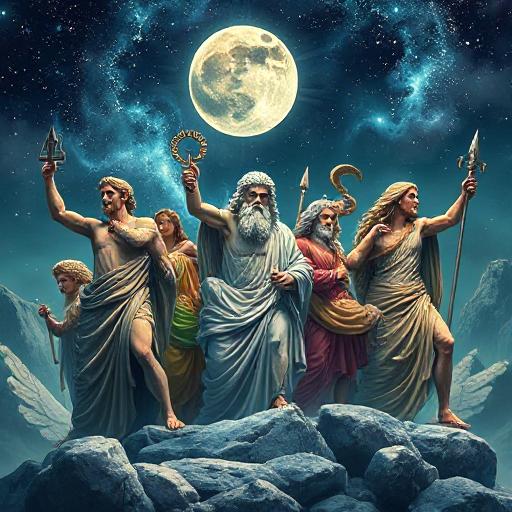
Illustration: the sun, the moon and the child between them.
Egypt: a moon god as the divine child
Ra was the sun god, sailing across the sky by day and through the underworld by night. The moon belonged to male gods: Thoth, god of writing and reckoning, and Khonsu, whose name means "traveller". In the city of Thebes, Khonsu was worshipped as the child in a family of three, with Amun as father and Mut as mother. That makes him one of the clearest cases anywhere of the moon as a divine son. Egyptians also described the sky god Horus as having the sun for his right eye and the moon for his left. In myth, his rival Seth damaged the left eye, and its healing was linked with the moon's waning and waxing.
Greece: three Titan siblings
In Hesiod's Theogony (around 700 BCE), the sun (Helios), the moon (Selene) and the dawn (Eos) are three children of the Titans Hyperion and Theia. Helios drives a chariot across the sky. Selene, in the best-known story about her, falls in love with the sleeping shepherd Endymion. Apollo and his twin Artemis were later identified with the sun and moon, but that came centuries afterwards. In Homer, Apollo is the archer god, not the sun.
Hindu tradition: two male lights and two royal lines
Surya (sun) and Chandra or Soma (moon) are both male. Surya's children are among the most important figures in Hindu story: Yama, god of death; Shani, the planet Saturn; and Karna, the tragic hero of the Mahabharata. Two great royal lineages trace their descent from the two lights. Rama belongs to the Solar Dynasty (Suryavamsha). The Lunar Dynasty (Chandravamsha) includes the Pandavas, the Kauravas and Krishna's Yadava clan. Eclipses were explained by the demon Rahu, whose head was cut off after he stole the nectar of immortality. The head chases the sun and moon and swallows them briefly.
China: a mother of ten suns
Early Chinese texts give the most literal sun-and-moon family. The goddess Xihe is the mother of ten suns, who took turns crossing the sky from a giant mulberry tree. Changxi is the mother of twelve moons, one for each month. Both are wives of the sky god Dijun. When all ten suns rose at once and scorched the earth, the archer Hou Yi shot down nine of them. In a later story his wife Chang'e drank an elixir of immortality and floated to the moon. That tale is told at the Mid-Autumn Festival, and China named its lunar exploration programme after her. Our post on Chinese mythology has more.
Japan: a sun goddess and her estranged brother
According to the Kojiki, Japan's oldest chronicle (712 CE), the god Izanagi washed his face after returning from the land of the dead. The sun goddess Amaterasu was born from his left eye, the moon god Tsukuyomi from his right and the storm god Susanoo from his nose. In the Nihon Shoki, a chronicle completed in 720, Tsukuyomi kills a food goddess, and Amaterasu refuses ever to see him again. That is why the sun and moon are never in the same place: day and night are a family quarrel. Japan's imperial family traditionally traced its descent from Amaterasu.
Norse: a sister sun pursued by wolves
Norse myth reverses the Greek pattern. Sól, the sun, is female and her brother Máni, the moon, is male. They are children of a man named Mundilfari, who was proud enough to name them after the sun and moon, so the gods set them to drive those lights across the sky. They are chased by wolves, Sköll and Hati, which catch them at Ragnarök. The poem Vafþrúðnismál adds a hopeful detail: before she is caught, Sól bears a daughter who will ride her mother's path in the new world.
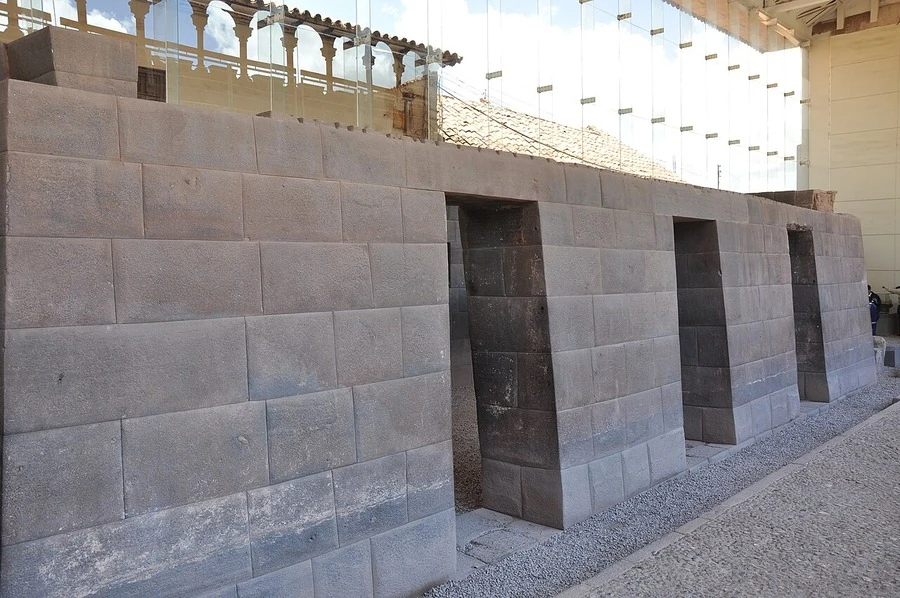
The Coricancha in Cusco, said to have had walls covered in gold for the sun. Photo: Jorge Láscar / Wikimedia Commons, CC BY 2.0
The Inca: the emperor as son of the sun
In the Andes, the sun god Inti was male and the moon, Mama Killa, was his wife and sister. The Inca emperor was called the "son of the sun", and the great temple in Cusco, the Coricancha, was said to have walls covered in gold for the sun and a chamber covered in silver for the moon. The sun-moon-child pattern here was political: it gave the ruling family its right to rule.
Judaism, Christianity and Islam: signs, not gods
The Abrahamic religions break the pattern on purpose. Genesis 1:16 calls the sun and moon only "the greater light" and "the lesser light". Many scholars read the avoidance of their names as a deliberate refusal to treat them as gods. The Hebrew calendar still follows the moon. The Bible also uses the sun as a metaphor, as in "the Lord God is a sun and shield" (Psalm 84:11).
Christianity applied light imagery to Jesus, "the light of the world" and the "sun of righteousness" (from Malachi 4:2). Revelation 12 describes "a woman clothed with the sun, with the moon under her feet" who gives birth to a son, and Christian art often uses this image for Mary. Some popular films and websites go further and claim Jesus was simply a renamed sun god. Historians reject this. The claimed parallels are mostly invented or stretched, and almost all scholars regard Jesus as a historical person.
Islam is the most explicit. The Qur'an says: "Among His signs are the night and the day, the sun and the moon. Do not bow down to the sun or the moon, but bow down to God who created them" (41:37). God "neither begets nor is begotten" (112:3), which rules out any divine family. The Qur'an tells how Abraham watched a star, then the moon, then the sun rise and set, and concluded that nothing that sets can be God (6:76–79). The Islamic calendar is purely lunar.
Buddhism: the hare in the moon
Buddhism has no sun or moon creators, but the two lights appear in its art and stories. The Medicine Buddha is often shown flanked by two bodhisattvas named Sunlight and Moonlight. One of the Jataka tales, stories of the Buddha's earlier lives, tells of a hare who threw himself into a fire to feed a hungry traveller. The traveller was the god Sakka in disguise, and he drew the hare's image on the moon in honour of its generosity. That is why many people across Asia see a rabbit, not a face, in the full moon.
Why the same themes keep appearing
Some similarities come from shared ancestry. The Greek Zeus, the Vedic Dyaus Pita and the Roman Jupiter all descend from a reconstructed Proto-Indo-European sky father, *Dyēus ph₂tḗr, which linguists can trace through the words themselves. Others come from the same sky. Every culture saw a bright daytime light linked to warmth, growth and power, and a changing night light whose 29.5-day cycle marked out months. It is not surprising that the sun so often became a king's ancestor and the moon a keeper of time.
The differences are just as telling as the parallels. Genders flip, families rearrange, and some faiths reject the whole idea. These stories don't show that every religion is secretly the same, and they don't prove one right and the others wrong. They show many peoples looking at the same two lights and asking what they mean. For how the sky shaped another ancient system, see the story of the zodiac.
Sources
- Theoi Classical Texts Library, "HESIOD, THEOGONY". https://www.theoi.com/Text/HesiodTheogony.html
- Quran.com, "Surah Fussilat Ayah 37 - Read, Listen, Translation, Tafsir". https://quran.com/41/37
- Quran.com, "Surah Al-An'am Ayahs 76-79 - Read, Listen, Translation, Tafsir". https://quran.com/6/76-79



Comments (0)
Leave a Reply
Comments are moderated. Please read our Comment Policy before posting.
Log in to post a comment.