

 Nov 24, 2025
 7 min read
Judgement Day Across Religions: How Faiths Picture the Final Reckoning

One of the best-known pictures of a judgement after death is about 3,300 years old. On a papyrus made for an Egyptian scribe named Hunefer, the jackal-headed god Anubis weighs Hunefer's heart against a feather. The ibis-headed Thoth writes down the result, and a monster waits beside the scales to eat the heart if it fails. Since then, many religions have described a reckoning in which lives are weighed and wrongs put right. Some place it at death, some at the end of the world, and some don't have one at all. This post compares what the major traditions teach, using their own texts. Every tradition contains a range of views, so these are summaries of the mainstream ones.
Illustration: the 'final dawn' imagined by many faiths.
Ancient Egypt: the weighing of the heart
Egyptian judgement was individual and happened after death, not at the end of the world. Spell 125 of the Book of the Dead takes the dead person into the Hall of Two Truths. There they declare to 42 divine judges that they have not committed a list of wrongs: "I have not stolen", "I have not killed", "I have not made anyone weep". The heart, which Egyptians saw as the seat of memory and conscience, is then weighed against the feather of Ma'at, goddess of truth and order. A balanced scale meant entry to the Field of Reeds, an idealised Egypt. A heavy heart was eaten by Ammit, part crocodile, part lion and part hippopotamus, and the person ceased to exist. People were buried with a "heart scarab" inscribed with a spell asking their heart not to testify against them.
Zoroastrianism: the bridge and the river of metal
Zoroastrianism has both a personal and a final judgement. At death each soul crosses the Chinvat Bridge, which widens for the righteous and narrows to a blade's edge for the wicked, who fall into a place of punishment. At the end of time comes Frashokereti, the renewal of the world. All people pass through a river of molten metal, which feels like warm milk to the righteous and burns the wicked. In most accounts the metal purifies rather than destroys, so that in the end even the damned are cleansed and evil is gone for good.
Judaism: resurrection and the World to Come
The Hebrew Bible's clearest statement on resurrection is late, in the Book of Daniel (12:2): "Many of those who sleep in the dust of the earth shall awake, some to everlasting life, and some to shame and everlasting contempt." Later rabbinic Judaism taught the resurrection of the dead in the messianic age and a "World to Come" (olam ha-ba). It also has a yearly day of judgement. On Rosh Hashanah, the Jewish New Year, the Mishnah says all people pass before God "like sheep", and their fate for the coming year is decided by Yom Kippur. Jewish thinkers have always differed on the details. Many emphasise right action in this world over speculation about the next.
Christianity: the Last Judgement
Christians believe that Christ will return to raise the dead and judge all people. Jesus' parable of the sheep and the goats (Matthew 25:31–46) makes the standard of judgement unusually concrete. People are separated by whether they fed the hungry, welcomed strangers, clothed the naked and visited the sick and imprisoned: "whatever you did for one of the least of these … you did for me." The Book of Revelation adds vivid imagery: seals, trumpets, the battle of Armageddon and finally "a new heaven and a new earth". Christians differ sharply on how literally to read it. Michelangelo's Last Judgement in the Sistine Chapel, painted from 1536 to 1541, is the most famous image of the scene.
Islam: the Day of Resurrection
Belief in the Last Day is one of the six articles of faith in Islam. The Qur'an calls it Yawm al-Qiyamah (the Day of Resurrection) and Yawm ad-Din (the Day of Judgement). Every Muslim recites the second name daily in the opening chapter, which calls God "Master of the Day of Judgement". The Qur'an describes the end in striking images. The sun is "wrapped up", the stars fall, the mountains are moved and the seas boil over (Surah 81:1–14). Then:
- The dead are raised and each person receives a record of their deeds, in the right hand for the saved and the left for the lost (69:19–25).
- Deeds are weighed on scales, and nothing is overlooked: "whoever does an atom's weight of good will see it, and whoever does an atom's weight of evil will see it" (99:7–8).
- Hadith add signs before the Day, including the appearance of the Mahdi, the return of Isa (Jesus), the Dajjal and the sun rising in the west.
The Qur'an is emphatic that the timing belongs to God alone (31:34).
Hinduism and Buddhism: no single day
Neither tradition has one universal Judgement Day. In Hindu thought, karma, the moral weight of actions, shapes each soul's next birth. Yama, the god of death, assisted by the record-keeper Chitragupta, assigns souls to heavens and hells. These are temporary stops, not final destinations, and the aim is moksha, release from the cycle altogether. On the cosmic scale, the present age (Kali Yuga) ends with the avatar Kalki. Over vastly longer periods, whole universes are dissolved and re-created in endless cycles.
Buddhism also sees karma as a natural law rather than a judge's verdict. No god decides; actions bring their own results across lifetimes. Buddhist texts describe world-systems forming and being destroyed over immense cycles of time, and a future Buddha, Maitreya, who will teach after the present teaching is forgotten. Our post on awaited saviours covers these future figures.
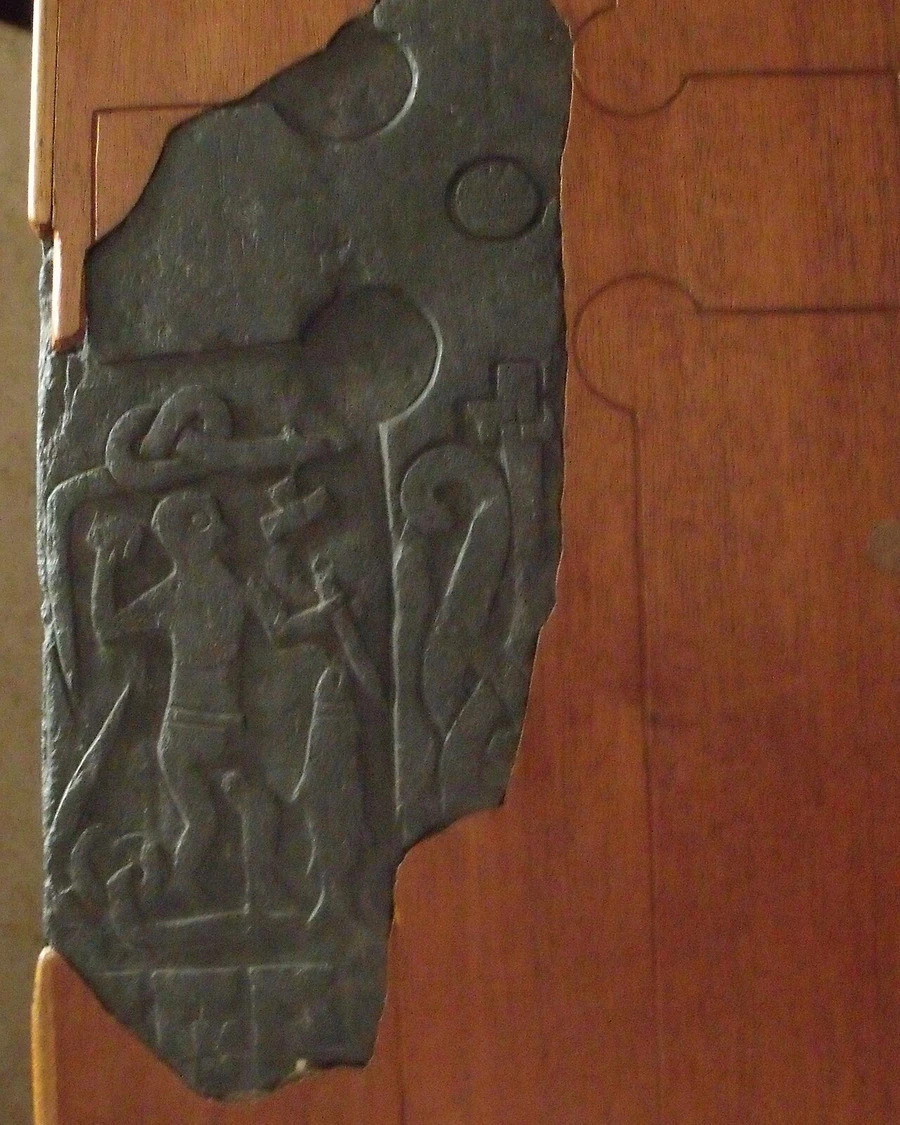
Ragnarök, the Norse end of the world, is a battle rather than a trial. Photo: Malost / Wikimedia Commons, CC BY-SA 3.0
Norse religion: Ragnarök
The Norse end of the world, told in the poem Völuspá and in Snorri Sturluson's 13th-century Prose Edda, is a battle, not a trial. Three winters come with no summer between them. The wolf Fenrir swallows Odin, and Thor kills the world serpent but dies from its venom. The fire giant Surtr sets the world ablaze. Yet the poem describes a new green earth rising from the sea, and it places oath-breakers and murderers in a grim hall called Nastrond. That is the nearest Norse myth comes to moral judgement.
What science says about the end
Science has no judgement, but it does have an end for Earth. The Sun grows about 10% brighter every billion years. Climate models suggest that within roughly one to two billion years, Earth will become too hot to keep liquid oceans (Wolf and Toon, 2015). In about five billion years the Sun will swell into a red giant. Nearer threats such as nuclear war, pandemics and climate change are human-made, which is why some people call them a "judgement" we pass on ourselves.
When?
Islam and Christianity both say plainly that no one knows the hour. Hindu and Buddhist cycles put the end unimaginably far away. People have still tried to set dates. The Millerites expected the end in 1844, and the radio preacher Harold Camping predicted 21 May 2011. Some read the end of a Maya calendar cycle in December 2012 as a doomsday, although the Maya themselves saw it as the turning of a count, like an odometer rolling over. Every one of these dates has passed.
What the traditions share
The details differ, and the differences matter to believers. Time is a line in some traditions and a circle in others. A divine judge decides in some, and karma operates impersonally in others. Punishment is eternal in some and purifying in others. Most share one conviction: what people do matters, and it will be accounted for. As the Egyptian dead tried to persuade their judges, the claim that counted was "I have not made anyone weep", not wealth or rank.
Sources
- Bible Gateway, "Matthew 25:31-46 NIV - The Sheep and the Goats - “When the". https://www.biblegateway.com/passage/?search=Matthew+25%3A31-46&version=NIV
- Quran.com, "Surah At-Takwir Ayahs 1-14 - Read, Listen, Translation, Tafsir". https://quran.com/81/1-14
- Quran.com, "Surah Az-Zalzalah Ayahs 7-8 - Read, Listen, Translation, Tafsir". https://quran.com/99/7-8
- Quran.com, "Surah Luqman Ayah 34 - Read, Listen, Translation, Tafsir". https://quran.com/31/34
- Wolf E, Toon O, "The evolution of habitable climates under the brightening Sun", Journal of Geophysical Research: Atmospheres 120 (2015): 5775-5794. https://doi.org/10.1002/2015JD023302




Comments (0)
Leave a Reply
Comments are moderated. Please read our Comment Policy before posting.
Log in to post a comment.