

 Oct 06, 2026
 5 min read
Compound Interest: The Math That Quietly Builds Fortunes
Albert Einstein is often quoted as calling compound interest the eighth wonder of the world, or the most powerful force in the universe. There is no evidence he said either. The researchers at Quote Investigator traced the attributions and found nothing earlier than decades after his death, mostly in financial advertising. The maths needs no famous endorsement, though. It is simple enough to do on a phone calculator, and the results surprise most people the first time they work them out.
Interest on interest
Put $10,000 into an account that pays 7 per cent simple interest, and you earn $700 a year on the original deposit, every year. After 30 years you have $10,000 plus 30 × $700, which is $31,000.
With compound interest, each year's interest is added to the balance, and the next year's interest is calculated on the new, larger total. In the second year you earn 7 per cent of $10,700, which is $749. In the third, 7 per cent of $11,449. The formula is A = P(1 + r)t, where P is the starting amount, r the rate per period as a decimal, and t the number of periods. The time sits in the exponent, which is what makes the curve bend upwards. After 30 years at 7 per cent, the $10,000 becomes $76,123, nearly two and a half times the simple-interest result. You can try other figures in the Pythous compound interest calculator.
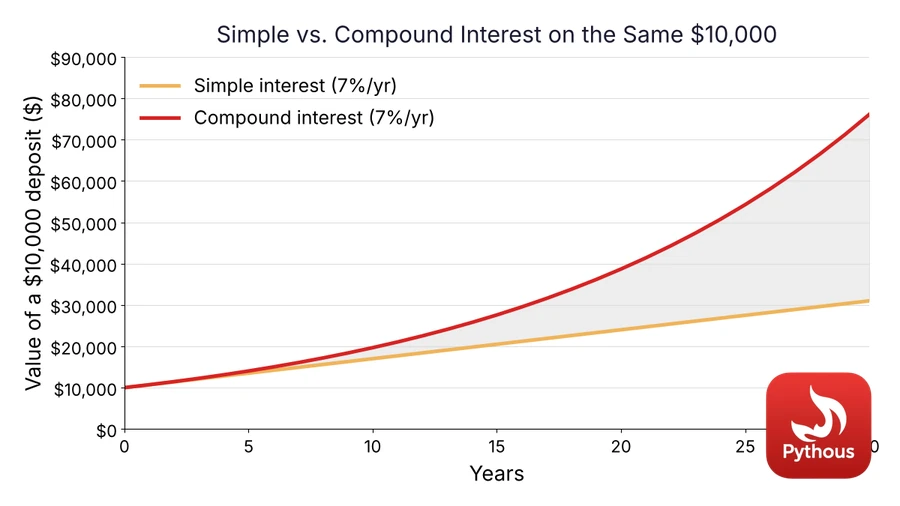
Chart: value of a $10,000 deposit over 30 years at 7% annual interest, comparing simple interest (linear growth) to compound interest (exponential growth), calculated from A = P(1 + r)^t.
The early years are slow. After five years the balance is only $14,026. After 20 it is $38,697. The last ten years of the 30 add more than $37,000, more than the first twenty put together. Compounding is back-loaded: most of the gain arrives at the end, which is why starting ten years earlier matters far more than saving a little more each month later on.
A small rate difference becomes a large one
Because the rate is raised to a power, small differences grow. The same $10,000 left for 30 years becomes $24,273 at 3 per cent, $57,435 at 6 per cent and $132,677 at 9 per cent. Tripling the rate multiplies the result by more than five.
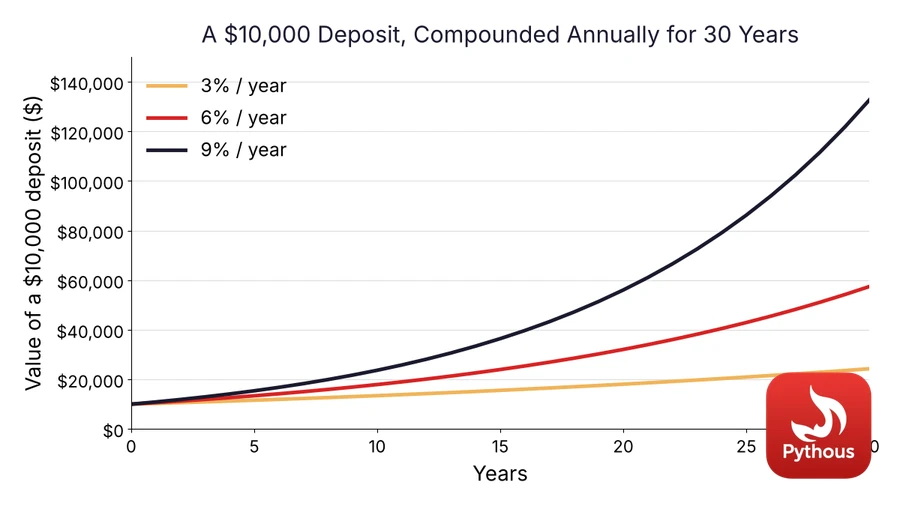
Chart: a $10,000 deposit compounded annually for 30 years at 3%, 6%, and 9%, calculated from A = P(1 + r)^t.
The same arithmetic works on costs. An investment fund that earns 7 per cent a year but charges 1 per cent in fees leaves you with 6 per cent. Over 30 years that one percentage point cuts the final balance from $76,123 to $57,435, about a quarter less. This is why low-cost index funds have taken so much money away from expensive managed funds over the past few decades.
The rule of 72
To estimate how long money takes to double, divide 72 by the annual percentage rate. At 6 per cent, 72 ÷ 6 = 12 years; the exact answer is 11.9. At 9 per cent, 8 years. At 3 per cent, 24. The rule is old: the Italian mathematician Luca Pacioli included it, without explanation, in his Summa de arithmetica, printed in Venice in 1494, which suggests merchants were already using it. The exact version uses the natural logarithm of 2, about 0.693, which is why some people prefer a "rule of 69" or "70"; 72 survives because it divides neatly by 2, 3, 4, 6, 8, 9 and 12.
That natural logarithm comes from compound interest too. In 1683 the Swiss mathematician Jacob Bernoulli asked what happens if interest is added more and more often: yearly, monthly, daily, every second. He found the result doesn't grow without limit. At 100 per cent a year compounded continuously, £1 grows to about £2.718 and no more. That number, now called e, turned out to be one of the most important constants in mathematics.
Compounding daily instead of yearly adds a little, but far less than a higher rate or more time. Photo: Towfiqu barbhuiya / Pexels
How often it compounds matters less than you'd think
Bernoulli's result also explains why compounding frequency is a minor detail. A rate of 6 per cent compounded once a year gives 6 per cent. Compounded monthly, it gives an effective 6.17 per cent a year. Compounded daily, about 6.18. The headline rate and the length of time matter far more. Banks often advertise "daily compounding" because it sounds generous; the difference is usually a fraction of a percentage point.
The same formula on a debt
Compounding has no preference for savers. An unpaid credit card balance grows by exactly the same rule, at much higher rates. A card charging 24 per cent a year, compounded monthly, has an effective annual rate of 26.8 per cent, and by the rule of 72 an unpaid balance would double in about three years. Paying only the minimum each month keeps most of the balance growing, which is why minimum payments can stretch a modest debt over many years. The quickest gain most people can make from compound interest is to stop paying it on high-interest debt before trying to earn it on savings.
Sources
- Quote Investigator, "Compound interest is man's greatest invention" (on the Einstein attribution). https://quoteinvestigator.com/2011/10/31/compound-interest/
- US Securities and Exchange Commission, Investor.gov, "Compound interest calculator". https://www.investor.gov/financial-tools-calculators/calculators/compound-interest-calculator
- J. J. O'Connor and E. F. Robertson, "The number e", MacTutor History of Mathematics, University of St Andrews (Bernoulli, 1683). https://mathshistory.st-andrews.ac.uk/HistTopics/e/
- "Rule of 72", Wikipedia (history, including Pacioli's Summa de arithmetica, 1494). https://en.wikipedia.org/wiki/Rule_of_72





Comments (0)
Leave a Reply
Comments are moderated. Please read our Comment Policy before posting.
Log in to post a comment.