
 Oct 23, 2025
 6 min read
Chinese Mythology: The Celestial Kingdom of Gods, Immortals, and the Balance of Heaven and Earth

Long before the first emperors ruled from their thrones, before ink brushed silk with calligraphy, the people of ancient China looked to the skies — to stars and storms, mountains and rivers — and saw them alive with divine spirit.
From this deep reverence was born Chinese mythology, a timeless web of gods, goddesses, dragons, and immortals who govern not just heaven, but the harmony of the universe itself.
Unlike many mythologies that divide good and evil sharply, Chinese mythology is about balance — the eternal dance of Yin and Yang, of Heaven and Earth, of creation and transformation.
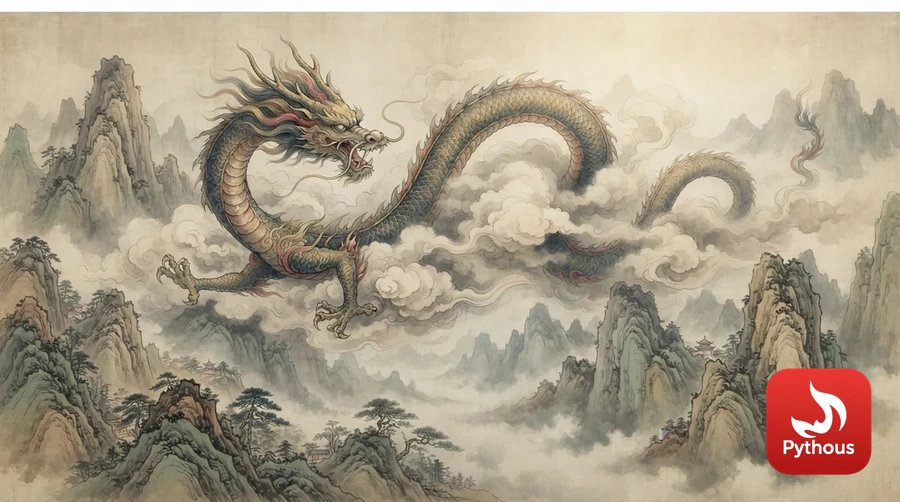
Illustration: in Chinese myth, dragons are spirits of water and the sky.
☯️ The Beginning: Pangu and the Creation of the World
In the beginning, there was nothing but chaos — a dark, swirling void.
From this cosmic egg emerged Pangu, the first living being, the creator of the world.
For 18,000 years, Pangu separated Heaven and Earth, holding the sky above and the earth below, growing taller every day until the balance was set.
When his work was done, his body became the world itself: his breath became the wind, his voice thunder, his eyes the sun and moon, his blood the rivers, and his hair the forests.
Through Pangu’s sacrifice, the universe came into being — a beautiful reminder that creation and transformation are one.
🌸 The Mother of Humanity – Nuwa
After Pangu’s passing, the world was silent. Then came Nuwa, the gentle mother goddess, who looked upon the empty lands and longed for companionship.
From yellow clay, she molded human figures, shaping them with care and breathing life into them.
When the clay ran out, she dipped a vine in mud and flicked droplets that became the common people — showing that all souls are divine, though some are molded with more care.
When the heavens later cracked and chaos threatened creation, Nuwa melted stones of five colors to patch the sky — restoring balance and saving the world.
She remains the eternal symbol of love, compassion, and creation — the divine mother of humankind.
🔥 Fuxi – The Father of Civilization
Beside Nuwa stands Fuxi, her brother and consort, the god of wisdom and civilization.
He taught humanity how to fish, hunt, weave nets, and write — and gave the Eight Trigrams (Bagua), the symbols that became the foundation of the I Ching (Book of Changes).
Together, Fuxi and Nuwa are the twin pillars of Chinese creation — embodying the perfect harmony of Yin and Yang.
🐲 The Jade Emperor – Ruler of Heaven
Above all gods reigns the Jade Emperor (Yuhuang Dadi), the celestial ruler of Heaven and the ultimate judge of all beings.
Once a mortal prince who achieved great virtue and enlightenment, he ascended to the heavens and was crowned the Lord of the Universe.
From his Celestial Palace, he oversees gods, spirits, demons, and mortals, ensuring that the balance of Heaven, Earth, and the Underworld remains unbroken.
Every year, people across China celebrate him during the Heavenly Emperor’s Birthday, offering incense and prayers for peace and prosperity.
The Jade Emperor is not a distant ruler — he represents the moral order of the cosmos, reminding mortals that virtue is the highest form of power.
🐉 Dragons – Spirits of Water and Heaven
In Chinese mythology, dragons are not monsters — they are sacred symbols of power, wisdom, and prosperity.
Unlike the fire-breathing beasts of Western legends, Chinese dragons bring rain, fertility, and good fortune.
The most revered among them is the Dragon King (Longwang), who rules over the seas and rain. There are four Dragon Kings, one for each sea of China — East, South, West, and North.
They control rainfall and rivers, and when angered by human greed or pollution, they withhold rain — a warning to respect nature’s balance.
The dragon embodies Yang energy — active, creative, and noble — making it one of the most beloved symbols in Chinese culture.
🌕 Chang’e – The Moon Goddess
Far above, in the silver glow of the moon, lives Chang’e, the goddess of immortality.
Her story is one of love, sacrifice, and longing.
Long ago, her husband, Hou Yi, was a mighty archer who shot down nine of the ten suns that scorched the earth. As a reward, he received the elixir of immortality.
But when a greedy man tried to steal it, Chang’e drank the potion to keep it safe — and floated to the moon, where she remains forever.
Every Mid-Autumn Festival, people look up to the moon, light lanterns, and offer mooncakes — honoring the goddess who reminds us that even immortality carries the ache of love.
🔥 The Monkey King – Sun Wukong
Among all heroes of Chinese mythology, none are more mischievous and beloved than Sun Wukong, the Monkey King.
Born from a stone on the Mountain of Flowers and Fruit, he gained supernatural powers through Taoist training — shape-shifting, immense strength, and cloud-leaping speed.
Yet his arrogance led him to rebel against Heaven, defeating celestial armies and proclaiming himself “Great Sage Equal to Heaven.”
Eventually, he was subdued by Buddha and later redeemed during his journey with the monk Xuanzang in the epic tale “Journey to the West.”
Sun Wukong symbolizes the untamed human spirit — powerful, flawed, but capable of enlightenment through humility and discipline.
🌊 Guanyin – The Goddess of Mercy
Among the most loved deities in Chinese belief is Guanyin, the Bodhisattva of Compassion.
Her name means “She Who Hears the Cries of the World.”
Once a mortal princess, she chose mercy over power, enlightenment over heaven.
Guanyin turned away from Nirvana to stay among humanity, guiding lost souls and comforting the suffering.
She embodies infinite compassion, showing that true divinity is not found in might, but in kindness.
🏮 The Eternal Harmony – Tao, Yin, and Yang
Beneath all Chinese mythology flows a single truth: everything in the universe exists in balance.
This is the way of the Tao — the natural order, the eternal rhythm of existence.
The forces of Yin (dark, receptive, feminine) and Yang (bright, active, masculine) are not opposites — they are complements, each completing the other.
From the gods of Heaven to the smallest blade of grass, all follow this harmony.
It teaches that peace, both divine and human, lies in balance — within ourselves, and within the world.
🕊️ The Legacy of the Celestial Realm
Chinese mythology is not just ancient folklore — it’s a living philosophy.
Its gods teach lessons of virtue, balance, humility, and compassion.
In their stories, we see our own struggles — pride and forgiveness, loss and rebirth, chaos and peace.
And through their eternal balance, the myths remind us of one timeless truth:
Heaven, Earth, and Humanity are not three realms — they are one harmony.
As long as the moon glows over the mountains and dragons ride the mist of rivers,
the gods of Chinese mythology will continue to whisper their wisdom through the ages.
✨ In Essence
Chinese mythology is a mirror of life — a harmony of Heaven and Earth, of strength and compassion, of gods who are as human as we are divine.
Their stories remind us to seek balance, honor nature, and find divinity within ourselves.

Comments (0)
Leave a Reply
Log in to post a comment.