

 Oct 14, 2025
 6 min read
The Gods of Ancient Egypt: Who They Were and Where Their Stories Come From

On 24 August 394 CE, someone at the temple of Isis on the island of Philae carved a short hieroglyphic inscription next to a figure of a god. It is the last dated hieroglyphic text known. By then the gods it honoured had been worshipped along the Nile for more than three thousand years. Egyptians recognised hundreds of deities. Many were local gods of a single town, and their roles, forms and family ties changed over the centuries. This guide covers the best-known of them, what they were responsible for, and the ancient sources where their stories come from.
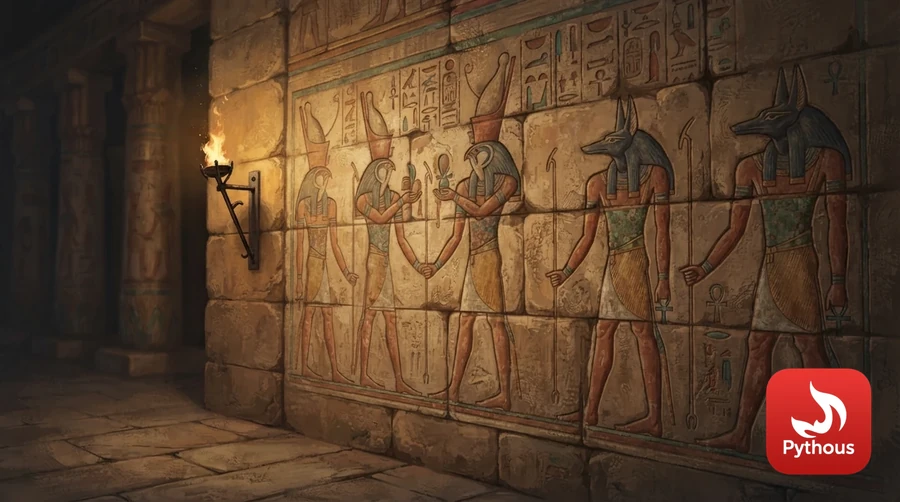
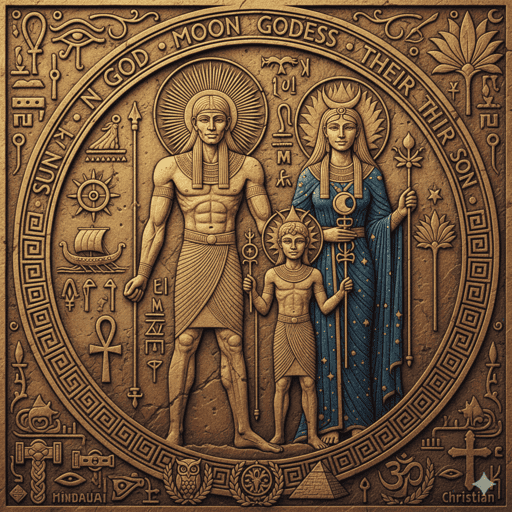
Illustration: Egyptian gods such as Horus and Anubis, as shown on temple walls.
A note on animal heads
Egyptian gods are often shown with an animal's head on a human body. Egyptians didn't think the gods literally looked like this. The animal was a visual sign of a god's nature: the falcon's soaring sight for Horus, the jackal that haunted desert cemeteries for Anubis. A single god could take several forms. Gods could also merge: Amun of Thebes and the sun god Ra combined as Amun-Ra, king of the gods in the New Kingdom (about 1550–1070 BCE).
Ra, the sun
Ra was the sun and, in the tradition of the city of Heliopolis, the creator. Each day he sailed across the sky in a boat. Each night he travelled through the twelve hours of the underworld, described in the tomb text known as the Amduat. There he fought the chaos serpent Apophis so that the sun could rise again. From the 4th Dynasty, around 2500 BCE, kings took the title "Son of Ra" as part of their official names. Ra's importance was never more obvious than under Akhenaten, around 1350 BCE, who briefly tried to replace the traditional gods with worship of the Aten, the sun disc itself.
Osiris, Isis, Horus and Seth: the central myth
The most important Egyptian story is about one family. Egyptian texts refer to it in pieces. The fullest connected version comes from the Greek writer Plutarch, around 100 CE, in his essay On Isis and Osiris.
- Osiris was a good king whom his jealous brother Seth murdered. In Plutarch's version, Seth tore the body into 14 pieces and scattered them across Egypt.
- Isis, his wife, searched for the pieces with her sister Nephthys, reassembled the body and, by her magic, conceived a son. Osiris became king of the dead. He was also linked with grain sprouting from the earth, and tombs sometimes held "Osiris beds", figures of the god planted with seeds. His main cult centre was Abydos.
- Horus, the son, grew up hidden in the marshes and then claimed his father's throne. A papyrus from about 1150 BCE, The Contendings of Horus and Seth, describes the gods' tribunal arguing over the case for 80 years. In one episode Seth tears out Horus's eye, and it is healed. The healed eye, the wedjat, became the most popular protective amulet in Egypt. Every living pharaoh was regarded as Horus on earth.
- Seth was the god of storms, deserts and foreign lands, violent but not simply evil. He stood at the prow of Ra's boat each night and speared Apophis. Kings Seti I and Seti II were named after him. Only in the last centuries of Egyptian religion was he treated as a villain to be cursed.
The cult of Isis spread far beyond Egypt. Her temples stood in Rome and Pompeii, and her temple at Philae, the source of that last inscription, was among the last in Egypt to function. Its closure is traditionally dated to the reign of the emperor Justinian in the 6th century.
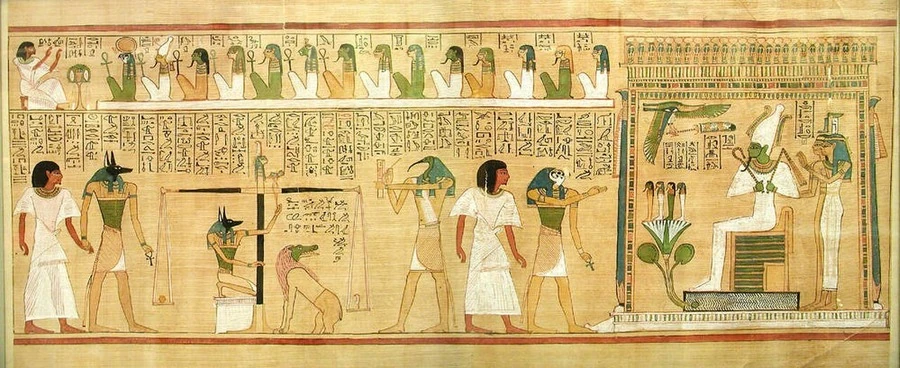
The weighing of the heart, best known from the papyrus of Hunefer, around 1300 BCE. Photo: Papyrus of Hunefer, British Museum / Wikimedia Commons, public domain
Anubis, guardian of the dead
Anubis presided over embalming, and priests preparing a mummy may have worn jackal masks. In the Book of the Dead he leads the deceased to the scales where the heart is weighed against the feather of truth. The best-known image of this scene is on the papyrus of the scribe Hunefer, made around 1300 BCE and now in the British Museum. Anubis was a god of protection and proper burial, not of fear.
Thoth, god of writing
Thoth, shown as an ibis or a baboon, was the scribe of the gods and was credited with inventing writing. He records the verdict at the weighing of the heart and was also a god of the moon and of calculation. In the Late Period, millions of ibises were mummified and buried as offerings to him in catacombs at Saqqara and Tuna el-Gebel. Greeks in Egypt identified him with Hermes. The combined figure, Hermes Trismegistus ("thrice-great"), became the legendary author of mystical texts that fascinated Renaissance Europe.
Bastet, the cat goddess
Bastet began as a lioness goddess and was later shown mainly as a cat or a cat-headed woman, protector of homes, women and children. Her temple was at Bubastis in the Nile Delta. The Greek historian Herodotus, who visited Egypt in the 5th century BCE, wrote that her festival drew 700,000 people, "not counting children", travelling by boat with music and clapping. He added that more wine was drunk there than in the whole rest of the year (Herodotus, Histories, Book 2). Huge cat cemeteries grew up around her cult. In the 1890s, tons of cat mummies dug from one at Beni Hasan were shipped to Britain and sold as fertiliser.
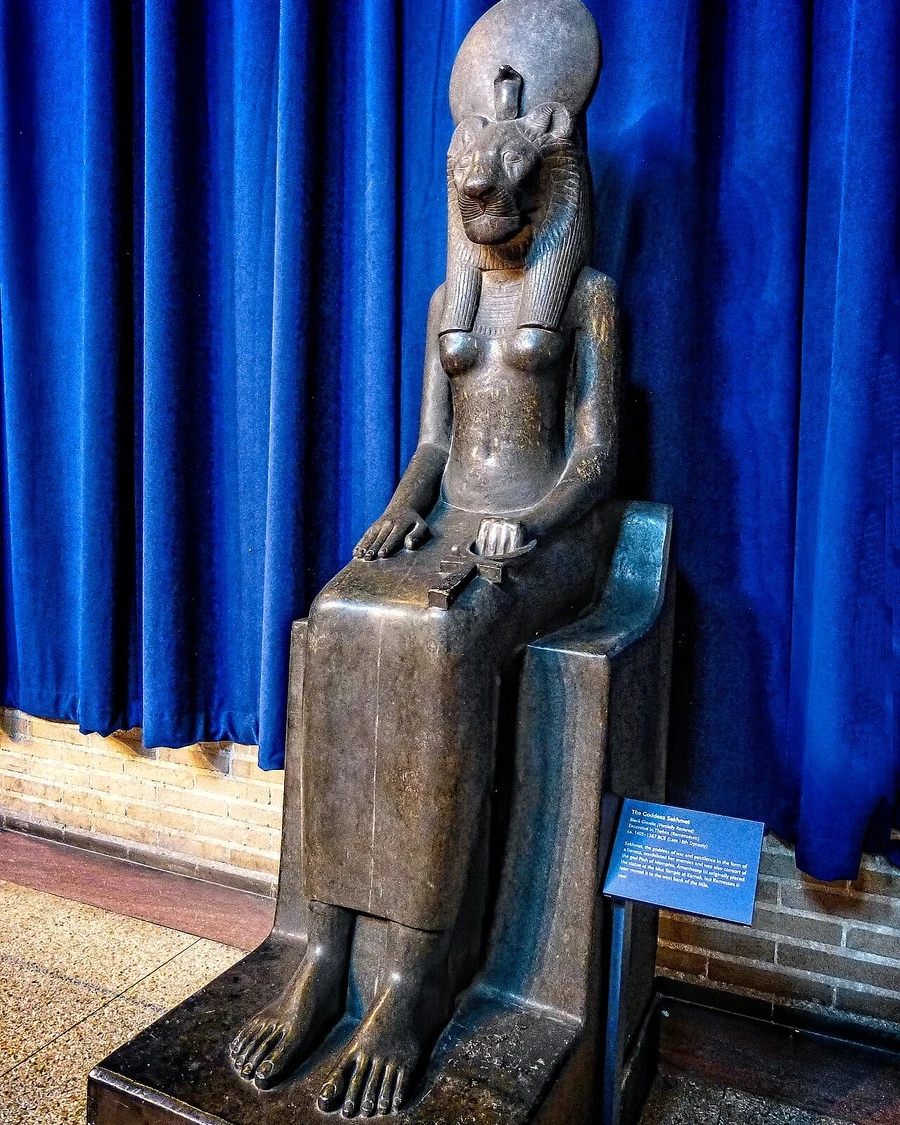
Sekhmet, lioness goddess of plague and war, and also of healing. Photo: Mary Harrsch / Wikimedia Commons, CC BY-SA 4.0
Sekhmet, the lioness
Sekhmet ("the powerful one") was a lioness goddess of plague and war, and also of healing. Her priests were among Egypt's physicians. A text called the Book of the Heavenly Cow tells how Ra, angered by human rebellion, sent his Eye as a raging goddess to punish humanity. When he relented she could not be stopped. So Ra had 7,000 jars of beer dyed red with ochre and poured over the fields. She drank it, thinking it was blood, became drunk and stopped. Amenhotep III set up hundreds of granite statues of Sekhmet at Thebes, perhaps to ward off an epidemic. Many survive in museums around the world.
Ma'at, truth and order
Ma'at was both a goddess, shown with an ostrich feather on her head, and the principle of truth, justice and cosmic order. Its opposite was isfet, chaos. The king's central duty was to uphold ma'at, and kings are often shown offering a small figure of the goddess to the other gods. The feather on the scales of judgement is hers. In the afterlife, the dead declared that they had lived by ma'at: "I have not stolen", "I have not lied", "I have not made anyone weep".
Why the gods lasted
Egyptian religion was practical as well as mythic. People wore amulets of Horus's eye, kept figurines of the household god Bes, wrote letters to dead relatives and asked gods for oracles. When Jean-François Champollion deciphered hieroglyphs in 1822, these gods became readable again after 1,400 years of silence. For more on the river at the centre of Egyptian life, see our post on the ancient Nile. To compare another pantheon, see the Greek gods.
Sources
- Project Gutenberg, "The History of Herodotus - Volume 1 by Herodotus". https://www.gutenberg.org/ebooks/2707
- Project Gutenberg, "The Book of the Dead by Sir E. A. Wallis Budge". https://www.gutenberg.org/ebooks/7145
- Wikipedia, "Ancient Egyptian deities". https://en.wikipedia.org/wiki/Ancient_Egyptian_deities



Comments (0)
Leave a Reply
Comments are moderated. Please read our Comment Policy before posting.
Log in to post a comment.