

 Jul 15, 2026
 6 min read
The Magical Map of Everything: A Guide to Dimensions
The Magical Map of Everything: A Guide to Dimensions
Have you ever wondered what the world is really made of? How does a video game character know where to walk, and how do we know where we are in the universe? The answer lies in something called dimensions.
But what exactly is a dimension? How many are there? And what could possibly be hiding in the ones we can’t see? Let’s dive into the ultimate map of reality.
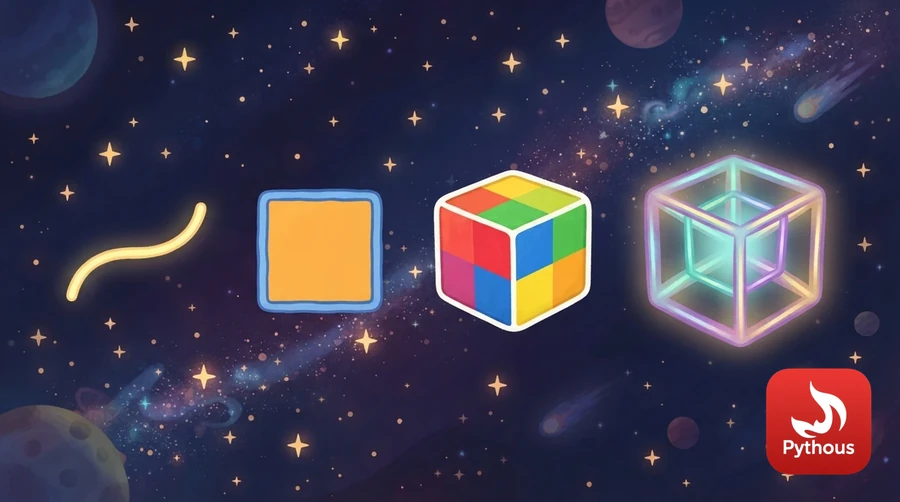
Illustration: from one dimension to four.
What is a Dimension?
Simply put, a dimension is a direction. It is a measurable extent of something. Think of it like a set of rules that tells things where they can go. If you are playing a board game, the rules say you can only move left, right, forward, or backward. Those are your dimensions. In science, a dimension is any physical measurement—like length, width, height, or time—that helps us pinpoint exactly where and when something is.
How Many Dimensions Have Been Discovered?
To answer this, we have to split science into two parts: experienced reality and theoretical physics.
We absolutely know that we live in four dimensions (three of space, one of time). However, advanced physics theories, like String Theory and M-Theory, mathematically propose that the universe actually contains 10 or 11 dimensions. While these extra dimensions haven't been "discovered" in the sense that we can see or touch them, the math of the universe suggests they are there, hiding in plain sight.
Let’s break them down one by one, looking at who discovered them.
The Known Dimensions (1 to 4)
The 0th Dimension: The Point
- What is it? A single dot. It has no length, no width, and no height. It just exists.
- Who discovered it? The ancient Greek mathematician Euclid (around 300 BC) was the first to formally define a "point" in his famous book, The Elements.
The 1st Dimension: The Line
- What is it? Take that dot and stretch it. You get a line. It has only one measurement: length.
- Who discovered it? Again, Euclid laid this out as the foundation of geometry. Later, in the 17th century, René Descartes invented the "Cartesian coordinate system" (the X-axis), giving us a mathematical way to measure this line.
The 2nd Dimension: The Flatland
- What is it? Stretch the line sideways. Now you have width and length. This is a flat surface, like a piece of paper or the screen on your phone.
- Who discovered it? René Descartes added the Y-axis to the X-axis, creating the 2D graph we still use in math classes today.
The 3rd Dimension: The Space We Live In
- What is it? Take your flat piece of paper and give it thickness (height/depth). Now it's a box. This is our physical world. We can move up, down, left, right, forward, and backward.
- Who discovered it? René Descartes added the Z-axis to complete the 3D coordinate system. However, the concept of 3D space was mathematically explored much later by brilliant minds like Carl Friedrich Gauss in the 19th century.
The 4th Dimension: Time
- What is it? Space isn't enough to plan a meeting. You have to say where (3D space) and when (Time). Time is the dimension that moves us forward.
- Who discovered it? In 1905, Albert Einstein published his Theory of Special Relativity. He proved that space and time are not separate; they are woven together into a single fabric called "spacetime."
The Hidden Dimensions (5 to 11)
If time is the 4th dimension, what are the 5th through 11th dimensions? These come from a field of physics called String Theory, which tries to explain how gravity and tiny particles work together.
The 5th Dimension: The Kaluza-Klein Cylinder
- What is it? A tiny, curled-up spatial dimension.
- Who discovered it? In 1919, a mathematician named Theodor Kaluza wrote to Einstein, suggesting that if light and gravity were connected, there must be a 5th dimension. In 1926, physicist Oskar Klein figured out that this dimension is rolled up so tightly (smaller than an atom) that we can never see it.
The 6th, 7th, 8th, and 9th Dimensions: The String Landscape
- What is it? Extra curled-up spaces where tiny strings of energy vibrate to create the particles that make up our universe.
- Who discovered them? In the 1970s and 1980s, physicists like Michael Green, John Schwarz, and Edward Witten developed Superstring Theory. They proved that the math only works if the universe has exactly 10 dimensions (9 of space, 1 of time).
The 10th and 11th Dimensions: The Membrane (M-Theory)
- What is it? The highest mathematical level. It suggests our entire universe is just one "bubble" or "membrane" floating in an 11-dimensional vastness, alongside other universes.
- Who discovered it? In 1995, Edward Witten unified five different string theories into one single framework called M-Theory, requiring an 11th dimension to make the math work.
What is in the Other Dimensions? (Explained Like You're a Child)
Imagine you are a tiny ant, and you are walking along a tightrope. To you, the tightrope is a 1-dimensional line. You can only walk forward or backward.
But now, imagine a tiny, microscopic flea sitting on that same tightrope. Because the flea is so small, it doesn’t just see a line. It sees the thickness of the rope. The flea can walk around the rope, doing little circles.
To the ant, that "around" direction doesn't exist. But to the flea, it is a whole extra dimension that is curled up tight inside the rope.
Our universe is just like that tightrope.
We are giant giants compared to the tiny particles that make up the universe. We can only see the big, stretched-out directions: left/right, up/down, and forward/backward. We can also feel time ticking forward.
But if you were to shrink down smaller than an atom, smaller than a fleck of dust, smaller than a microscopic flea, you would see that empty space isn't empty at all.
So, what is hiding in these other dimensions?
- Tiny Hidden Highways: In the 6th, 7th, and 8th dimensions, there are microscopic, twisted tunnels and loops. It is believed that tiny particles travel through these secret tunnels.
- The Force of Gravity: Scientists think gravity is actually leaking into these extra dimensions! That is why gravity feels so weak to us. If you hold up a tiny fridge magnet, its magnetic force is beating the gravity of the entire Earth pulling down on it. Gravity is weak because it is busy spreading out into the hidden dimensions we can't see.
- Different Universes: In the higher dimensions (like the 9th and 11th), our entire universe might look like a thin piece of paper floating in a giant dark room. There could be other "pieces of paper" (other universes) floating right next to ours, but we can't touch them or see them because they exist in directions our giant bodies can't point to.
- Vibrating Strings: At the very bottom of reality, inside these hidden dimensions, are tiny rubber-band-like strings. Because these extra dimensions have crazy, twisty shapes, when the strings vibrate inside them, they wiggle in different patterns. Those wiggles create the "notes" that become electrons, light, and the stuff you are made of.
In short, the other dimensions don't have monsters or magic portals like in sci-fi movies. Instead, they hold the secret invisible engines of our universe. They are the tiny, unseen gears and strings that make gravity pull, light shine, and atoms stick together to make... you!



Comments (0)
Leave a Reply
Log in to post a comment.