

 May 31, 2026
 4 min read
Who Really Discovered Black Holes? A Story Bigger Than Einstein
On a cold night beneath a sky full of stars, a question quietly waited for humanity:
Can gravity become so powerful that even light cannot escape?
Most people assume the answer came from the famous genius with wild hair—Albert Einstein. After all, Einstein transformed our understanding of space, time, and gravity. But the true story of black holes is far more dramatic, and it begins long before Einstein entered the stage.
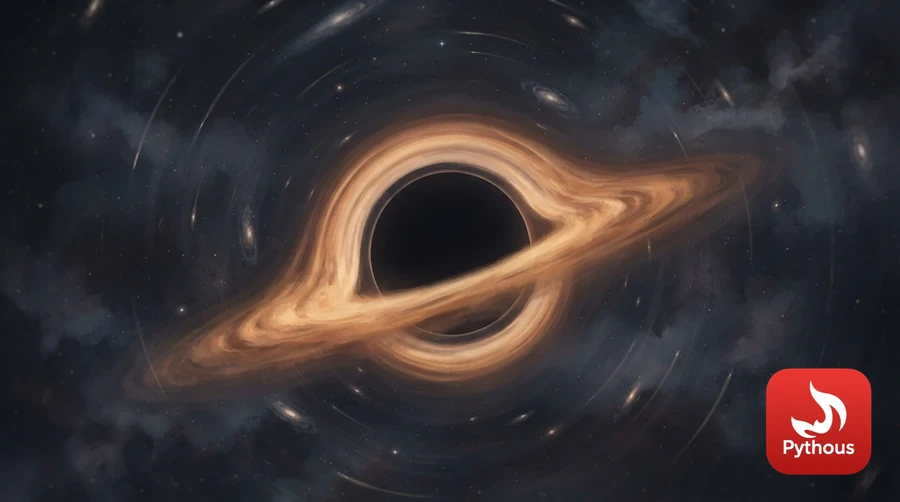
Illustration: a black hole bending light around it.
The First Whisper of a Dark Star
The year was 1783.
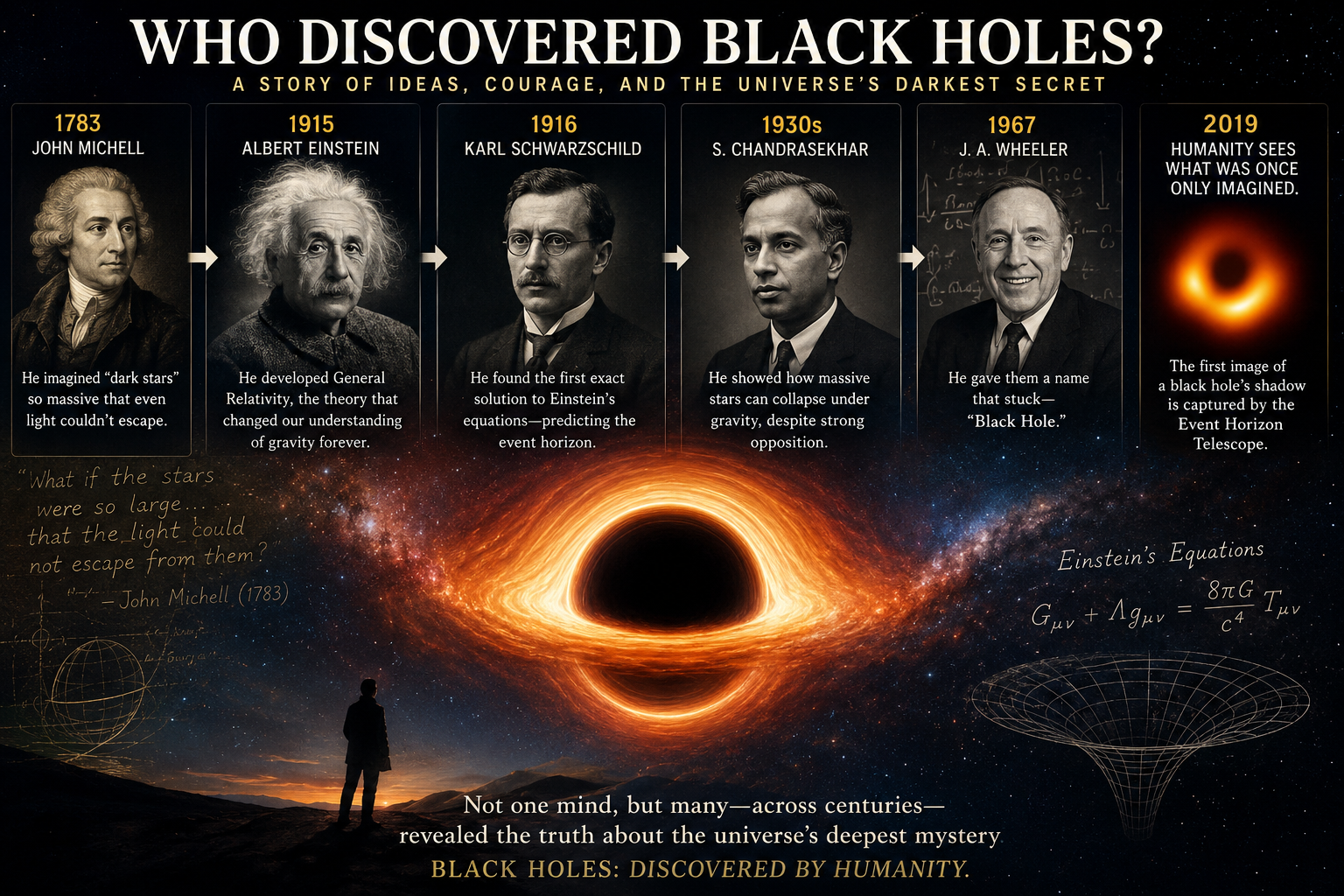
A little-known English scientist named John Michell sat thinking about gravity. Inspired by the work of Isaac Newton, he imagined a star so massive that its gravity would trap even light.
It was a shocking idea.
At the time, nobody knew what light really was. There were no telescopes powerful enough to test such a thought. Michell called these objects "dark stars." His idea was astonishingly close to what we now call black holes.
Yet the world barely noticed.
His theory drifted into the shadows and was largely forgotten.
Enter Einstein
More than a century later, in 1915, Einstein unveiled one of the greatest scientific achievements in history:
General Relativity.
This revolutionary theory described gravity not as an invisible force pulling objects together, but as the bending of space and time itself.
Suddenly, the universe became stranger than anyone had imagined.
Einstein's equations were elegant, beautiful, and terrifyingly complex. Most scientists were still trying to understand them when an unexpected figure stepped forward.
The Soldier Who Solved Einstein's Puzzle
Just months after Einstein published his theory, a German physicist named Karl Schwarzschild found a remarkable solution to Einstein's equations.
He was not sitting comfortably in a university office.
He was serving on the front lines during World War I.
Amid the chaos of war, Schwarzschild calculated what would happen if an enormous mass were compressed into a tiny region of space.
The mathematics revealed something extraordinary.
There would be a boundary beyond which nothing—not even light—could escape.
Today we call this boundary the event horizon.
Without realizing it, Schwarzschild had provided the first mathematical description of a black hole.
The Irony: Einstein Didn't Like Black Holes
Here's the twist that surprises many people.
Einstein himself did not believe black holes could truly exist in nature.
Although his equations allowed them, he thought the universe would somehow prevent such extreme objects from forming.
For years, many scientists agreed with him.
Black holes seemed too bizarre.
Too impossible.
Too frightening.
How could nature create a place where gravity becomes overwhelmingly powerful and known physics begins to break down?
The idea remained controversial.
The Scientists Who Refused to Let Go
In the 1930s, a young physicist named Subrahmanyan Chandrasekhar studied dying stars.
His calculations suggested that some stars could collapse under their own gravity after exhausting their fuel.
Many senior scientists mocked the idea.
One of the most influential astronomers of the time publicly criticized Chandrasekhar's work.
But the young scientist persisted.
Years later, other researchers, including J. Robert Oppenheimer, showed that massive stars could indeed collapse endlessly, creating the kind of object predicted by Schwarzschild's solution.
The seeds of black-hole theory were growing.
Giving the Monster a Name
For decades, these mysterious objects had no memorable name.
Then, in 1967, physicist John Archibald Wheeler introduced a simple phrase:
Black Hole.
The name was perfect.
Dark.
Mysterious.
Unforgettable.
It captured the imagination of scientists and the public alike.
The Universe Reveals the Truth
Even then, many people wondered whether black holes were merely mathematical fantasies.
Then the evidence began to arrive.
Astronomers observed stars moving around invisible objects with enormous mass. They detected powerful X-ray emissions from matter falling into unseen gravitational traps.
Decade after decade, the evidence grew stronger.
Finally, in 2019, the world saw something once thought impossible: the first image of a black hole's shadow, produced by the Event Horizon Telescope Collaboration.
Humanity had found the monster.
The dark prediction of centuries had become reality.
So Who Discovered Black Holes?
The answer is not one person.
John Michell first imagined "dark stars" in the 1700s.
Albert Einstein created the theory of gravity that made black holes possible.
Karl Schwarzschild found the mathematical solution describing them.
Subrahmanyan Chandrasekhar and others showed how stars could collapse to form them.
John Archibald Wheeler gave them the name we use today.
Black holes were not discovered by Einstein alone.
They were the result of a scientific adventure spanning nearly two and a half centuries—a story of forgotten ideas, wartime calculations, fierce debates, and brilliant minds refusing to abandon a strange possibility.
And perhaps that is what makes the story so powerful.
The greatest discoveries are rarely the work of one person. They are torches passed from one generation to the next, each scientist lighting the path a little farther into the darkness—until humanity finally sees what was hiding there all along.



Comments (0)
Leave a Reply
Log in to post a comment.