

 Jan 24, 2025
 5 min read
The Night Sky's Mysteries: Old Light, Shared Stories and Open Questions
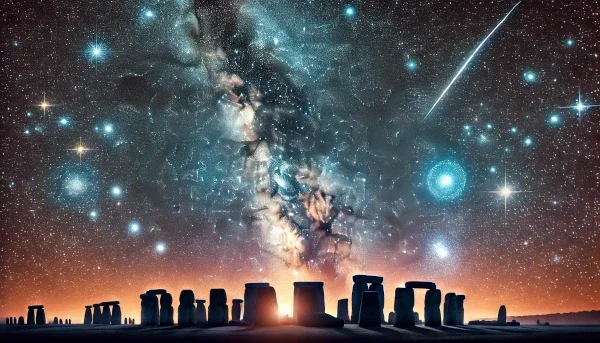
Look at Orion on a winter evening and you are seeing light of very different ages at once. The glow from Betelgeuse, the orange star at the hunter's shoulder, left it roughly 550 to 700 years ago, around the time of the Black Death. Sirius, the bright star below Orion, is only about 8.6 light years away, so its light is younger than most primary-school children. On a dark night you can also find the faint smudge of the Andromeda galaxy. That light set out about 2.5 million years ago, before our own species existed.
The night sky is a mix of the old and the very old, and people have been reading it for as long as there have been people.
A star that went dim
Betelgeuse is a red supergiant, a star so large that it would swallow the orbit of Mars if it took the Sun's place. In late 2019 and early 2020 it dimmed so sharply that it dropped out of the list of the sky's twenty brightest stars, and some people wondered whether it was about to explode. It wasn't. Images from the Very Large Telescope and Hubble showed that the star had blown out a huge cloud of gas, which cooled into dust and blocked part of its light. Betelgeuse will end as a supernova eventually, but "eventually" probably means within the next hundred thousand years, not next week.
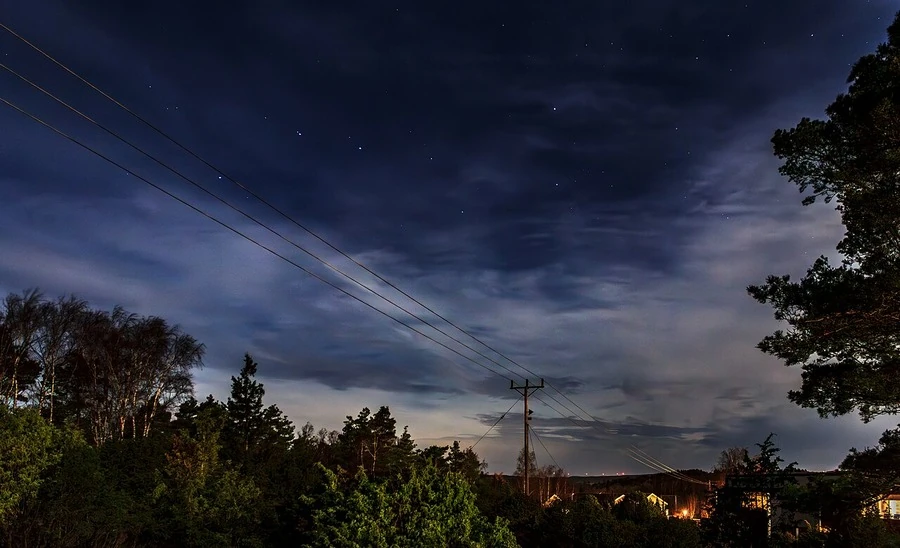
In India, the Big Dipper's seven stars are the Saptarishi, the seven sages. Photo: W.carter / Wikimedia Commons, CC BY-SA 4.0
The same stars, different stories
Every culture that watched the sky turned the same few patterns into its own stories, and some of the overlaps are striking.
In India the seven bright stars of the Big Dipper are the Saptarishi, the seven sages. The middle star of the handle is the sage Vasishtha, and the faint star beside it is his wife Arundhati. In some Hindu weddings the couple are shown that pair as a model of a faithful marriage. Arab sky-watchers knew the same faint companion (Alcor, beside Mizar) as a test of good eyesight: if you could pick it out, your eyes were sharp.
The Qur'an describes the stars as lamps adorning the nearest heaven (67:5) and as guides: "It is He who made the stars for you, so that you may be guided by them through the darkness of land and sea" (6:97). Medieval Muslim astronomers took the second idea literally. Many star names still used today, such as Aldebaran, Altair, Deneb, Rigel and Vega, come from Arabic.
The Gospel of Matthew's star that led the Magi to Bethlehem has been argued over for centuries. Johannes Kepler suggested it might have been a close meeting of Jupiter and Saturn in 7 BCE. Others have proposed a comet or a nova. The text itself doesn't settle the question.
Then there is the story that should come with a warning label. In the 1950s the French anthropologists Marcel Griaule and Germaine Dieterlen reported that the Dogon people of Mali knew Sirius had an invisible companion star, which is true: Sirius B was only spotted through a telescope in 1862. The claim became a favourite of "ancient astronaut" books. When the anthropologist Walter van Beek later did fieldwork among the Dogon, he could not find anyone who knew the story. Most researchers now think it came from contact with outsiders, or from the interviews themselves.
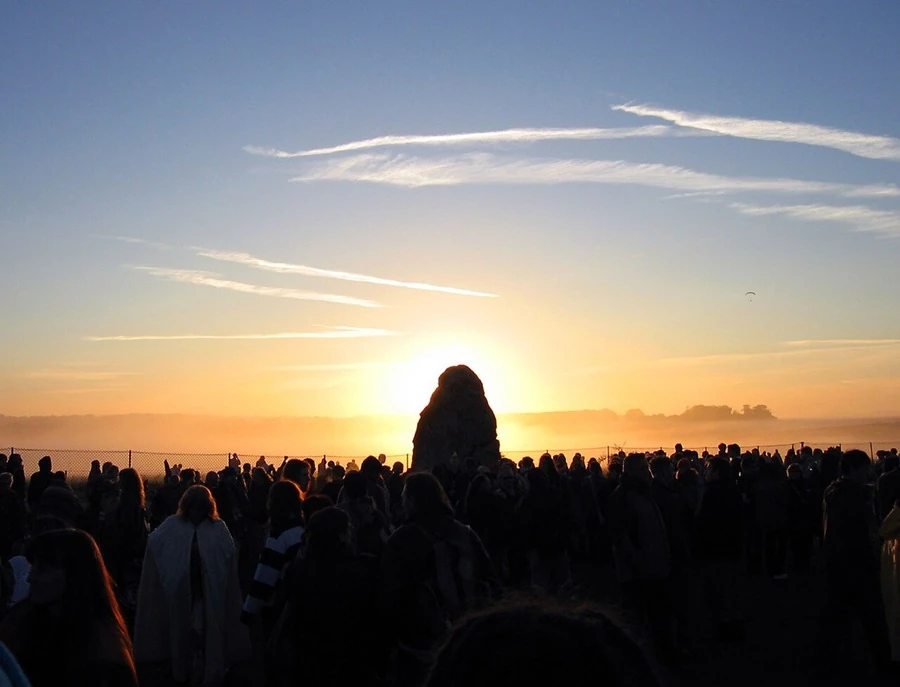
Stonehenge's main axis lines up with sunrise at the summer solstice. Photo: Andrew Dunn / Wikimedia Commons, CC BY-SA 2.0
Building with the sky
Stonehenge's main axis lines up with sunrise at the summer solstice and sunset at the winter solstice. The sides of the Great Pyramid of Giza face the four compass directions with an error of only a few arcminutes, a tiny fraction of a degree. The builders had no compass, so they most likely took their bearings from the stars circling the celestial pole.
What we still don't know
Modern astronomy has its own open questions, and some of them are big.
Most of the universe is missing. Ordinary matter, meaning every star, planet and person, makes up only about 5% of the cosmos. Roughly 27% is dark matter, which we detect only by its gravity, and about 68% is dark energy, which is pushing the universe's expansion to speed up. What either one actually is remains unknown.
Flashes from deep space. Fast radio bursts are pulses of radio waves lasting a few thousandths of a second. The first was found in 2007 in old telescope data. In 2020 one was traced to a magnetar, a highly magnetised dead star, inside our own galaxy. That solved part of the puzzle, but not all bursts seem to come from the same kind of source.
Other universes. Some theories in physics suggest our universe could be one of many. A few researchers have searched the cosmic microwave background for "bruises" left by collisions with neighbouring universes. None has been confirmed, and for now the idea remains theory rather than observation.
Seeing it for yourself
A 2016 study estimated that more than a third of humanity can no longer see the Milky Way from home because of light pollution. In Europe the figure is about 60%, and in North America nearly 80%. If you get the chance, go somewhere dark, give your eyes twenty minutes to adjust, and look up. Find Orion, then Betelgeuse, then the faint companion beside Mizar. It is the same sky that guided caravans and sailors, and the one the psalmist had in mind: "The heavens declare the glory of God; the skies proclaim the work of his hands" (Psalm 19:1).
Sources
- NASA, "What Is a Light-Year? - NASA Space Place". https://spaceplace.nasa.gov/light-year/en/
- Wikipedia, "Olbers' paradox". https://en.wikipedia.org/wiki/Olbers%27_paradox
- Wikipedia, "Constellation". https://en.wikipedia.org/wiki/Constellation




Comments (0)
Leave a Reply
Comments are moderated. Please read our Comment Policy before posting.
Log in to post a comment.