

 Jan 21, 2025
 4 min read
The Cosmic Ballet: What a Rare Seven-Planet Alignment Actually Means

In late February 2025, skywatchers got a genuinely rare treat: all seven other planets in our solar system — Mercury, Venus, Mars, Jupiter, Saturn, Uranus, and Neptune — appeared in the night sky simultaneously, arranged in a rough arc across the horizon. Events like this don't happen often, and they're a useful excuse to actually understand what a "planetary alignment" is, why they're rare, and why astronomers care about them beyond the spectacle.
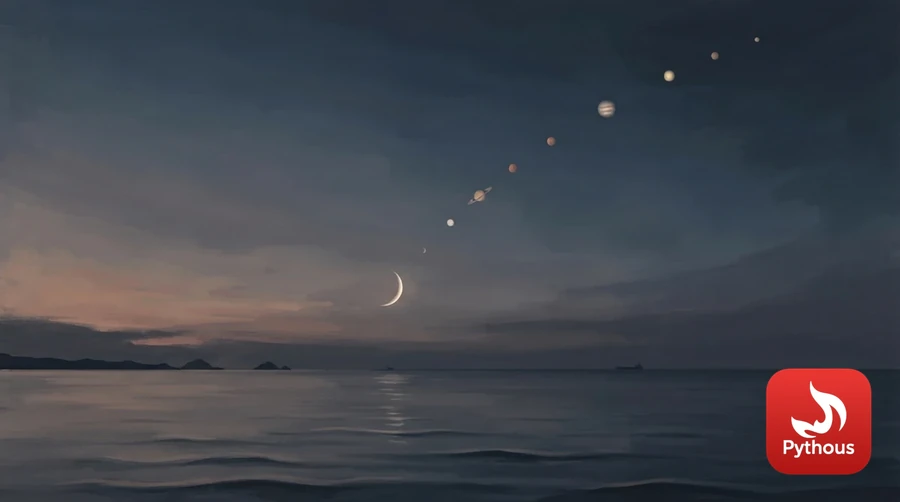
Illustration: planets strung along the ecliptic in the evening sky.
What a planetary alignment actually is
Despite how dramatic the term sounds, a planetary alignment doesn't mean the planets line up in a perfectly straight line pointing out from the sun — that configuration essentially never happens given how differently each planet orbits. What actually happens is that, from Earth's vantage point, the planets all appear within a relatively narrow band of sky at the same time, because all the planets in our solar system orbit roughly within the same flat plane (called the ecliptic). A "planet parade" like the one in February 2025 means several planets are visible above the horizon together during the same window of night, not that they're physically clustered together in space — they're still hundreds of millions of miles apart from each other.
Why the February 2025 alignment was unusual
Having two or three planets visible together isn't especially rare — it happens somewhat regularly given how many planets are orbiting at any given time. Getting all seven visible in the same period, including outer planets that take decades to orbit the sun, requires a much more specific and much rarer coincidence of orbital positions. Mercury, Venus, Mars, Jupiter, and Saturn were visible to the naked eye; Uranus and Neptune, both far dimmer from Earth's distance, required binoculars or a telescope to actually pick out.
Why alignments matter beyond the view
Space exploration
Alignments have real, practical scientific value: spacecraft can use a favorably aligned sequence of planets for gravitational slingshot maneuvers, gaining speed by passing close to a planet and using its gravity to accelerate onward, without expending fuel. NASA's Voyager missions, launched in 1977, deliberately timed their launch to take advantage of a rare alignment of the outer planets that let both spacecraft visit multiple worlds — a "grand tour" opportunity that wouldn't recur for well over a century.
Exoplanet research
The same basic geometry — objects passing in front of each other from a given vantage point — is central to how astronomers find planets around other stars. The transit method detects exoplanets by measuring the tiny, regular dimming of a star's light as a planet passes in front of it. This technique is how systems like TRAPPIST-1, home to seven roughly Earth-sized planets, were discovered and characterized.
Gravitational lensing
On a much larger scale, alignments between Earth, a massive foreground galaxy, and a much more distant object can bend and magnify the distant object's light through gravitational lensing — a direct consequence of Einstein's general relativity. Telescopes like the James Webb Space Telescope use naturally occurring lensing alignments to observe extremely distant, faint galaxies that would otherwise be too dim to detect at all.
Does an alignment affect anything on Earth?
This is worth addressing directly, since alignments regularly generate speculation about effects on Earth or the sun. The gravitational influence of even all the planets combined on the sun is extremely small compared to the sun's own mass — there's no established mechanism by which a visual alignment as seen from Earth produces a meaningful physical effect on solar activity, tides, or anything else at ground level. The scientific interest in alignments is about visibility and orbital mechanics, not about any influence being exerted on Earth itself.
Frequently Asked Questions
How rare was the February 2025 seven-planet alignment? True naked-eye-and-telescope visibility of all seven planets together is uncommon enough that it draws significant public and media attention each time it occurs, though the exact frequency varies depending on how strictly "visible together" is defined.
Do I need special equipment to see a planetary alignment? The brighter, closer planets (Mercury, Venus, Mars, Jupiter, Saturn) are typically visible to the naked eye under reasonably dark skies; Uranus and Neptune are far dimmer and generally require binoculars or a telescope to spot.
When is the next major alignment? Alignments of varying scale happen periodically — smaller two- or three-planet groupings are relatively frequent, while events on the scale of the February 2025 alignment are notably rarer; astronomy news sources and planetarium apps are the most reliable way to track upcoming events as they're identified.



Comments (0)
Leave a Reply
Log in to post a comment.