

 Oct 29, 2025
 4 min read
The 'Mystery' of 3, 6 and 9: The Real Maths Behind the Tesla Myth

"If you only knew the magnificence of the 3, 6 and 9, then you would have a key to the universe." The line is attributed to Nikola Tesla on countless posters and videos. There is no evidence he said it. It doesn't appear in his published writings, patents, letters or recorded interviews, and it seems to have spread online in the 2010s. Tesla did have a real fixation with threes. His biographers describe him walking around a building three times before entering, and insisting on numbers of napkins divisible by three. But the "key to the universe" quote is modern folklore.
That doesn't make the numbers dull. Some of what makes 3, 6 and 9 seem special is genuine mathematics and physics. Some is an artefact of counting in tens. And some comes from the way human minds look for patterns.
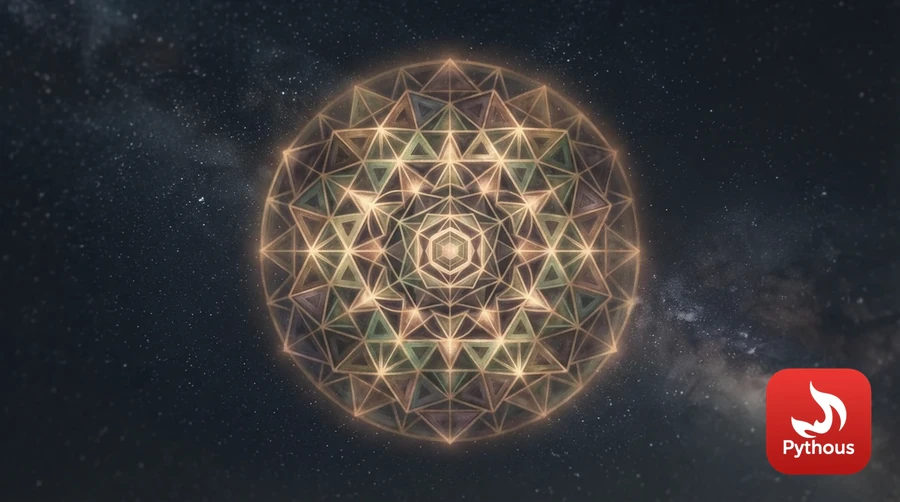
Illustration: the geometry that makes these numbers feel special.
The "magic" of 9 is a base-10 effect
Add up the digits of any multiple of 9, repeating until one digit remains, and you always get 9. For example, 9 × 47 = 423, and 4 + 2 + 3 = 9. This single digit is called the digital root. It works because 10 is one more than 9, so every power of ten leaves a remainder of 1 when divided by 9. A number's digits therefore add up to the same remainder the number itself has. For multiples of 9, that remainder is zero, which shows up as a 9.
A popular diagram ("vortex maths") doubles numbers and reduces them to digital roots: 1, 2, 4, 8, 16 (7), 32 (5), 64 (1), and so on. The sequence 1, 2, 4, 8, 7, 5 repeats forever and never touches 3, 6 or 9. That looks mysterious until you notice that doubling a number never makes it divisible by 3 if it wasn't already. The digital roots 3, 6 and 9 are exactly the multiples of 3, so the doubling sequence can never reach them.
Count in base 12 instead of base 10 and the "special" number becomes 11, the number one less than the base. The pattern belongs to our counting system, not to the universe.
Where 3 and 6 genuinely matter
Triangles are rigid. A triangle made of three bars can't change shape without one bar bending or breaking. A square can collapse into a parallelogram. That is why bridges, cranes, roof trusses and bicycle frames are full of triangles.
Hexagons tile efficiently. Bees build hexagonal cells. In 1999 the mathematician Thomas Hales proved the honeycomb conjecture, which had been suspected since antiquity: of all ways to divide a flat surface into equal areas, regular hexagons use the least total wall length (Hales, 1999). Bees save wax, and the geometry is optimal.
Six-fold symmetry in snowflakes comes from the way water molecules bond in ice. Each molecule links to its neighbours at angles that build a hexagonal crystal lattice, so the crystal grows six arms.
Carbon has six protons. Its ring-shaped compounds, such as the six-carbon benzene ring, are central to organic chemistry and biology.
Three dimensions of space are what we live in. Physicists have pointed out that stable planetary orbits and atoms are hard to get in other numbers of dimensions, though whether that "explains" anything is debated.
Pythagoras and the sacred number
Much of the mystical tradition around numbers traces back to Pythagoras (6th century BCE) and his followers, who held that "all is number". They treated 3 as the first number with a beginning, middle and end, and found whole-number ratios in musical harmony. Two notes an octave apart have string lengths in a ratio of 2:1, and a fifth is 3:2. That musical discovery was real and important. The idea that numbers have moral or spiritual qualities became the basis of numerology, which has no scientific support.
Threes and nines across cultures
Many traditions give these numbers special weight. Christianity has the Trinity, and Hinduism the Trimurti of Brahma, Vishnu and Shiva. Folk tales are full of three wishes, three brothers and three trials. Nine appears in the Hindu festival of Navaratri ("nine nights"), the nine celestial bodies of Vedic astrology (navagraha), the nine worlds of Norse mythology, and Chinese tradition, where "nine" sounds like the word for "long-lasting". Islamic tradition speaks of the 99 names of God.
Part of the explanation is practical. Three is the smallest number that makes a pattern: one is an event, two a coincidence, three a rule. Storytellers and speakers use "rule of three" structures because listeners remember them.
Why the pattern feels meaningful
Humans are pattern-seeking animals. Psychologists call the tendency to see meaningful connections in random data apophenia. Once someone is primed to notice 3, 6 and 9, confirmation bias does the rest: the times they appear are noticed and remembered, and the times they don't are ignored. The same happens with "11:11" on clocks.
The honest summary is that 3 and 6 are built into real geometry and chemistry, 9's digit tricks come from counting in tens, and the Tesla quote is invented. The real mathematics, from digital roots to the honeycomb proof, is more satisfying than the myth.
Sources
- arXiv, "[math/9906042] The Honeycomb Conjecture". https://arxiv.org/abs/math/9906042
- Wikipedia, "Digital root". https://en.wikipedia.org/wiki/Digital_root
Comments (0)
Leave a Reply
Comments are moderated. Please read our Comment Policy before posting.
Log in to post a comment.