

 Jan 20, 2025
 5 min read
Mathematics in 2024: The Langlands Proof, AI at the Olympiad and Other Breakthroughs
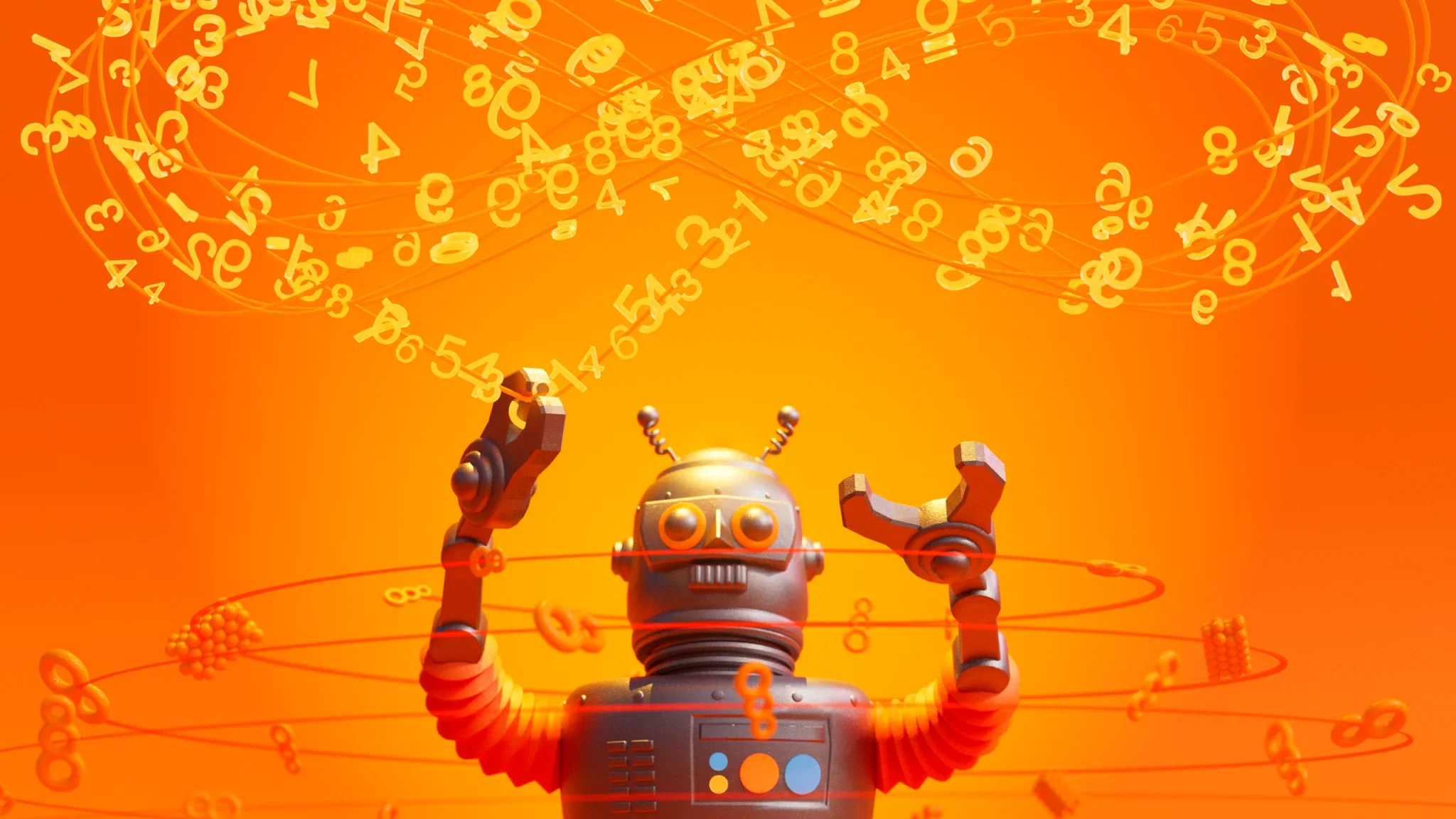
Mathematics rarely makes headlines, but 2024 produced several results that specialists will be working through for decades. These included a proof more than 800 pages long, counterexamples that toppled long-held expectations, records that had stood since the 1940s, and the first serious showing by AI at the International Mathematical Olympiad. Here is what happened, with links to the papers themselves, and a note on what came next.

Illustration: sphere packing, geometry and number theory, three of the year's big themes.
The geometric Langlands conjecture
The Langlands program, proposed by Robert Langlands in the late 1960s, predicts deep links between number theory, the study of whole numbers and primes, and harmonic analysis, the study of waves and symmetry. It is often called a grand unified theory of mathematics. Its "geometric" version, formulated in the 1980s, translates these predictions into the language of geometry.
In May 2024, a team of nine mathematicians led by Dennis Gaitsgory and Sam Raskin posted the first of a series of papers proving the geometric Langlands conjecture (arXiv:2405.03599). The full proof runs to more than 800 pages and builds on about three decades of work. Gaitsgory received the 2025 Breakthrough Prize in Mathematics in part for it. It does not settle the original number-theory version, but it confirms the framework in a setting where it can be fully proved.
AI arrives at the Olympiad
In January 2024, Google DeepMind's AlphaGeometry solved 25 of 30 past Olympiad geometry problems, close to the level of a human gold medallist (Nature, 2024). It combined a language model, which suggested constructions, with a symbolic engine that checked the logic. In July, DeepMind's AlphaProof and AlphaGeometry 2 together solved four of the six problems at the 2024 International Mathematical Olympiad, a score equivalent to a silver medal. However, they sometimes needed days per problem where humans get four and a half hours (DeepMind). AlphaProof wrote its proofs in the formal language Lean, so a computer could verify every step.
AI had already contributed in another way. In 2022, researchers using machine-learning tools to analyse data on elliptic curves noticed an unexpected oscillating pattern, which they called "murmurations" after the swirling flight of starling flocks. Number theorists have since proved parts of the pattern.
Sphere packing: the first big gain since 1947
How densely can identical spheres fill space? In three dimensions, the answer is the greengrocer's stacking of oranges, proved only in 1998. In 2016, Maryna Viazovska solved dimensions 8 and 24 (the latter with collaborators), work that earned her a Fields Medal. In most other dimensions the best possible packing is unknown. For very high dimensions, the best general lower bound had barely moved since C. A. Rogers' work in 1947.
In December 2023, Marcelo Campos, Matthew Jenssen, Marcus Michelen and Julian Sahasrabudhe improved that bound by a factor that grows with the dimension. They used methods from graph theory and random processes to build packings that look disordered but beat the old constructions.
A geometry conjecture falls
In 1968, John Milnor conjectured that certain curved spaces, complete manifolds with non-negative Ricci curvature, must have relatively simple "loop structures" (finitely generated fundamental groups). Elia Bruè, Aaron Naber and Daniele Semola built a six-dimensional counterexample, showing the conjecture fails in general. Counterexamples like this often teach as much as proofs, because they reveal which intuitions were wrong.
Number theory: old records broken
- Towards the Riemann hypothesis. Larry Guth and James Maynard improved a bound from 1940 on how many zeros of the Riemann zeta function could lie off the critical line. This is a key estimate for how evenly primes are distributed. It doesn't prove the Riemann hypothesis, but it broke a barrier that had resisted 80 years of effort.
- Patterns in large sets. James Leng, Ashwin Sah and Mehtaab Sawhney, then graduate students, sharpened the bounds in Szemerédi's theorem. That theorem says any sufficiently "dense" set of whole numbers must contain evenly spaced patterns of any length.
- Primes in n² + 1. Héctor Pasten proved new lower bounds on the largest prime factor of numbers of the form n² + 1, using an unusual mix of tools linking addition and multiplication.
For another 2024 result about primes, see our explainer on the Green–Sawhney proof.
What came next
Two developments in 2025 followed directly from these threads. In February, Hong Wang and Joshua Zahl posted a proof of the Kakeya set conjecture in three dimensions. That problem, about how small a set can be while containing a line segment pointing in every direction, had been open for decades. In July, AI systems from Google DeepMind and OpenAI each reached gold-medal level at the 2025 International Mathematical Olympiad, working in natural language within the normal time limits. One year earlier, the best systems had managed silver with days of computing per problem.
The common thread is that progress in mathematics often comes from connecting fields that seemed separate: geometry with number theory, probability with packing problems, and increasingly, human insight with machine search.
Sources
- arXiv:2405.03599, "Proof of the geometric Langlands conjecture I: construction of the functor". https://arxiv.org/abs/2405.03599
- Trinh T, Wu Y, Le Q, He H et al., "Solving olympiad geometry without human demonstrations", Nature 625 (2024): 476-482. https://doi.org/10.1038/s41586-023-06747-5
- Google DeepMind, "AI achieves silver-medal standard solving International Mathematical Olympiad problems". https://deepmind.google/blog/ai-solves-imo-problems-at-silver-medal-level/
- arXiv:2204.10140, "Murmurations of elliptic curves". https://arxiv.org/abs/2204.10140
- arXiv:2312.10026, "A new lower bound for sphere packing". https://arxiv.org/abs/2312.10026
- arXiv:2311.12155, "Six dimensional counterexample to the Milnor Conjecture". https://arxiv.org/abs/2311.12155
- arXiv:2405.20552, "New large value estimates for Dirichlet polynomials". https://arxiv.org/abs/2405.20552
- arXiv:2402.17995, "Improved Bounds for Szemerédi's Theorem". https://arxiv.org/abs/2402.17995
- arXiv:2502.17655, "Volume estimates for unions of convex sets, and the Kakeya set conjecture in three dimensions". https://arxiv.org/abs/2502.17655



Comments (0)
Leave a Reply
Comments are moderated. Please read our Comment Policy before posting.
Log in to post a comment.