

 Feb 03, 2025
 5 min read
The Yonaguni Monument: Japan's Underwater 'Pyramid' and the Evidence on Both Sides
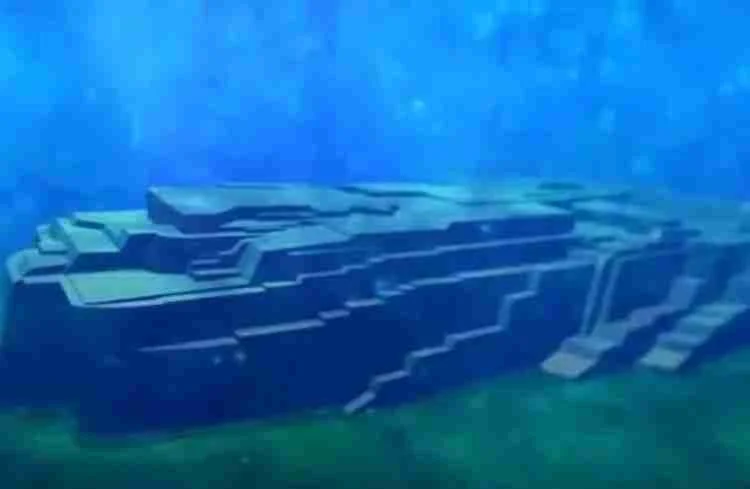
In 1986 a local diver exploring the sea off Yonaguni, Japan's westernmost inhabited island, swam over something unexpected. It was a block of rock rising from about 25 metres down, with flat terraces, steps that looked cut at right angles and straight vertical walls. The island lies just over 100 km east of Taiwan and is better known for hammerhead sharks than archaeology. Forty years later people still argue about what the diver found: the ruins of a city that sank, or rock that happens to break into very regular shapes.
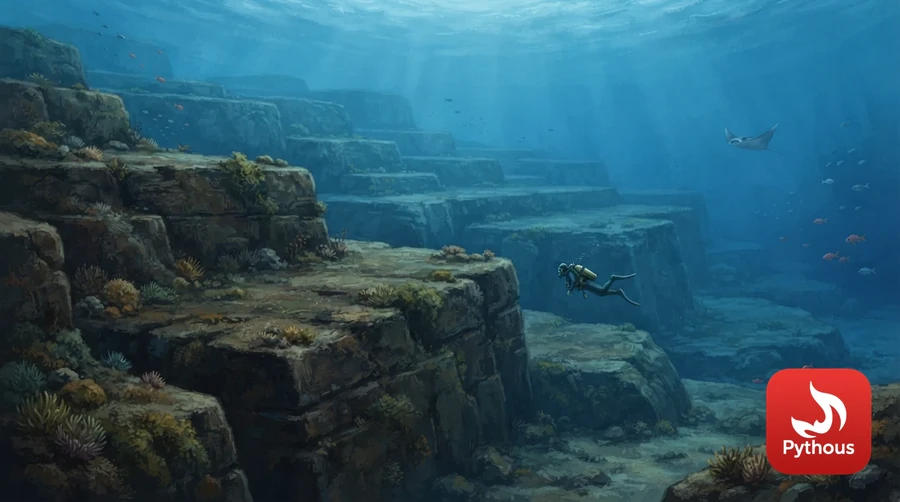
Illustration: the stepped rock terraces of the Yonaguni monument.
What is down there
The main formation, usually called the Monument, sits off the island's south coast. Its base is on the seabed at about 25 metres and its top comes within a few metres of the surface. Divers describe broad flat platforms, staircase-like ledges, a pair of tall parallel slabs, channels and holes in the rock. The wider area of formations covers roughly 300 by 150 metres, according to a 2007 National Geographic report.
The rock itself isn't in dispute. It is layered sandstone and mudstone laid down on an ancient sea floor many millions of years ago, long before any humans existed. The only question is whether people later shaped it.
The case for human work
The main advocate of an artificial origin is Masaaki Kimura, a marine geologist at the University of the Ryukyus who spent years diving, measuring and mapping the site. He has said he first assumed it was natural and changed his mind after diving it himself. He identifies features he calls a castle, an arch, temples, a stadium, roads and water channels. He points to holes he reads as post sockets, marks he reads as tool or quarry marks, and scratches he reads as carved symbols and faces.
Kimura's dates have varied. In the 2007 interview he described a city sunk by an earthquake about 2,000 years ago, and elsewhere he has argued for at least 5,000 years. The second figure is based on stalactites in nearby underwater caves, which can only form in air. The region is seismically violent: the Meiwa tsunami of 1771 killed around 12,000 people in the southern Ryukyu islands. A seismologist at Kobe University, Toru Ouchi, has supported Kimura's view.
Many online accounts go further and call the site 10,000 years old, "older than the pyramids". That idea comes from sea level, not from any dated object. At the end of the last ice age the sea stood far lower, and the depth of the base matches roughly 9,000 to 10,000 years ago. If people carved the whole structure on dry land, they would have done it then. That would make it far older than any known monumental stone building in East Asia. The closest comparison anywhere is Göbekli Tepe in Turkey, and that site comes with carved pillars, tools, animal bones and debris from the people who built it.
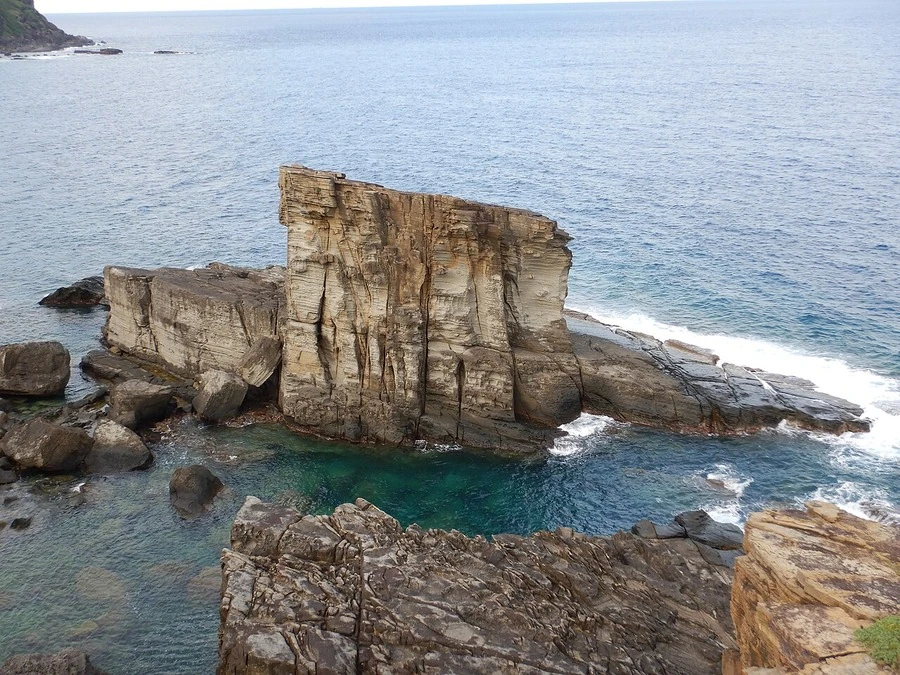
Thin, flat sandstone beds crossed by vertical joints break naturally into step-like blocks. Photo: Melkov / Wikimedia Commons, CC0
The case for nature
Robert Schoch, a geologist at Boston University, dived at Yonaguni in the 1990s and concluded that the formations are natural (his notes on the site). His argument rests on how this kind of rock behaves:
- Layers and cracks. The sandstone is laid down in thin, flat beds and crossed by vertical cracks called joints. When waves and earthquakes break it, it splits along both, leaving flat tops, square edges and step-like profiles.
- Holes and lines. Schoch attributes the round holes to swirling currents scouring depressions. He attributes rows of smaller holes to marine animals boring into a weak seam.
- Less regular than photos suggest. He has said the "right angles" and "steps" are less regular in person than in well-chosen photographs, and that the supposed carvings are natural scratches.
The strongest point is what hasn't been found. In decades of diving no one has recovered tools, pottery, hearths, bones or inscriptions that specialists accept. Japan's Agency for Cultural Affairs told National Geographic in 2007 that neither it nor Okinawa Prefecture recognised the formations as a cultural property, and neither had studied the site.
Mu and the lost continent
Yonaguni is often linked to Mu, a "lost continent" said to have sunk in the Pacific. Mu began as a 19th-century misreading. In the 1860s the French scholar Charles-Étienne Brasseur de Bourbourg "translated" a Maya manuscript using a flawed key to Maya writing and believed it described a land called Mu destroyed by catastrophe. The antiquarian Augustus Le Plongeon built a whole history on it, and the British writer James Churchward popularised the idea in The Lost Continent of Mu (1926). Geology rules it out. Continents are made of relatively light rock that floats high on the Earth's mantle, and the floor of the Pacific is dense oceanic crust. A continent cannot sink into it. Kimura himself has written about Mu, which is one reason many scientists are wary of his interpretations.
Where that leaves it
Most geologists who have examined Yonaguni regard it as a natural formation. One possibility is hard to rule out without excavation: people living on the island may once have used or trimmed natural ledges, as people have done with rock outcrops everywhere. A lost advanced civilisation, however, has no evidence behind it. What would change the picture is simple to state: a securely dated tool, a hearth or a worked block found in place.
The site is open to divers, and dive operators on the island run trips there. Currents can be strong, so it is usually recommended for experienced divers. Seen in person, it is a striking example of how far natural processes can go towards looking designed. For other unsolved puzzles, see our posts on the Nazca lines and the Antikythera mechanism.
Sources
- National Geographic, "Japan's Ancient Underwater "Pyramid" Mystifies Scholars". https://www.nationalgeographic.com/history/article/yonaguni-jima-japan-underwater-city
- robertschoch.com, "Robert M. Schoch: Younaguni". https://www.robertschoch.com/yonaguni.html
- Wikipedia, "Yonaguni Monument". https://en.wikipedia.org/wiki/Yonaguni_Monument





Comments (0)
Leave a Reply
Comments are moderated. Please read our Comment Policy before posting.
Log in to post a comment.