

 Aug 26, 2026
 5 min read
How the Nabataeans Built a City Where There Was No Water
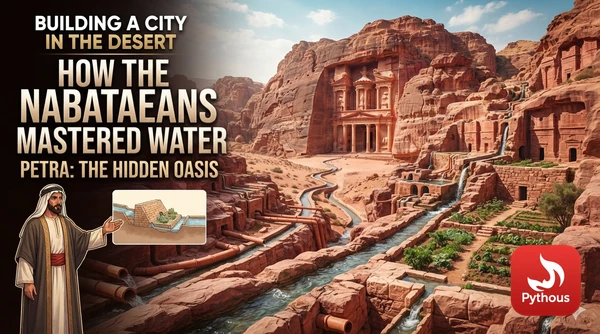
The famous view of Petra is the Treasury, al-Khazneh, seen through the last bend of the Siq, the narrow gorge that leads into the city: a Hellenistic temple front carved straight into rose-coloured sandstone. What the photograph doesn't show is what made the city possible. Petra lies in a basin in southern Jordan that gets only around 150 millimetres of rain in a typical year, about as much as parts of the Sahel. At its height in the first century CE it may have housed 20,000 or more people. The Nabataeans managed that with one of the most careful water systems of the ancient world.
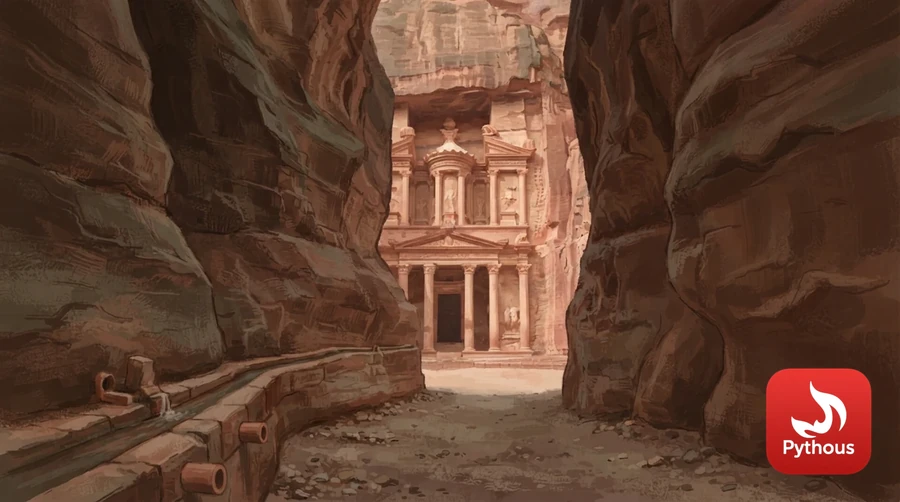
Illustration: Petra's Treasury, with a carved channel that carried water through the canyon.
The people with hidden cisterns
The Nabataeans first appear in written history in 312 BCE, when Antigonus, one of the generals who divided Alexander the Great's empire, sent an army against them. The Greek historian Diodorus of Sicily, writing in the first century BCE but drawing on Hieronymus of Cardia, who took part in the campaign, describes them as nomads who lived in tents, by their own law sowed no grain, planted no fruit trees and built no houses, on pain of death. In the desert they were almost impossible to attack.
Diodorus also explains how they survived there. They dug cisterns into the rock or the clay, with narrow openings that they covered and disguised so that only they could find them, then widened the cisterns below. Pursuers would die of thirst while the Nabataeans drew water in places that looked dry. Antigonus's forces raided the tribe's stronghold while the men were away, but were overtaken on the way back and largely destroyed. A second expedition, under his son Demetrius, achieved little.
A trading city and its water
Over the next three centuries the Nabataeans grew rich on the caravan trade in frankincense, myrrh and spices from southern Arabia to Gaza and the Mediterranean, and Petra became their capital. A city, unlike a tribe on the move, needs water in quantity and in one place, so the old cistern skills were scaled up.
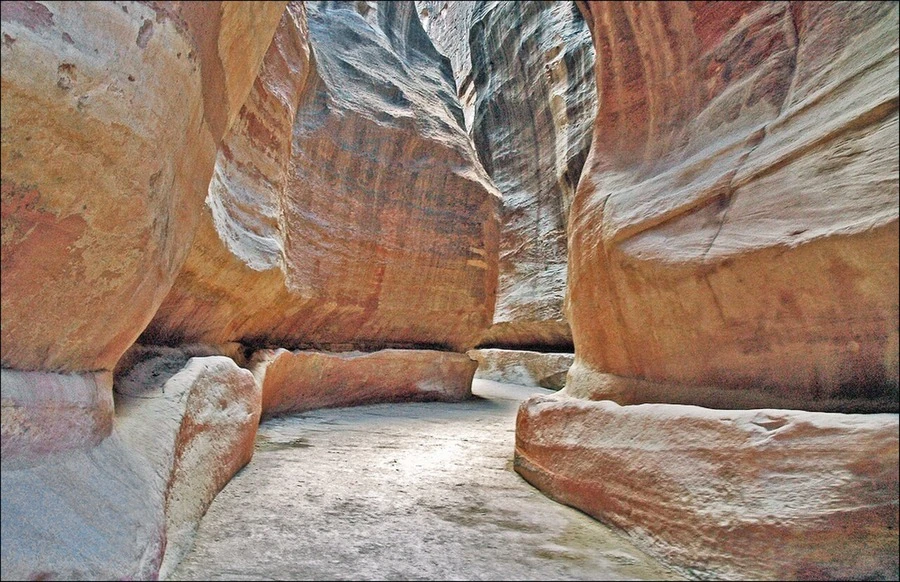
As Petra grew rich on the incense trade, channels and pipes carried water through the city. Photo: Le Médocain / Wikimedia Commons, CC BY-SA 4.0
Water from the spring of Ain Musa, a few kilometres east, was carried into the city along channels cut into the walls of the Siq, and later through pipelines of fitted terracotta sections. Archaeologists have found well over a hundred cisterns and reservoirs in and around the basin, along with small dams across side valleys and terraces that slowed runoff so it could soak into the ground. In the city centre, excavators in the 1990s and 2000s uncovered a large garden with an ornamental pool and island pavilion, a display of wealth in a place where water was the scarcest thing.
The American engineer Charles Ortloff, who has spent years modelling the system with the methods used for modern pipe networks, argues that the Nabataeans understood hydraulics better than their Greek and Roman contemporaries. In a study published in the Cambridge Archaeological Journal in 2005, he showed that the pipeline in the Siq was laid at gradients that kept water flowing just below the speed at which turbulence and pressure surges would build up and break the joints. In effect, they ran the pipes partly full on purpose, which delivered the most water the line could carry safely. Whether they reached that by calculation or long trial and error, the result was a system that worked.
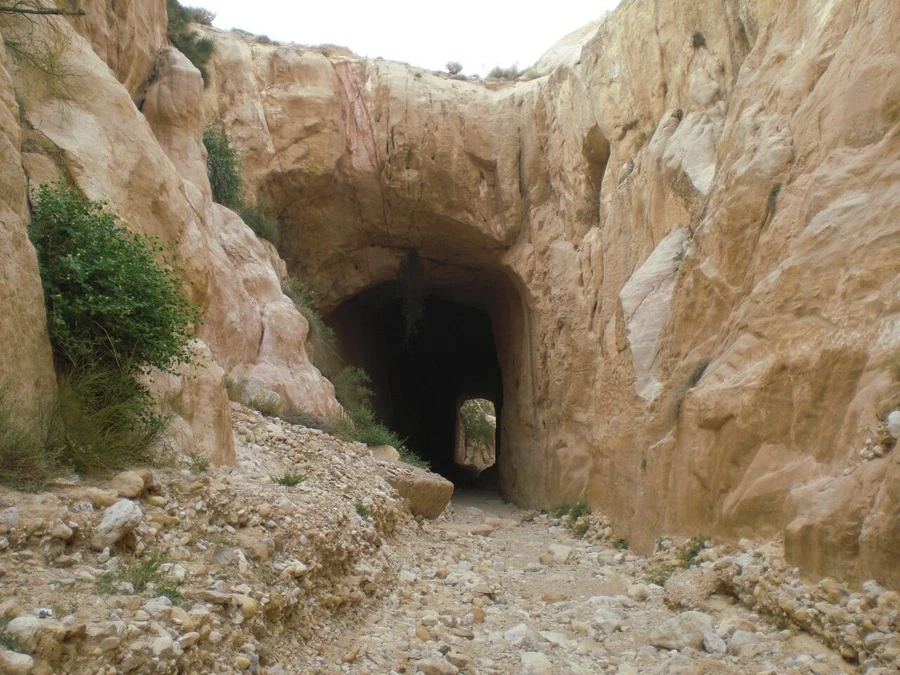
The Nabataeans dammed the Siq's entrance and cut a tunnel to divert floods into Wadi Muthlim. Photo: Tousleso / Wikimedia Commons, public domain
Floods as well as drought
The opposite danger was sudden floods. When heavy rain does fall on the mountains around Petra, it runs off the bare rock all at once, and the Siq, a cleft a few metres wide between sheer walls many tens of metres high, channels it straight towards the city. The Nabataeans built a dam across the entrance to the Siq and cut a tunnel about 88 metres long through the rock to send floodwater into a neighbouring valley, Wadi Muthlim, and around the city.
The value of that design became clear in modern times. In April 1963 a flash flood poured down the Siq and drowned more than twenty French tourists and their guide. Afterwards the Jordanian authorities rebuilt a dam at the Siq entrance on the Nabataean pattern, and it still protects the route used by visitors today.
What came after
In 106 CE the Roman emperor Trajan annexed the Nabataean kingdom and made it the province of Arabia. Petra stayed prosperous for a time, but trade gradually moved to sea routes through the Red Sea and to roads further north, and a severe earthquake in 363 CE destroyed much of the city. A water system like Petra's needed constant cleaning and repair. As the population shrank, the channels silted up and the cisterns cracked, and by the early Islamic period the city was largely abandoned, known to local Bedouin but not to the outside world until the Swiss traveller Johann Ludwig Burckhardt visited it in 1812.
The Nabataeans left one inheritance far larger than their city. They wrote in a form of Aramaic script, and over the following centuries Nabataean letters developed, through intermediate forms seen in inscriptions of the fourth to sixth centuries, into the Arabic alphabet in which the Qur'an was written down.
Sources
- Diodorus Siculus, Library of History 19.94–100 (the Nabataeans and Antigonus's expeditions), translated by Russel M. Geer, LacusCurtius. https://penelope.uchicago.edu/Thayer/E/Roman/Texts/Diodorus_Siculus/19E*.html
- Charles R. Ortloff, "The water supply and distribution system of the Nabataean city of Petra (Jordan), 300 BC–AD 300", Cambridge Archaeological Journal 15 (2005): 93–109. https://doi.org/10.1017/s0959774305000053
- Charles R. Ortloff, "Hydraulic engineering at 100 BC–AD 300 Nabataean Petra (Jordan)", Water 12 (2020): 3498. https://doi.org/10.3390/w12123498
- UNESCO World Heritage Centre, "Petra". https://whc.unesco.org/en/list/326





Comments (0)
Leave a Reply
Comments are moderated. Please read our Comment Policy before posting.
Log in to post a comment.