

 Oct 28, 2025
 5 min read
The History of the Gregorian Calendar: The 10 Days That Changed Time Itself

In Rome, Avila and Lisbon, the night of Thursday 4 October 1582 was followed by the morning of Friday 15 October. The days in between never happened. The order came from Pope Gregory XIII, in a papal bull called Inter gravissimas, signed in February that year, and it was the end of a problem that had been building for more than 1,600 years.

Illustration: the astronomy behind the 1582 calendar reform.
Eleven minutes a year
The calendar Julius Caesar introduced in 45 BCE gave the year 365 days, with an extra day every fourth year, an average of 365.25 days. The year of the seasons, measured from one spring equinox to the next, is a little shorter, about 365.2422 days. The difference is roughly 11 minutes a year, which adds up to a full day about every 128 years.
For the Church, the effect mattered because of Easter. In 325 the Council of Nicaea had settled the rule that is still used: Easter falls on the first Sunday after the first full moon on or after the spring equinox, which the Church fixed at 21 March. But the real equinox kept arriving earlier in the calendar. By the sixteenth century it fell around 11 March, and Easter was drifting away from the season it was meant to mark. Reform had been discussed for centuries, by the English friar Roger Bacon in the thirteenth century and at the Council of Constance in the fifteenth, without agreement.
The reform
The scheme Gregory adopted came from Aloysius Lilius, a physician and astronomer from Calabria, who had died in 1576. His brother presented the proposal to a papal commission, and the German Jesuit mathematician Christopher Clavius refined it and then spent years defending it in print.
It had two parts. The first was the jump of ten days, which put the equinox back on 21 March, where it had been in 325; restoring Caesar's date would have needed thirteen. The second was a new leap-year rule. Years divisible by four stay leap years, except century years, which are leap years only if divisible by 400. So 1600 and 2000 were leap years, but 1700, 1800 and 1900 were not. That removes three leap days every four centuries and brings the average year to 365.2425 days, close enough to the seasons that it drifts by only about a day in 3,000 years. The commission also replaced the old tables used to predict the Easter full moon.
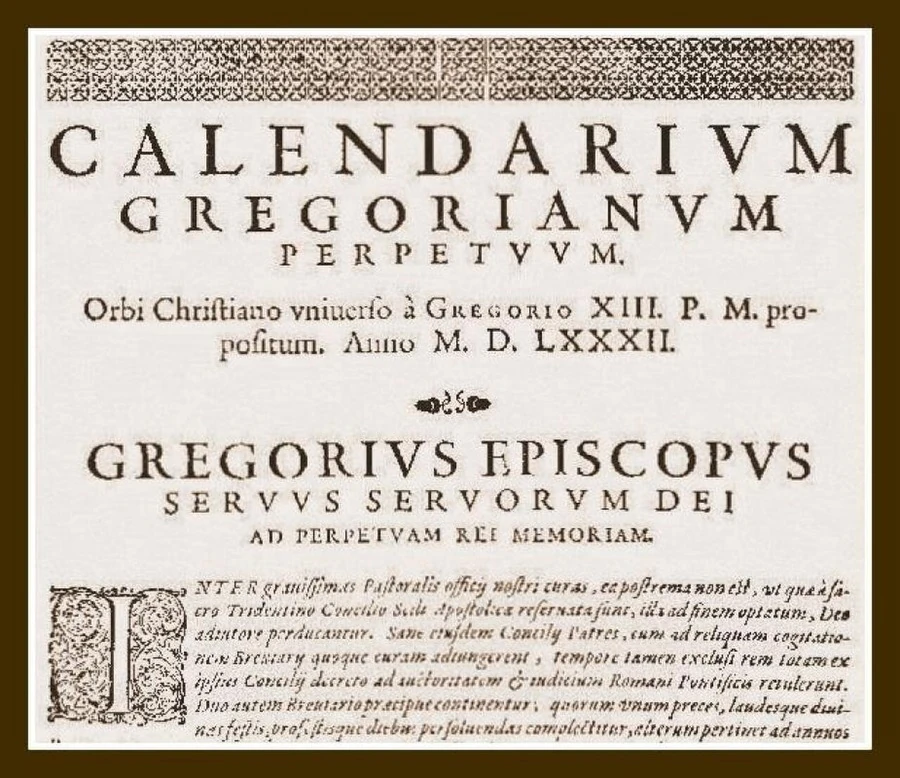
In 1582, ten days vanished in Italy, Spain, Portugal and Poland. Image: Wikimedia Commons, public domain
Who changed, and when
Italy, Spain, Portugal and Poland-Lithuania switched on the date the bull set. France followed in December 1582, and most Catholic states in Europe within a few years. Protestant countries were reluctant to take orders from Rome, and the German Protestant states held out until 1700.
Britain and its colonies changed in 1752, by an act of Parliament passed in 1751. By then the gap had grown to eleven days, so Wednesday 2 September 1752 was followed by Thursday 14 September. The same act moved the start of the legal year from 25 March, Lady Day, to 1 January. That is why George Washington, born in Virginia on 11 February 1731 by the old reckoning, celebrated his birthday as 22 February 1732: the calendar shifted the day by eleven, and the new year rule shifted the year by one.
Britain's change is often said to have caused riots, with crowds shouting "Give us our eleven days!" The historian Robert Poole looked for evidence and found none in contemporary newspapers or records. The slogan seems to come from a 1755 painting by William Hogarth, An Election Entertainment, which shows a captured banner reading "Give us our eleven days" as a jibe at the ruling Whigs, and the "riots" were embellished by Victorian writers. People did worry about rents, wages and interest for a shortened month, which the act addressed by counting payments by the full number of days.
Further east, change came with politics. Japan adopted the Gregorian calendar in 1873, during its modernisation under the Meiji emperor. Soviet Russia switched in February 1918, by which time it had to drop thirteen days, which is why the October Revolution of 1917 is commemorated in November. Greece, in 1923, was the last European country to change. Turkey adopted it for civil purposes in 1926. Saudi Arabia, which had used the Islamic Hijri calendar for official business, moved government salaries and its fiscal year to the Gregorian calendar in 2016.

More than 95% of the world now uses the Gregorian calendar. Photo: Matheus Bertelli / Pexels
Two calendars at once
Today the Gregorian calendar is the civil calendar almost everywhere, but it rarely stands alone. Most Orthodox churches still calculate Easter by the Julian calendar, so Orthodox Easter usually falls later than the Western date, and Christmas on 25 December by the Julian calendar now falls on 7 January. Muslims everywhere use the lunar Hijri calendar for Ramadan, the two Eids and the Hajj, which is why those dates move about 11 days earlier each Gregorian year. Jewish, Chinese, Hindu and Iranian calendars govern festivals and, in some countries, official life. Our date difference calculator works in Gregorian dates, which is worth remembering when comparing anything recorded before a country made the switch.
Sources
- "Inter gravissimas", Wikipedia (the 1582 bull, with links to the Latin text and translations). https://en.wikipedia.org/wiki/Inter_gravissimas
- Claus Tøndering, "The Gregorian calendar", Calendar FAQ. https://www.tondering.dk/claus/cal/gregorian.php
- Calendar (New Style) Act 1750, legislation.gov.uk. https://www.legislation.gov.uk/apgb/Geo2/24/23
- Robert Poole, "'Give us our eleven days!': calendar reform in eighteenth-century England", Past & Present 149 (1995): 95–139. https://doi.org/10.1093/past/149.1.95





Comments (0)
Leave a Reply
Comments are moderated. Please read our Comment Policy before posting.
Log in to post a comment.