

 Oct 28, 2025
 4 min read
How Julius and Augustus Changed the Months — and Disordered Time
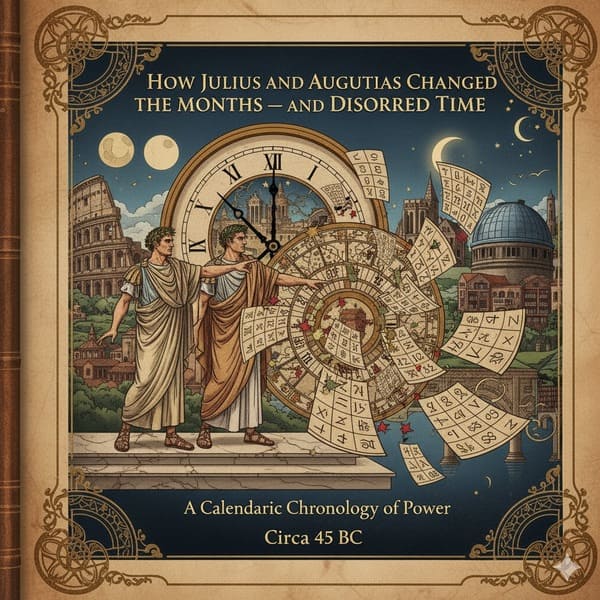
The story of the Gregorian calendar doesn’t just stop with days and leap years — even the names of our months carry echoes of ancient power struggles, politics, and pride.
To understand how September (which means “seventh”) became our ninth month, or how December (“tenth”) became our twelfth, we need to travel back to the Roman Empire — when emperors could literally rename time itself.

Illustration: Romans told the hours by the sun, and the months by priests and politicians.
🗓️ The Original Roman Calendar
The earliest Roman calendar — long before Julius Caesar’s reform — was a 10-month calendar.
It began in March (Martius), named after Mars, the god of war, and ended in December (December).
Here’s what it originally looked like:
| MonthOriginal OrderName MeaningNotes | |||
| Martius | 1 | Named after Mars | Start of the year |
| Aprilis | 2 | Possibly from “aperire” (to open/spring) | |
| Maius | 3 | Named after Maia, goddess of growth | |
| Junius | 4 | Named after Juno | |
| Quintilis | 5 | “Fifth month” | Later renamed July |
| Sextilis | 6 | “Sixth month” | Later renamed August |
| September | 7 | “Seventh month” | Still called September |
| October | 8 | “Eighth month” | Still called October |
| November | 9 | “Ninth month” | Still called November |
| December | 10 | “Tenth month” | Still called December |
That’s why September (septem = seven), October (octo = eight), November (novem = nine), and December (decem = ten) were perfectly named.
They matched their numerical positions in the year.
But… the Romans later realized this 10-month system didn’t match the solar year. There were missing winter days that weren’t assigned to any month — chaos for farmers and priests alike.
🌞 Julius Caesar Fixes the Year — and Adds January and February
When Julius Caesar reformed the calendar in 46 BCE, he followed advice from the Egyptian astronomer Sosigenes and switched to a 12-month solar calendar.
He added January (Januarius) and February (Februarius) to the beginning of the year — months that were already used occasionally for winter timekeeping but not fixed.
The new order began with January 1, honoring Janus, the two-faced god of beginnings and transitions.
Now, the year had 12 months — but that shift meant the original number-based months (September to December) got pushed forward by two positions:
| Old PositionNew PositionMonthMeaning | |||
| 7 | 9 | September | “Seventh” → now 9th month |
| 8 | 10 | October | “Eighth” → now 10th month |
| 9 | 11 | November | “Ninth” → now 11th month |
| 10 | 12 | December | “Tenth” → now 12th month |
So, September no longer matched “seven,” and December no longer matched “ten.”
The names stayed the same — but their meaning got lost in history’s shuffle.
👑 How Julius and Augustus Claimed Their Own Months
Julius Caesar’s reform worked beautifully… but then came politics.
After Caesar’s assassination, the Roman Senate decided to honor him by renaming Quintilis (the fifth month) as Julius — which we now call July.
A few decades later, Emperor Augustus wanted equal glory, so Sextilis (the sixth month) became Augustus — now August.
But there was a problem:
- July had 31 days.
- August originally had 30 days.
Augustus couldn’t have a shorter month than Julius!
So the Romans borrowed one day from February, giving both July and August 31 days.
That’s why February remains the shortest month today.
This reshuffling not only affected the calendar’s symmetry — it caused generations of confusion and forced scribes and scholars to constantly adjust how months were counted.
⚖️ The Result: Time by Emperors, Not by Nature
After all these changes:
- The names no longer matched their numbers.
- February became shorter.
- And two emperors literally carved their names into time.
Yet, despite all the confusion, the Julian and later Gregorian calendars kept these names.
Over centuries, they became familiar, sacred, and too deeply woven into culture to change.
When Pope Gregory XIII introduced his reforms in 1582, he adjusted the dates and leap year rules — but the names of the months stayed the same.
Thus, the legacy of Julius and Augustus still lives on in every calendar we use today.
🧠 Quick Summary — How the Month Disorder Happened
| MonthOriginal MeaningModern PositionReason for Shift | |||
| September | 7 | 9 | January and February were added at the start |
| October | 8 | 10 | Same reason — months shifted forward |
| November | 9 | 11 | Same reason |
| December | 10 | 12 | Same reason |
| July (Julius) | 5 | 7 | Renamed from Quintilis for Julius Caesar |
| August (Augustus) | 6 | 8 | Renamed from Sextilis for Emperor Augustus |
| February | — | 2 | Lost one day to balance August’s days |
🌍 Conclusion: Time Written by Power
What began as an effort to measure the seasons became a reflection of human ego, empire, and ambition.
Julius Caesar gave us structure.
Augustus added pride.
And Pope Gregory later brought precision.
So when we glance at a calendar today — at September or December — we’re not just seeing dates.
We’re seeing thousands of years of history, political legacy, and human attempts to bring order to the chaos of time.



Comments (0)
Leave a Reply
Log in to post a comment.