

 Aug 13, 2026
 34 min read
Napoleon Bonaparte: The Life, Battles and Rule of the Man Who Remade Europe
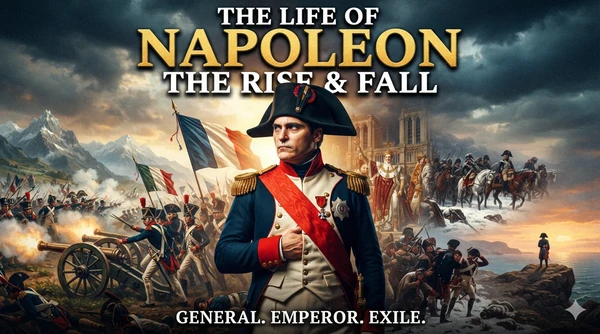
In the space of twenty years, a young artillery officer from a minor Corsican family made himself master of a continent. He fought roughly sixty battles and lost only a handful. He wrote a legal code that still shapes the laws of dozens of nations. He crowned himself Emperor in Notre-Dame, dissolved an empire that had stood for a thousand years, and died a prisoner on a rock in the South Atlantic, guarded by the British navy.
Napoleon Bonaparte is one of those rare figures who cannot be neatly filed away. To some he is the great modernizer who carried the Revolution's ideals across Europe on the points of bayonets. To others he is the prototype of the modern military dictator, a man whose ambition cost somewhere between three and six million lives. Both readings are supported by the evidence, and that tension is exactly what makes him worth studying.
This article walks through his whole story: the Corsican childhood, the meteoric rise, the great campaigns, the reforms that outlived him, the catastrophic overreach, and the long argument over what it all meant.
Table of Contents
- A Corsican Childhood
- The Revolution Opens a Door
- Italy: The Making of a Legend
- Egypt: Glory, Disaster and the Rosetta Stone
- 18 Brumaire: The Seizure of Power
- The Consulate: Building the Modern French State
- Emperor of the French
- Austerlitz: The Battle of the Three Emperors
- The Empire at Its Height
- The Spanish Ulcer
- Russia, 1812: The Great Catastrophe
- Leipzig, Abdication and Elba
- The Hundred Days and Waterloo
- Saint Helena: The Last Six Years
- How Napoleon Actually Won Battles
- The Legacy: What Survived Him
- Five Myths About Napoleon
- Timeline
- Frequently Asked Questions
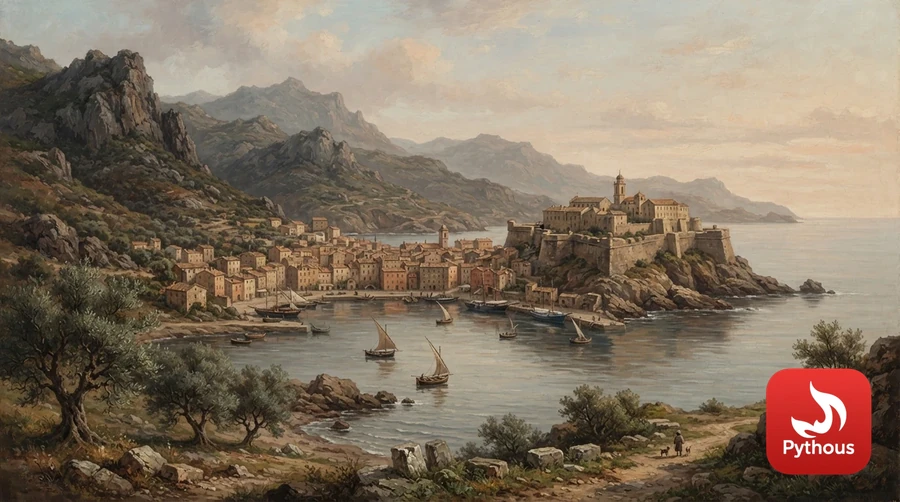
Illustration: Ajaccio, Corsica, where Napoleon was born in 1769.
A Corsican Childhood
Napoleone di Buonaparte was born in Ajaccio, Corsica, on 15 August 1769 — barely a year after the Republic of Genoa sold the island to France and French troops crushed the Corsican independence movement. That timing matters. He was born a French subject by a matter of months, into a family that had supported the losing side.
His father, Carlo Maria Buonaparte, was a lawyer from the minor Corsican nobility: enough pedigree to claim status, not nearly enough money to enjoy it. His mother, Letizia Ramolino, was tough, frugal, and by every account the disciplinarian of the household. Eight of her children survived infancy, and Napoleon was the second surviving son. Late in life, at the height of his power, he still said that everything he became he owed to his mother's early strictness.
Carlo made a pragmatic decision that changed history: he cooperated with the French administration and secured a scholarship for his second son. At the age of nine, Napoleon was sent to mainland France, first to Autun to learn the language, then in 1779 to the military academy at Brienne-le-Château.
He was miserable there. He spoke French with a heavy Corsican accent, was mocked for being poor and provincial, and responded by becoming solitary, prickly and ferociously studious. He devoured Plutarch, Caesar, and above all mathematics — the subject that fed directly into artillery, the one branch of the army where a man without money or connections could still advance on merit.
In 1784 he moved to the École Militaire in Paris, and completed a two-year course in one year — partly out of talent, partly out of necessity: his father had died of stomach cancer, leaving the family in debt. In September 1785, aged sixteen, he was commissioned a second lieutenant in the La Fère artillery regiment.
He spent the next several years as a junior officer with a great deal of leave and very little to do, reading obsessively and writing pamphlets in favour of Corsican independence. Nothing about his prospects in 1789 suggested he would ever command more than a battery of guns.
The Revolution Opens a Door
The French Revolution destroyed the old officer corps. Aristocratic officers emigrated in droves, and the new Republic — at war with most of Europe by 1792 — desperately needed men who could actually handle troops. Ambitious young officers with no name and no money suddenly found that promotion had become possible on a scale unimaginable a decade earlier.
Napoleon's break came at Toulon in late 1793. The great naval port had handed itself over to a British and Spanish fleet, and the Republican siege was going badly. The young artillery captain arrived, surveyed the ground, and identified what the senior commanders had missed: a promontory called l'Éguillette that dominated the harbour. Take it, put guns on it, and the Allied fleet would have to leave or be destroyed. The plan worked. Toulon fell in December 1793, and Napoleon — wounded in the thigh during the assault — was promoted brigadier general at twenty-four.
The rise was almost immediately interrupted. He was close to Augustin Robespierre, and when the Robespierres fell in the Thermidorian reaction of July 1794, Napoleon was briefly arrested and left without a command. For over a year he hovered on the edge of obscurity, at one point considering an offer to serve the Ottoman Sultan.
His second break came on 13 Vendémiaire (5 October 1795), when a royalist mob marched on the National Convention in Paris. Paul Barras handed Napoleon the job of defending the government. He sent a young cavalry officer named Joachim Murat to fetch cannon from the artillery park, positioned them to sweep the approaches, and fired grapeshot into the crowd. Hundreds died. Thomas Carlyle later immortalised it as "a whiff of grapeshot," and the phrase has stuck, though it flatters the neatness of what was really a massacre in the streets.
The Directory now owed him. In March 1796 he married Joséphine de Beauharnais — a widow of the Terror, six years his senior, well connected in Directory society — and days later took command of the Army of Italy.
Italy: The Making of a Legend
The Italian campaign of 1796–97 is where the myth was born, and it is still one of the most impressive campaigns in military history.
Napoleon inherited an army that was the Directory's afterthought: roughly 40,000 hungry, unpaid, badly clothed men, expected to make a diversion while the real war was won in Germany. He faced the combined forces of Austria and Piedmont-Sardinia, numerically superior and better supplied.
What he did with them established his signature method. He drove a wedge between the Austrian and Piedmontese armies, defeated them separately before they could combine, and knocked Piedmont out of the war in a fortnight. Then he turned on the Austrians and beat four successive relief armies sent to save the fortress of Mantua.
The names became famous almost overnight:
- Lodi (10 May 1796) — the storming of the bridge over the Adda. Militarily it was a minor action; as propaganda it was priceless, and Napoleon later said it was at Lodi that he first believed he could be more than a general.
- Arcole (15–17 November 1796) — three days of vicious fighting in the marshes, where Napoleon personally carried a standard onto the causeway.
- Rivoli (14 January 1797) — the decisive victory that sealed Mantua's fate and broke Austrian power in northern Italy.
The campaign revealed the other half of his genius, which had nothing to do with battles. He fed his army by requisitioning from the territory he conquered, sent crates of Italian gold and art treasures back to Paris (buying the gratitude of a bankrupt government), negotiated directly with defeated states as though he were a head of state rather than a general, and — crucially — ran his own press. He founded army newspapers and wrote the bulletins himself, curating his image with a skill no general before him had bothered with.
By the Treaty of Campo Formio (October 1797), which he negotiated essentially on his own authority, Austria was out of the war and Napoleon was the most famous man in France. He was twenty-eight.
Egypt: Glory, Disaster and the Rosetta Stone
With Britain undefeated and an invasion across the Channel judged impossible, Napoleon proposed something spectacular: strike at Britain's route to India by seizing Egypt. The Directory, happy to have its dangerous young general far away, agreed.
He sailed in May 1798 with roughly 35,000 troops, seized Malta on the way, and landed near Alexandria in July. On 21 July, in sight of the pyramids, he destroyed the Mamluk cavalry at the Battle of the Pyramids — infantry squares and disciplined musketry against magnificent, obsolete horsemen.
Ten days later the campaign was effectively doomed. Admiral Horatio Nelson found the French fleet anchored in Aboukir Bay and annihilated it at the Battle of the Nile (1 August 1798), sailing part of his squadron between the French line and the shore to catch them from both sides. Napoleon's army was now stranded in Egypt with no way home.
He pressed on regardless, marching into Syria in 1799. The campaign produced a genuine atrocity at Jaffa, where thousands of prisoners were executed, and ended in failure at the Siege of Acre, where Ottoman defenders backed by British naval guns held out for two months while plague thinned the French ranks. He retreated to Egypt, won a sharp victory over an Ottoman landing at Aboukir in July, and then — hearing that France was in political crisis and had lost most of his Italian conquests — abandoned his army and slipped back to France with a handful of companions in August 1799.
By any military accounting, Egypt was a defeat. Yet it produced two lasting things. The first was the scientific expedition Napoleon brought with him: 167 scholars, engineers and artists whose work became the monumental Description de l'Égypte and effectively founded the discipline of Egyptology. The second was a slab of granodiorite unearthed near Rosetta in July 1799 — the Rosetta Stone, which would eventually let Jean-François Champollion read hieroglyphs. (The stone itself was surrendered to the British in 1801 and has been in the British Museum ever since.)
And politically, Egypt cost Napoleon nothing at all. He controlled the narrative, France heard about the Pyramids rather than Acre, and he arrived home to cheering crowds.
18 Brumaire: The Seizure of Power
The Directory was exhausted, corrupt and widely despised. A group of insiders led by the Abbé Sieyès wanted to replace it with a stronger executive, and needed a general to provide the muscle. Sieyès expected to use Napoleon. Napoleon used Sieyès.
The coup of 18–19 Brumaire, Year VIII (9–10 November 1799) very nearly failed. Facing the Council of Five Hundred at Saint-Cloud, Napoleon gave a rambling, defensive speech, was shouted down, and was physically jostled by deputies crying "Outlaw!" It was his brother Lucien — presiding over the chamber — who saved the day by walking outside, telling the grenadiers that the deputies were being held hostage by knife-wielding conspirators, and ordering them to clear the hall. The soldiers marched in and the deputies went out the windows.
The Constitution of Year VIII established three Consuls. Napoleon was First Consul, and the constitution was written so that the other two barely mattered. It was submitted to a plebiscite and approved by a wildly inflated margin.
He was thirty years old, and he now ran France.
The Consulate: Building the Modern French State
Here is the part of Napoleon's career that the battle narratives tend to swallow, and it is arguably the more important part. Between 1800 and 1804 he carried out a programme of state-building whose results outlasted his empire by two centuries.
The Napoleonic Code (1804). France had a chaos of overlapping legal systems — Roman law in the south, customary law in the north, royal edicts, church law. The Civil Code, promulgated on 21 March 1804, replaced all of it with a single rational body of civil law. It guaranteed equality before the law, secured property rights, abolished feudal privilege, and established secular civil marriage and divorce. It was exported wherever French armies went, and it remains the ancestor of the legal systems of much of Europe, Latin America, parts of the Middle East, Louisiana and Quebec. Napoleon knew what he had done: on Saint Helena he said his true glory was not his forty battles but his Code, which would live forever.
It was also, by modern standards, harshly patriarchal. It placed married women under the legal authority of their husbands, restricted their control of property, and rolled back several rights women had gained during the Revolution.
The Concordat of 1801. The Revolution's war on the Church had left France bitterly divided. Napoleon negotiated a settlement with Pope Pius VII: Catholicism was recognised as the religion of the majority of French citizens, bishops were nominated by the state and confirmed by Rome, and — critically — the Church renounced any claim to the lands confiscated during the Revolution. It was a religious peace built on political arithmetic, and it worked.
Money and administration. He founded the Bank of France (1800), stabilised the currency with the franc germinal, built a professional tax collection system, and imposed the prefect system — a centrally appointed prefect running each département — which is essentially still how French local administration works.
Education. The lycées (1802) created a state secondary school system designed to produce competent officials and officers, judged by examination rather than birth.
Merit. The Legion of Honour (1802) rewarded service to the state regardless of origin. "La carrière ouverte aux talents" — careers open to talent — was the real revolutionary promise Napoleon kept, and it is why so many ordinary Frenchmen followed him to the end.
Abroad, he consolidated too. Marengo (14 June 1800) — a battle he nearly lost, saved by Desaix's counter-attack and Kellermann's cavalry charge — restored French control of Italy, and General Moreau's victory at Hohenlinden finished Austria off. The Treaty of Lunéville (1801) and the Peace of Amiens with Britain (1802) brought Europe its only genuine breathing space in twenty-three years of war.
There is a dark side to this period that deserves naming plainly. In 1802 Napoleon reinstated slavery in the French colonies, reversing the abolition decreed by the Revolution in 1794, and sent an army to retake Saint-Domingue. Toussaint Louverture was seized and shipped to France, where he died in captivity in 1803. The expedition was destroyed by yellow fever and Haitian resistance; Haiti declared independence on 1 January 1804. The failure also convinced Napoleon that a French empire in North America was pointless, which is how the United States came to buy Louisiana in 1803.
Emperor of the French
In August 1802 a plebiscite made him Consul for Life. In 1804, after a royalist assassination plot, he responded by having the Duc d'Enghien kidnapped from neutral territory, tried overnight and shot — a killing that shocked European courts and prompted Talleyrand's famous verdict that it was worse than a crime, it was a blunder.
But it also fed the argument that the regime needed an heir to make assassination pointless. On 18 May 1804, Napoleon was proclaimed Emperor of the French.
The coronation at Notre-Dame on 2 December 1804 was staged with total deliberation. Pope Pius VII was present but did not crown him; Napoleon took the crown and placed it on his own head, then crowned Joséphine. The title was significant too — Emperor of the French, not of France. His authority, in theory, came from the nation, not from land or God. He was building a new kind of monarchy on revolutionary foundations, and he wanted everyone to see it.
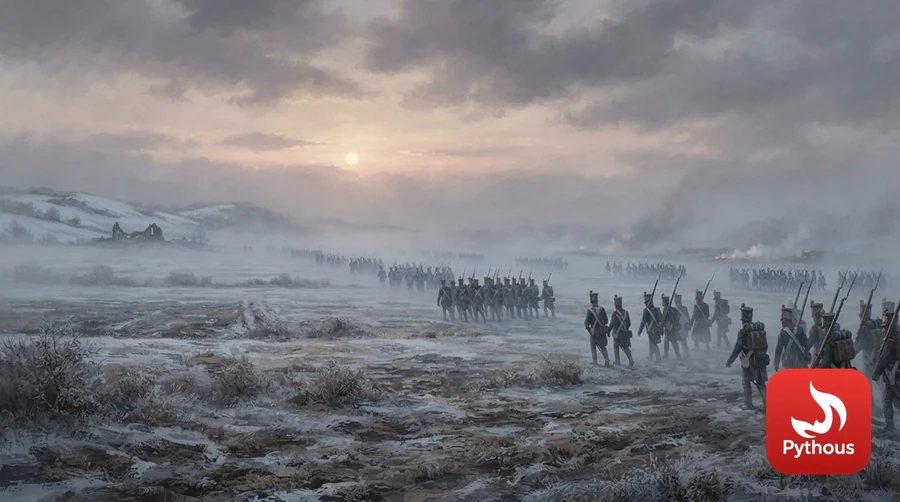
Illustration: the winter fog at Austerlitz, 1805.
Austerlitz: The Battle of the Three Emperors
Peace with Britain collapsed in 1803, and by 1805 Britain, Austria and Russia had formed the Third Coalition. Napoleon spent two years assembling and drilling an invasion force at Boulogne — an army that never crossed the Channel but became, in the process, the finest instrument he ever commanded: La Grande Armée.
When Austria moved, he turned that army east and marched it across Europe with a speed nobody thought possible. The Austrian general Mack was enveloped at Ulm and surrendered some 27,000 men in October 1805 having barely fought a battle.
The day after Ulm's surrender, Nelson destroyed the combined French and Spanish fleets at Trafalgar (21 October 1805). Nelson died in the battle; British naval supremacy was settled for a century. Napoleon would never seriously threaten invasion again, and the war became a contest between an unbeatable land power and an unbeatable sea power.
On land, though, came his masterpiece. At Austerlitz (2 December 1805) — the first anniversary of his coronation — Napoleon faced the combined Russian and Austrian armies under Tsar Alexander I and Emperor Francis II. He deliberately weakened his right flank and abandoned the high ground of the Pratzen Heights, making his position look vulnerable. The Allies took the bait, swung their mass south to roll up the exposed flank, and in doing so stripped their own centre. Napoleon then drove Soult's corps straight through the emptied middle, seized the heights, and cut the Allied army in two.
It was total. The Third Coalition collapsed, Austria signed the Treaty of Pressburg, and the British prime minister William Pitt, on hearing the news, reportedly asked for the map of Europe to be rolled up — it would not be wanted for ten years.
The Empire at Its Height
The years 1806–1807 were the summit.
Prussia, alarmed and belatedly aggressive, mobilised in 1806 and was destroyed in a single day at the twin battles of Jena and Auerstedt (14 October 1806). Napoleon beat a secondary force at Jena while Davout, badly outnumbered, beat the Prussian main army at Auerstedt — one of the great feats of the era. French troops entered Berlin within a fortnight.
Napoleon then reorganised Germany. He created the Confederation of the Rhine as a French client bloc, and on 6 August 1806 Francis II laid down the imperial crown: the Holy Roman Empire, after more than eight hundred years, simply ceased to exist. In its place Napoleon consolidated hundreds of tiny German states into a few dozen larger ones — an unintentional but decisive step towards German unification later in the century.
The Russians fought on. Eylau (February 1807) was a horrifying draw fought in a snowstorm, and the first battle that visibly shook him. Friedland (June 1807) was the decisive victory that followed, and it brought Tsar Alexander to the negotiating table.
The Treaties of Tilsit (July 1807) were signed on a raft moored in the middle of the Niemen River — a piece of theatre as calculated as the coronation. Prussia was stripped of half its territory. Russia became a nominal ally. Napoleon's family was installed on thrones across Europe: Joseph in Naples and then Spain, Louis in Holland, Jérôme in Westphalia, Murat eventually in Naples.
At this moment his control ran from the Atlantic to the Vistula. And his central strategic problem was still Britain, untouchable behind the Royal Navy.
His answer was the Continental System — the Berlin and Milan Decrees, closing all European ports to British trade in an attempt to strangle the British economy. It hurt Britain, but it hurt Europe more. Smuggling became a way of life, European economies dependent on British goods and colonial markets suffered badly, and enforcing the blockade required Napoleon to keep intervening in countries he had no other reason to invade. Two of those interventions — Spain and Russia — would destroy him.
The Spanish Ulcer
Portugal refused to close its ports to Britain. In 1807 French troops marched through Spain to invade Portugal; in 1808 Napoleon decided he might as well take Spain too, lured the Bourbon royal family to Bayonne, forced their abdication, and installed his brother Joseph on the throne.
He had badly misjudged. The Spanish did not see a modernising reformer; they saw a foreign occupier who had kidnapped their king and was manhandling their Church. Madrid rose on 2 May 1808 — the Dos de Mayo, immortalised in Goya's paintings — and the rising was put down with a brutality that set the tone for six years of savagery on both sides. Goya's Disasters of War is the definitive record, and it is not a heroic one.
In July 1808 an entire French army surrendered at Bailén — the first time a Napoleonic field army had capitulated, and a signal to the rest of Europe that the French were not invincible.
The Peninsular War ground on until 1814. It combined two things Napoleon's system could not handle. First, a British expeditionary force under Sir Arthur Wellesley — later the Duke of Wellington — operating from a secure base at Lisbon, supplied by sea, and fighting a patient defensive-offensive campaign. Second, guerrilla warfare: the word itself entered English from this conflict. Irregular bands ambushed couriers, destroyed supply convoys and made the countryside lethal. An army that lived off the land starves in a country that refuses to feed it.
The Peninsula tied down hundreds of thousands of French troops for six years. Napoleon himself called it his "Spanish ulcer" — a wound that never closed and slowly drained him.
Meanwhile Austria tried again in 1809. Napoleon suffered his first outright personal defeat at Aspern-Essling in May, then won at Wagram in July — a victory achieved by massed artillery and sheer weight rather than manoeuvre, which is itself a sign of how the Grande Armée had changed as its veterans died and conscripts replaced them.
In personal terms 1809 was also a turning point. Joséphine had given him no heir. He divorced her — apparently with genuine grief on both sides — and in 1810 married the Archduchess Marie Louise of Austria, daughter of the emperor he had beaten three times. On 20 March 1811 she bore him a son, styled the King of Rome. The revolutionary general was now marrying into the Habsburgs, and many of his oldest supporters never forgave it.
Russia, 1812: The Great Catastrophe
Russia's economy was being wrecked by the Continental System, and by 1810 Alexander was quietly trading with Britain again. Relations soured over Poland, over trade, over prestige. In June 1812 Napoleon crossed the Niemen with the largest army Europe had ever seen — around 600,000 men, of whom fewer than half were French; the rest were Poles, Germans, Italians, Dutch, Swiss and others.
The campaign went wrong immediately, and not in the way anyone expected. The Russians would not stand and fight. They retreated, burning crops and villages as they went. Napoleon's entire method depended on forcing a decisive battle and living off captured supply; the Russians denied him both. Disease, heat, exhaustion and desertion stripped tens of thousands from the army before a shot was fired in earnest.
At Borodino (7 September 1812), seventy miles from Moscow, Kutuzov finally gave battle. It was the bloodiest single day of the Napoleonic Wars — something like 70,000 casualties in twelve hours. Napoleon won the field but refused to commit the Imperial Guard to make it decisive, and the Russian army withdrew intact. That refusal has been argued over ever since.
He entered Moscow on 14 September and found it largely empty. That night fires broke out — almost certainly set on the orders of the city's governor — and burned most of the city. Napoleon sat in the ruins for five weeks waiting for a peace offer from Alexander that never came. There was no one to negotiate a surrender with, because the Russians simply refused to accept that they had lost.
On 19 October he began to retreat, and the retreat became one of the most terrible episodes in European history. The temperature collapsed. Horses died and with them the cavalry, the artillery teams and the supply wagons. Cossacks and partisans harried the column endlessly. Men froze in their sleep, ate their horses, and were left behind by the thousand. The crossing of the Berezina in late November was a nightmare of improvised bridges and drowning men, and it counts as a success only because any part of the army survived it at all.
Of the enormous force that crossed the Niemen in June, only a small fraction returned as an organized body — estimates vary, but the central group that recrossed in fighting condition is usually numbered in the tens of thousands. The Grande Armée, the instrument of Austerlitz and Jena, no longer existed.
Napoleon had already left, racing ahead to Paris to raise a new army before the news broke.
Leipzig, Abdication and Elba
He did raise one — an astonishing administrative feat, conscripting boys and pulling troops from Spain — but it was an army of teenagers with almost no cavalry, and everyone knew it. Prussia and Austria, sensing the moment, switched sides. Sweden and Britain joined. The Sixth Coalition was the whole of Europe.
Napoleon won at Lützen and Bautzen in the spring of 1813 but could not pursue without horses. He won again at Dresden in August. But the Allies adopted the Trachenberg Plan: refuse battle with Napoleon in person, attack his marshals instead. It worked. His subordinates lost battle after battle while he chased shadows.
At Leipzig (16–19 October 1813) — the Battle of the Nations — more than half a million men fought over four days, the largest battle in Europe until the First World War. Napoleon was outnumbered nearly two to one, his German allies changed sides mid-battle, and a bridge over the Elster was blown prematurely, stranding thousands of his rearguard. He lost decisively, and with him went French power east of the Rhine.
The 1814 campaign in France is, paradoxically, admired by military historians as much as anything he ever did. With perhaps 70,000 men against several hundred thousand, he fought the Six Days' Campaign in February — Champaubert, Montmirail, Château-Thierry, Vauchamps — striking each Allied column separately and beating four of them in a week. It was the old Napoleon of 1796, brilliant and fast.
It made no difference. The Allies simply marched around him to Paris, which surrendered on 31 March. His marshals refused to fight on. On 6 April 1814 he abdicated.
The Treaty of Fontainebleau gave him sovereignty over the island of Elba, a pension and a guard of several hundred men. Louis XVIII returned to the French throne. It was, on the face of it, an extraordinarily generous settlement — and an extraordinarily foolish one, since Elba is a short sail from the French coast.
The Hundred Days and Waterloo
The restored Bourbons were unpopular almost at once. Returning émigrés demanded their old lands back, the army was slashed and its veterans left unpaid, and Napoleon — on Elba, reading French newspapers — could see it all. He also had reason to believe the Allies meant to move him somewhere far more remote.
On 26 February 1815 he sailed. He landed at Golfe-Juan on 1 March with roughly a thousand men and walked north. At Laffrey a royal regiment was sent to stop him. He walked out alone in front of their muskets, opened his coat, and told them that if any of them wished to kill his emperor, here he was. They joined him. Marshal Ney, who had promised the king he would bring Napoleon back in an iron cage, went over with his entire command.
He entered Paris on 20 March without a shot fired. Louis XVIII had already fled. The Hundred Days had begun.
The Allies declared him an outlaw and began mobilising nearly a million men. Napoleon's only hope was to destroy the two armies already in Belgium — Wellington's Anglo-Dutch-German force and Blücher's Prussians — before the Austrians and Russians arrived. He moved fast to get between them, beat the Prussians at Ligny on 16 June, and sent Marshal Grouchy with 33,000 men to pursue them and keep them away.
On 18 June 1815 he attacked Wellington's position on the ridge at Mont-Saint-Jean, south of Waterloo.
Several things went wrong at once. Overnight rain had soaked the ground, so Napoleon delayed his main attack until nearly noon to let the artillery move — hours he could not spare. Wellington had chosen his ground with great skill, sheltering his infantry on the reverse slope where French guns could not see them, and anchoring his right on the farmhouse of Hougoumont, which held out all day against repeated attacks. Ney, misreading a movement as a retreat, launched thousands of cavalry against unbroken infantry squares without infantry or artillery support, and shattered the French cavalry to no purpose. Grouchy, hearing the guns, marched away from them rather than towards them, and the Prussians he was supposed to be containing arrived on the French right flank in the late afternoon.
By evening Napoleon threw in the Imperial Guard, which had never been beaten. British and Dutch infantry stopped it and threw it back. The cry went along the French line — "La Garde recule!" — and the army broke.
Four days later he abdicated for the second time. He briefly considered fleeing to America, then surrendered to Captain Maitland of HMS Bellerophon, hoping to be allowed to live quietly in the English countryside. The British had no intention of making that mistake twice.
Saint Helena: The Last Six Years
Saint Helena is a volcanic island in the South Atlantic, roughly 1,200 miles from the nearest land. Napoleon arrived in October 1815 and was housed at Longwood House, a damp, windswept building on a plateau. The governor, Sir Hudson Lowe, was a suspicious and petty man who feuded with his prisoner over everything from correspondence to the form of address used in letters. Napoleon insisted on being called Emperor; Lowe insisted on "General Bonaparte." They met only a handful of times and loathed each other.
He filled the years with dictation. The memoirs he produced — above all the Mémorial de Sainte-Hélène, recorded by Las Cases — were his last and perhaps most successful campaign. In them he recast himself not as a conqueror but as the champion of the Revolution, the man who wanted a united Europe of free peoples and was thwarted by reactionary kings. It was heavily edited history. It was also enormously influential: the Napoleonic legend that swept nineteenth-century Europe, and that eventually put his nephew on a throne as Napoleon III, was largely written on that island.
His health declined from 1817. He died on 5 May 1821, aged fifty-one. The autopsy, performed the next day, found a badly diseased stomach — almost certainly gastric cancer, the same disease that killed his father. Hair samples analysed in the twentieth century showed elevated arsenic, prompting a long-running poisoning theory, but arsenic was ubiquitous in the era's wallpaper dyes, medicines and hair preparations, and the medical consensus remains cancer.
He was buried on Saint Helena. In 1840, after years of French petitioning, his remains were returned to Paris in the retour des cendres and interred beneath the dome of Les Invalides, where a vast red quartzite sarcophagus holds them today. Hundreds of thousands lined the route.
How Napoleon Actually Won Battles
It is worth being specific about his method, because "military genius" explains nothing on its own.
The corps system. Napoleon organised his army into corps d'armée — self-contained miniature armies of 15,000–30,000 men, each with its own infantry, cavalry and artillery, each commanded by a marshal capable of independent action. A corps could survive alone against much larger forces for a day or more. This let him march his army along separate roads — faster, and easier to feed — while keeping every element within a day's support of the others. It is the ancestor of all modern army organisation.
The central position. Facing two allied armies, he would drive between them, then destroy each in turn with his whole force while a detachment held the other off. He used it in Italy in 1796, in the Six Days' Campaign in 1814, and attempted it at Waterloo in 1815.
La manœuvre sur les derrières. Against a single enemy, he would pin them frontally with a portion of his force while the mass swung wide around a flank and onto their line of communications. An enemy cut off from its supplies and its capital must either fight at a disadvantage or surrender. Ulm in 1805 is the classic execution.
Artillery. He was a gunner by training and never stopped thinking like one. He concentrated batteries into massed grand batteries at the decisive point rather than spreading guns along the line — a shift that became standard practice.
Speed and morale. He marched his troops harder than anyone thought possible and understood that morale, not numbers, decides battles. His often-quoted maxim was that in war the moral is to the physical as three to one. He learned names, handed out decorations personally, wrote bulletins that made ordinary soldiers feel part of something historic, and cultivated a personal bond with his men that survived even the retreat from Moscow.
And his limits. He could not adapt to war where there was no decisive battle to win — Spain and Russia both defeated him by refusing to be defeated in the way he needed. He centralised everything on himself and never developed subordinates who could act well without him, which is why the Trachenberg Plan worked so well. He consistently ignored sea power. And as the wars ground on he increasingly substituted mass and artillery for the finesse of his early campaigns, because the veterans who made finesse possible were dead.
The Legacy: What Survived Him
The Code. The most durable thing he built. Legal systems descended from the Napoleonic Code operate today across continental Europe, Latin America, parts of Africa and the Middle East, Quebec and Louisiana.
The modern state. Centralised administration, professional bureaucracy recruited by examination, standardised education, a national bank, systematic taxation, civil registry. Not all of it was original to him, but he made it work and exported it.
The end of feudalism in western Europe. Wherever French rule reached, serfdom, guild monopolies, seigneurial dues and legal privilege by birth tended to be swept away. Much of it stayed swept away after 1815, because too many people had benefited to allow a full restoration.
Nationalism — the unintended consequence. French occupation created German, Italian, Spanish and Polish national feeling where mostly local loyalties had existed before. His consolidation of the German states and destruction of the Holy Roman Empire cleared the ground for German unification in 1871. He may have done more for European nationalism than any nationalist.
The metric system. Not his invention — it was a Revolutionary project — but his armies and administrations spread it across Europe.
The cost. Estimates of deaths from the Napoleonic Wars generally run between three and six million, soldiers and civilians together. Whole regions were stripped of a generation of young men. France itself came out of it smaller than it went in, with a restored Bourbon king and a demographic scar visible for decades.
The template. He also demonstrated something that the twentieth century would learn well: that a modern state, a mass conscript army, and a controlled press could be combined by one man into a machine of unprecedented power, and that plebiscites and constitutions could legitimise personal rule rather than restrain it.
Five Myths About Napoleon
"He was extremely short." He was recorded at 5 feet 2 inches — in French units, where the pouce was larger than the English inch. In modern terms that is roughly 1.68–1.70 m, or about 5 feet 6 or 7 inches: average or slightly above for a Frenchman of his generation. The myth comes from the unit confusion, from British caricature (Gillray's "Little Boney"), and from the fact that he was usually seen surrounded by Imperial Guard grenadiers selected for height.
"He shot the nose off the Sphinx." No. Damage to the Sphinx's face is documented centuries before Napoleon was born.
"He was defeated by Wellington alone." Waterloo was won by Wellington's stubborn defence and Blücher's Prussians arriving on the French flank. Wellington himself said so.
"He wanted to conquer the world." He wanted to dominate Europe and force Britain to terms. There was no plan for global conquest — but the Continental System meant that securing Europe kept requiring one more war.
"The Napoleon complex." Coined by Alfred Adler over a century later. It says a good deal about how the British caricature stuck, and nothing about the man.
Timeline
| YearEvent | |
| 1769 | Born in Ajaccio, Corsica, 15 August |
| 1785 | Commissioned second lieutenant of artillery |
| 1793 | Siege of Toulon; promoted brigadier general at 24 |
| 1795 | Suppresses royalist rising in Paris (13 Vendémiaire) |
| 1796 | Marries Joséphine; takes command in Italy; Lodi, Arcole |
| 1797 | Rivoli; Treaty of Campo Formio |
| 1798 | Egyptian expedition; Battle of the Pyramids; Nelson wins at the Nile |
| 1799 | Siege of Acre fails; coup of 18 Brumaire; becomes First Consul |
| 1800 | Battle of Marengo; Bank of France founded |
| 1801 | Concordat with Pope Pius VII |
| 1802 | Peace of Amiens; Consul for Life; slavery reinstated in the colonies |
| 1803 | Louisiana Purchase; war with Britain resumes |
| 1804 | Napoleonic Code; crowned Emperor at Notre-Dame, 2 December |
| 1805 | Ulm; Trafalgar; Austerlitz, 2 December |
| 1806 | Jena–Auerstedt; Holy Roman Empire dissolved; Continental System begins |
| 1807 | Eylau; Friedland; Treaties of Tilsit |
| 1808 | Spain invaded; Dos de Mayo rising; French surrender at Bailén |
| 1809 | Aspern-Essling; Wagram; divorce from Joséphine |
| 1810 | Marries Marie Louise of Austria |
| 1811 | Birth of his son, the King of Rome |
| 1812 | Invasion of Russia; Borodino; Moscow burns; catastrophic retreat |
| 1813 | Leipzig — the Battle of the Nations |
| 1814 | Six Days' Campaign; Paris falls; abdication; exile to Elba |
| 1815 | Return; the Hundred Days; Waterloo, 18 June; exile to Saint Helena |
| 1821 | Dies at Longwood House, 5 May, aged 51 |
| 1840 | Remains returned to Paris and interred at Les Invalides |
Frequently Asked Questions
Who was Napoleon Bonaparte? A French military commander and statesman who rose from minor Corsican nobility to become Emperor of the French (1804–1814, and briefly in 1815). He dominated European affairs for roughly fifteen years and left behind a legal and administrative system still in use today.
What was Napoleon's greatest victory? Austerlitz, on 2 December 1805, is almost universally regarded as his masterpiece — a deliberately baited trap that destroyed the combined Russian and Austrian armies and collapsed the Third Coalition.
Why did Napoleon lose the invasion of Russia? Because the Russians refused to fight the war he needed. They retreated, burned their own supplies, and declined to negotiate even after Moscow fell. His system depended on rapid decisive battle and living off the land; Russia offered neither. Winter finished an army that logistics, disease and desertion had already broken.
Why did Napoleon lose at Waterloo? A combination of factors: rain that delayed his attack, Wellington's excellent defensive position and reverse-slope tactics, Ney's unsupported cavalry charges, Grouchy's failure to keep the Prussians away, and the arrival of Blücher's army on his flank in the afternoon.
What is the Napoleonic Code? The French civil code of 1804. It abolished feudal privilege, established equality before the law and secure property rights, and unified France's chaotic legal traditions into one rational system. It became the model for civil law across much of the world.
How did Napoleon die? Of stomach cancer at Longwood House on Saint Helena, on 5 May 1821, aged 51. Arsenic poisoning theories persist but are not supported by the medical evidence; arsenic exposure was common in the period.
Was Napoleon a hero or a tyrant? Both cases can be made honestly. He entrenched legal equality, meritocracy and modern administration across Europe. He also seized power by force, muzzled the press, built a police state, reinstated colonial slavery, and fought wars that killed millions. Historians have argued about it for two centuries, and the argument is not going to be settled here.
Further Reading
- Andrew Roberts, Napoleon: A Life (2014) — sympathetic, comprehensive, built on his complete correspondence
- Philip Dwyer, Napoleon: The Path to Power and Citizen Emperor — a more sceptical two-volume treatment
- David Chandler, The Campaigns of Napoleon (1966) — still the standard military study
- Charles Esdaile, Napoleon's Wars: An International History — the wars from the perspective of the rest of Europe
- Alan Forrest, Napoleon's Men — the experience of the ordinary soldier
- Napoleon's own Mémorial de Sainte-Hélène — unreliable as history, essential as the origin of the legend

Comments (0)
Leave a Reply
Log in to post a comment.