

 Aug 16, 2026
 9 min read
Cyprus Independence Day: A Nation Born in Struggle, Divided by Tragedy
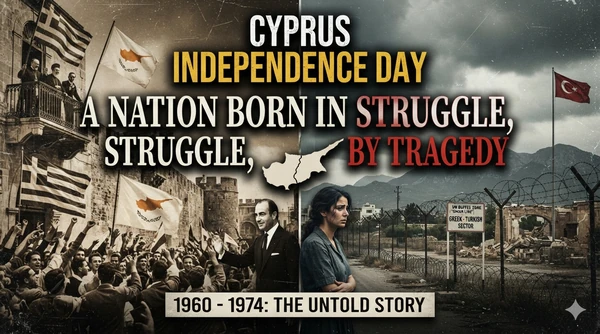
Every year on August 16, the Republic of Cyprus marks its Independence Day — the anniversary of the moment in 1960 when the small Mediterranean island finally shed nearly a century of British colonial rule and became a sovereign state. But unlike many independence stories that end with the raising of a new flag, Cyprus's is a story that keeps unfolding. Independence did not bring the peace its people hoped for. Within a decade and a half, the island was invaded, divided, and left with wounds that remain open to this day. To understand Cyprus Independence Day is to understand both a hard-won freedom and an unfinished tragedy.
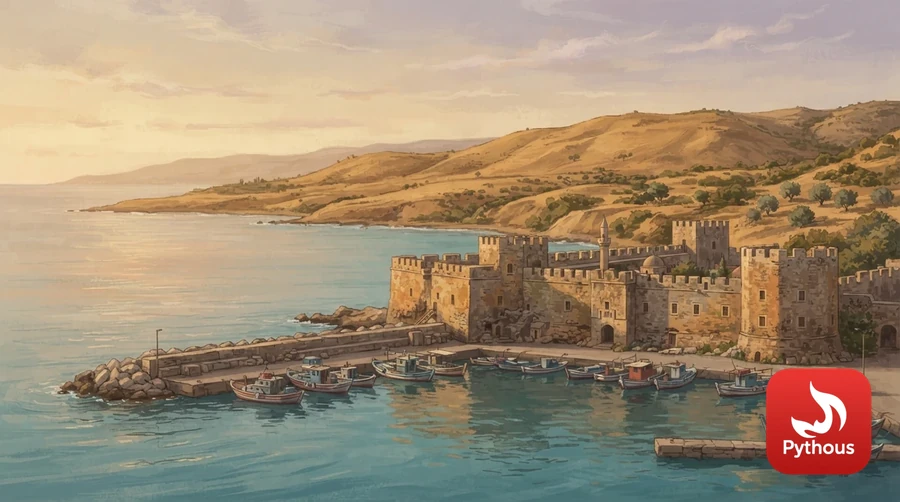
Illustration: a medieval harbour fortress on the coast of Cyprus.
A Crossroads Island, Colonized Again and Again
Cyprus has rarely belonged only to itself. Sitting at the meeting point of Europe, Asia, and Africa, it has been ruled over the centuries by Assyrians, Egyptians, Persians, Greeks, Romans, Byzantines, Crusaders, Venetians, and Ottomans. Greek settlement on the island stretches back millennia, giving the majority of Cypriots their language, religion, and cultural identity. Turkish presence began under Ottoman rule, which lasted from 1571 until 1878, and it was this centuries-long Ottoman chapter that planted a permanent Turkish Cypriot community on the island alongside the Greek Cypriot majority.
In 1878, control passed to Britain, first as an administrative arrangement with the Ottoman Empire and later, after the First World War, as a formal Crown Colony. By the mid-twentieth century, Cyprus's population was overwhelmingly Greek Cypriot — around three-quarters of the island — with a substantial Turkish Cypriot minority making up close to a fifth, alongside smaller communities. This demographic reality, and the very different national aspirations it produced, would shape everything that followed.
The Dream of Enosis and the EOKA Struggle
Most Greek Cypriots did not simply want independence — they wanted enosis, union with Greece, a dream nurtured for generations. By the early 1950s, patience with British rule had run out. On April 1, 1955, an underground movement called EOKA (Ethniki Organosis Kyprion Agoniston — the National Organization of Cypriot Fighters) launched an armed campaign against British colonial administration. It was founded by Colonel George Grivas, a Cyprus-born officer of the Greek army, with the political backing of Archbishop Makarios III, head of the Cypriot Orthodox Church and the most influential Greek Cypriot leader of his generation.
What followed was four years of guerrilla warfare, bombings, ambushes, and brutal counter-insurgency. Britain exiled Makarios to the Seychelles in 1956, hoping to break the movement by removing its figurehead, but the campaign continued. EOKA's fighters targeted British soldiers, police stations, and government installations, while Britain responded with mass arrests, curfews, and hangings of captured militants — several of whom became martyrs in the Greek Cypriot national memory. The violence hardened not only Greek Cypriot resolve against Britain, but also stoked fear among Turkish Cypriots, who saw enosis not as liberation but as the prospect of becoming a small, vulnerable minority inside a Greek nation. Turkish Cypriot paramilitary groups formed in response, and by 1958 the conflict had taken on a second, more dangerous dimension: violence between the two communities themselves, not just against the colonial power.
The Compromise Nobody Fully Wanted
By 1958, it was clear that neither full union with Greece nor Turkish Cypriot partition (taksim) was achievable without catastrophe. Facing pressure from the United Nations, the United States, and the wider tide of decolonization sweeping Asia and Africa, Makarios shifted his position: he would accept independence instead of enosis, provided Greek Cypriots were not simply left to Turkish Cypriot veto or partition.
Negotiations between Britain, Greece, Turkey, and representatives of both Cypriot communities produced the Zurich and London Agreements of February 1959. The resulting settlement was an intricate, almost fragile balancing act: Cyprus would become an independent republic with a Greek Cypriot president and a Turkish Cypriot vice-president, separate communal chambers for each community, guaranteed proportional representation in the civil service, army, and police, and a constitution that gave the Turkish Cypriot minority veto powers far beyond its share of the population. Britain, for its part, would retain two Sovereign Base Areas — Akrotiri and Dhekelia — which it governs to this day. Greece and Turkey were each permitted to station a small number of troops on the island as "guarantor powers," alongside Britain, responsible for upholding the new constitutional order.
It was a compromise that satisfied almost no one completely, but on August 16, 1960, the Republic of Cyprus was formally proclaimed in Nicosia. Archbishop Makarios III was sworn in as the island's first president. After 82 years of British rule and centuries of foreign domination before that, Cyprus was, on paper, finally its own master.
A Republic on Fragile Ground
Independence did not resolve the deeper tension at the heart of Cypriot society — it merely gave it a constitutional shape. The 1960 constitution required extraordinary cooperation between two communities that had just spent years regarding one another with suspicion, and in places, open hostility. Within three years, that cooperation broke down. In December 1963, Makarios proposed constitutional amendments aimed at reducing what Greek Cypriots saw as an unworkable Turkish Cypriot veto. Turkish Cypriots rejected the changes as an attempt to strip away their guaranteed protections, and intercommunal fighting erupted across the island — the first of what would be a decade of intermittent violence.
Turkish Cypriots largely withdrew into enclaves, guarded by their own militias, while the central government functioned increasingly as a Greek Cypriot state in practice, even as it remained internationally recognized as representing all of Cyprus. A United Nations peacekeeping force, UNFICYP, arrived in 1964 and remains on the island to this day — one of the longest-running peacekeeping missions in UN history, a quiet but telling marker of how unresolved the situation has always been.
1974: Coup, Invasion, and the Island Torn in Two
The gravest hardship in Cyprus's post-independence story arrived in the summer of 1974. Greece was then ruled by a right-wing military junta, and hardline Greek Cypriot nationalists — many organized under EOKA-B, a successor to the original movement — still dreamed of enosis and viewed Makarios, who had long since abandoned that goal in favor of a genuinely independent Cyprus, as an obstacle. On July 15, 1974, the Cypriot National Guard, backed and directed by the Greek junta, staged a coup against Makarios. He narrowly escaped assassination, fled the island, and addressed the UN Security Council, describing the coup as an invasion of Cyprus by Greece itself. In his place, the coup plotters installed Nikos Sampson, a hardline nationalist, in what was widely regarded as a puppet government aimed at annexing the island.
Turkey, one of the constitutional guarantor powers, responded five days later. On July 20, 1974, Turkish forces launched a military operation and landed troops near Kyrenia on the northern coast. A ceasefire brokered by the UN halted the fighting on July 22, and within days the Greek junta collapsed and the Sampson regime fell, replaced by the constitutional government under Glafkos Clerides. But peace talks in Geneva failed to produce a lasting political settlement, and on August 14, 1974, Turkey launched a second, larger offensive. By the time it ended, Turkish forces controlled roughly 37 percent of the island in the north, including the city of Famagusta.
The human cost was devastating. An estimated 162,000 Greek Cypriots fled or were displaced from the north, becoming refugees in their own country almost overnight, while tens of thousands of Turkish Cypriots moved north, many leaving homes and land in the south. Families were separated, entire towns emptied, and the ghost city of Varosha, once a thriving resort district of Famagusta, was fenced off and left abandoned — it remains largely frozen in time to this day. Several thousand people were killed across the coup and the invasion, and the fate of hundreds of missing persons from both communities was not resolved for decades, with identification of remains continuing well into the twenty-first century.
A Divided Island Ever Since
In the aftermath, Cyprus settled into a partition that has now lasted longer than the unified republic itself managed to survive. The north, under Turkish Cypriot administration and Turkish military presence, declared itself the "Turkish Republic of Northern Cyprus" in 1983 — a state recognized only by Turkey and regarded by the rest of the international community as an illegal entity under occupation. The Green Line, a UN-patrolled buffer zone, still cuts across the island and through the heart of Nicosia, making it the last divided capital city in Europe. Successive rounds of UN-mediated reunification talks — most notably the Annan Plan referendum of 2004 and the Crans-Montana talks of 2017 — have all failed to produce a settlement, though checkpoints along the Green Line have opened since 2003, allowing Cypriots on both sides to cross for the first time in nearly thirty years.
Cyprus joined the European Union in 2004, but EU law technically applies only to the government-controlled south, since the island entered as a nation still formally divided. The dream of reunification has not died, but neither has the practical reality of two separate administrations, two currencies of daily life, and two communities still negotiating what a shared future might look like.
What Independence Day Means Today
For Cypriots, August 16 is a day layered with contradiction. It commemorates the end of colonial rule and the extraordinary sacrifice of the EOKA years — a genuine anti-colonial achievement won against a global imperial power. But it also sits in the shadow of everything that came after: a constitution that could not hold, a coup engineered by outsiders, an invasion that redrew the map of the island by force, and a division that, more than five decades on, still has not healed. Independence Day in Cyprus is not simply a celebration; it is also, inevitably, a moment of reflection on how fragile a nation's freedom can be when it is built on a compromise nobody was ever fully at peace with.
The story of Cyprus is a reminder that becoming a country is rarely a single triumphant moment — it is often the beginning of a much longer and harder negotiation between the people who must share that country afterward.

Comments (0)
Leave a Reply
Log in to post a comment.