

 Aug 06, 2026
 6 min read
Before He Was "Hitler": Ambition, War, and the Making of a Dictator
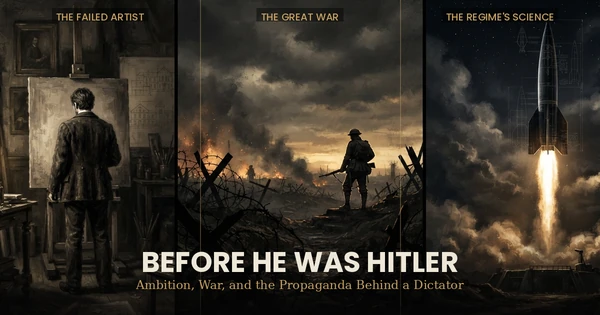
A historical look at Adolf Hitler's early life, his path to power, the men who tried to kill him, the propaganda behind his antisemitism, and the scientific programs run under his regime.
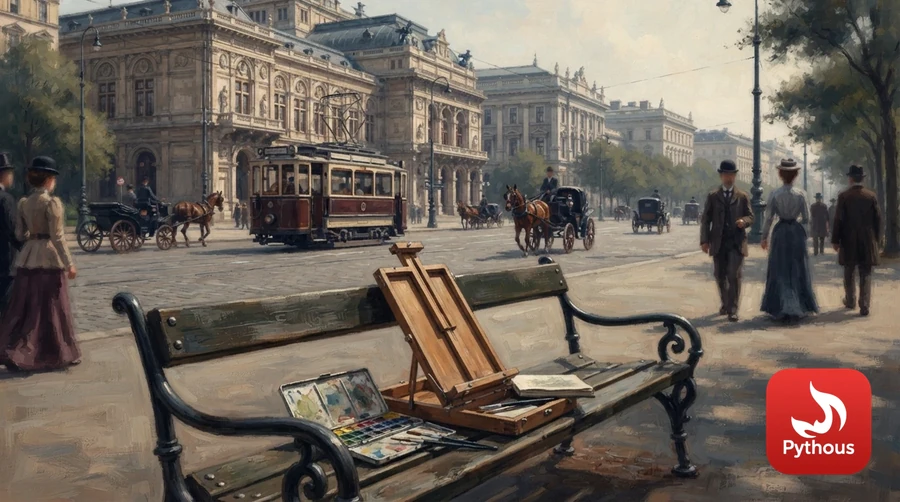
Illustration: Vienna around 1910, where the young Hitler failed to get into art school.
1. The Failed Artist (1889–1913)
Adolf Hitler was born in 1889 in Braunau am Inn, a small Austrian town on the German border — not in Germany itself, a fact he later worked hard to obscure. His father, Alois, was a customs official; his mother, Klara, doted on him. He was a mediocre student who left school without finishing, and by his late teens his one real ambition was to become a painter.
He applied twice to the Vienna Academy of Fine Arts, in 1907 and 1908, and was rejected both times — the examiners judged his work technically competent but unimaginative, better suited to architecture than fine art. He drifted through Vienna for years afterward, selling postcard-style watercolors to get by, living in a men's hostel, absorbing the city's virulent antisemitic press and pan-German nationalist politics along the way. This period — poor, aimless, resentful — is where his worldview began to take shape, years before politics gave it an outlet.
2. The War That Gave Him Purpose
World War I changed that trajectory entirely. Hitler volunteered for a Bavarian regiment in 1914 and served as a message runner on the Western Front — a genuinely dangerous job. He was wounded twice, gassed once, and decorated with the Iron Cross, First Class, an unusual honor for someone of his low rank. He later described the war as the most meaningful period of his life; Germany's defeat in 1918, and the humiliation of the Versailles Treaty that followed, felt to him like a personal betrayal.
Like many veterans of the collapsed Imperial Army, he gravitated toward the fringe nationalist movements of postwar Munich. In 1919 he joined a small group called the German Workers' Party, which he rapidly reshaped and rebranded as the Nazi Party (NSDAP). His talent, it turned out, wasn't painting — it was public speaking. Crowds that had ignored him for years now listened.
3. Prison, a Book, and a Blueprint
In 1923, Hitler attempted to seize power in Munich by force — the Beer Hall Putsch — and failed within a day. The coup collapsed, and he was arrested and tried for treason. The trial made him a national figure; he used the courtroom as a stage to declare his intentions rather than deny them. He served only about a year in a comfortable fortress prison, where he dictated Mein Kampf, laying out both his personal grievances and the ideological program he would later attempt to enact: territorial expansion ("Lebensraum"), a racial hierarchy, and a conspiratorial hatred of Jews as the supposed cause of Germany's defeat and economic collapse.
By 1933, exploiting the Great Depression, mass unemployment, and the fractured Weimar political system, he was appointed Chancellor — not through a coup this time, but through legal, if manipulated, political maneuvering. Within months he had dismantled the democratic structures that put him there.
4. The Plots Against Him
Hitler survived more assassination attempts than almost any other 20th-century leader — historians count over 40 serious plots against his life. Two stand out:
Georg Elser, 1939. A lone carpenter, acting without any organization behind him, built a time bomb by hand and hid it inside a pillar at the Munich beer hall where Hitler gave an annual speech. Hitler left the building thirteen minutes earlier than usual because of fog delaying his travel; the bomb killed eight other people. Elser was captured trying to cross into Switzerland and was executed in a concentration camp just weeks before the war's end.
Operation Valkyrie, July 20, 1944. The most famous attempt came from inside Hitler's own military. Colonel Claus von Stauffenberg, part of a resistance network of officers and officials who had concluded the war was unwinnable and Hitler's regime was catastrophic, planted a briefcase bomb in a conference room at the Wolf's Lair headquarters. A heavy oak table leg partially shielded Hitler from the blast; he survived with burst eardrums and minor injuries. The plot's failure led to a brutal purge — an estimated 4,000-plus people were arrested and roughly 200 executed in the aftermath, including Stauffenberg himself, shot the same night.
5. The Propaganda Behind the Hatred
Hitler's antisemitism didn't originate with him — it drew on centuries of European religious and racial prejudice, and specifically on conspiracy literature circulating in early-20th-century Vienna, including the forged "Protocols of the Elders of Zion," which falsely claimed a Jewish plot for world domination. Hitler absorbed this material during his Vienna years and, after Germany's WWI defeat, folded it into what's known as the "stab-in-the-back" myth — the false claim that Germany hadn't been defeated militarily but betrayed from within by Jews, socialists, and communists.
None of this was rooted in fact. Germany's WWI collapse had ordinary causes: exhaustion, blockade-driven starvation, and battlefield attrition on a scale the Allies could replace and Germany couldn't. But scapegoating offered Hitler something a truthful account didn't: a single, visible enemy he could rally a humiliated and economically devastated country against. He used this narrative relentlessly in speeches and in Mein Kampf, and once in power turned it into state policy — first exclusion and expropriation, escalating to the Holocaust, in which six million Jews were murdered along with millions of others targeted by the regime.
6. The Regime's Scientific and Research Programs
Alongside its atrocities, the Nazi state ran a number of large scientific and engineering programs — some of lasting technical significance, others pseudoscientific:
- The V-weapons program. At Peenemünde, a team led by Wernher von Braun developed the V-2, the world's first long-range guided ballistic missile. It was built using forced labor from concentration camp prisoners, tens of thousands of whom died constructing it — a death toll that exceeded the number killed by the weapon in combat. After the war, the same engineering knowledge fed directly into both the American and Soviet space and missile programs.
- The German nuclear program ("Uranverein"). A group of German physicists, including Werner Heisenberg, researched nuclear fission under state sponsorship, but the effort never approached a working weapon — hampered by resource shortages, the exile or persecution of many top physicists (a number of them Jewish), and disagreements over how close a bomb actually was.
- Jet aircraft. Germany fielded the Messerschmitt Me 262, the first operational jet fighter, late in the war — technically ahead of Allied aircraft but too late and too few in number to change the outcome.
- The Ahnenerbe. A very different kind of "research" body: an SS-run institute that conducted pseudo-archaeological and pseudo-anthropological expeditions to manufacture historical justification for Nazi racial ideology, and which was also linked to horrific human experimentation in concentration camps.
7. Collapse
By 1945, with Soviet forces closing in on Berlin, Hitler retreated to an underground bunker beneath the Reich Chancellery. He married his longtime partner Eva Braun on April 29; the next day, both died by suicide as the city fell. The regime he built — which he had promised would last a thousand years — collapsed twelve years after it began, leaving a continent in ruins and a death toll in the tens of millions.
Sources for further reading: Ian Kershaw's two-volume biography (Hitler: 1889–1936 and Hitler: 1936–1945), William Shirer's The Rise and Fall of the Third Reich, and the Peenemünde/Mittelbau-Dora historical records for the V-2 program's forced-labor history.



Comments (0)
Leave a Reply
Log in to post a comment.