

 Sep 06, 2026
 7 min read
The Sultan Was Already Dead: The Siege of Szigetvár, 1566

In the first days of September 1566, the most powerful ruler in the world sat inside his tent in the marshes of southern Hungary while officers came and went with reports on the siege, servants brought food, and sealed orders went out to an army of perhaps a hundred thousand men. Süleyman the Magnificent had been dead for two days. His Grand Vizier, knowing that an army deep in enemy country at the end of the campaigning season would break up the moment it learned the sultan was gone, kept the death secret. The deception worked: the army did not learn of it for weeks.
Behind that story is the reason Süleyman was there at all: a small fortress in a swamp, Szigetvár, held by fewer than three thousand men, which was expected to fall in days and held out for thirty-three.
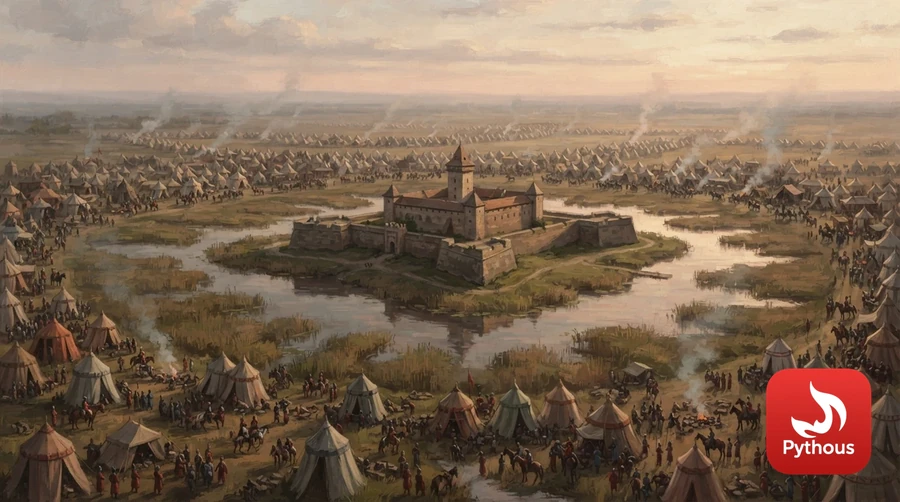
Illustration: the island fortress of Szigetvár under Ottoman siege, 1566.
An old man's last campaign
By 1566 Süleyman had reigned for forty-six years. He had taken Belgrade in 1521 and Rhodes in 1522, and destroyed the medieval kingdom of Hungary at Mohács in 1526 in a battle of a couple of hours. He had also twice failed to reach or take Vienna, in 1529 and 1532. Now about seventy-one, he suffered badly from gout and probably from more serious illness, and he travelled north mostly in a covered carriage, his condition kept from the soldiers.
Ottoman chroniclers gave his army as a hundred thousand men and three hundred guns. Modern historians, such as Rhoads Murphey in his study of Ottoman warfare, treat figures like these with caution, but even cautious estimates put the force far beyond anything a border fortress could resist. The campaign was meant to break the Habsburg position in Hungary. Its first target seems to have been Eger, further north. It turned towards Szigetvár after the captain of the fortress, Nikola Šubić Zrinski (Miklós Zrínyi in Hungarian), Ban of Croatia, ambushed and killed an Ottoman provincial governor near Siklós that summer. Whether that changed Süleyman's plans or gave him a convenient reason, the army marched on Szigetvár.
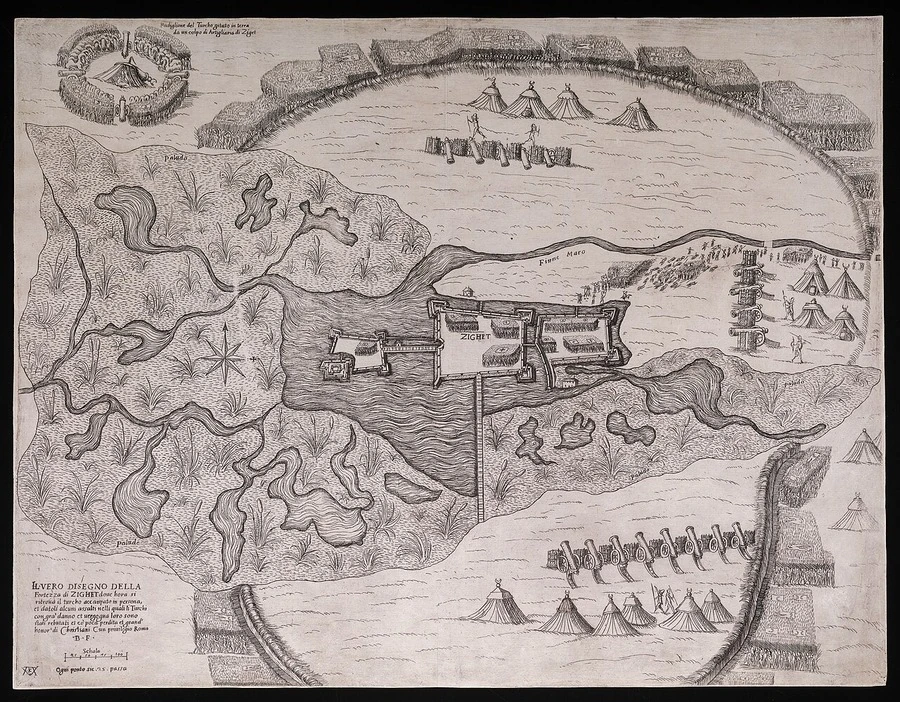
Szigetvár was three linked strongholds in the marshes, connected by causeways and bridges. Image: Mario Cartaro / Wikimedia Commons, public domain
The island castle
Szigetvár means "island castle", and it was built as a chain of three linked strongholds, an outer town, an old town and an inner castle, out in the marshes of the Almás stream and joined by causeways and bridges. Water was its main defence. Ottoman siege artillery was the best in the world, but it had to be hauled into range, and marshland is the worst ground for heavy guns.
Zrinski was in his fifties and had spent his whole life on a frontier that kept moving the wrong way. He had fought in the defence of Vienna in 1529 and risen to be Ban of Croatia. According to the eyewitness account of his chamberlain, Ferenc Črnko, who survived the siege and was later ransomed, he gathered the garrison and had them swear an oath, not to hold the castle, but never to surrender or abandon it and to share the same end. Then he burned the outer bridge, cutting off his own retreat. The garrison numbered between about 2,300 and 3,000, mostly Croatian and Hungarian soldiers, with civilians sheltering inside.
Thirty-three days
The siege began on 6 August 1566 and went the way Ottoman sieges usually did, methodically. Engineers drained parts of the marsh and built causeways of earth and brushwood across it, dragging the guns forward until the walls were in range. Miners dug tunnels under the defences, packed them with gunpowder, and blew holes for the assault troops.
Zrinski used the castle's layout to fight a retreat. When the outer town could not be held, he withdrew and burned it behind him, and did the same when the old town fell. Each step cost the attackers time and lives for ground that was worthless by the time they took it, and each left the defenders less room and fewer men. The sources disagree on how many general assaults there were, usually seven or more, but agree that they were beaten back at heavy cost. Süleyman is said to have offered Zrinski generous terms, including rule over Croatia and safety for his family; he did not reply.
The death in the tent
Süleyman died on the night of 6 to 7 September, about a kilometre from the fortress. The Grand Vizier, Sokollu Mehmed Pasha, decided at once to keep the death secret. The heir, Prince Selim, was far away in Anatolia, and a sultan's death in the field could set commanders racing home to secure their positions. So the body was embalmed and kept in the tent, orders kept coming out in the Vizier's hand under the sultan's seal, and couriers rode secretly to fetch Selim. The Ottoman historian Ibrahim Peçevi, writing some decades later, describes the lengths taken to maintain the fiction; later accounts add that the doctors who attended the death were killed. Some of that may be embellishment, but the central fact is well established, and the plan worked. Selim was proclaimed only after he had reached the army on its march home.
The last sortie
On the morning of 8 September, two days after the sultan's death, the inner castle was burning, the walls were breached, and Zrinski had perhaps six hundred men left who could fight. According to Črnko's account and the tradition that grew from it, he did not put on armour. He dressed in a silk coat and a velvet cap with a jewelled plume, put a hundred gold coins in his pocket so that whoever stripped his body would find something worth taking, hung the castle keys on his belt, and had a cannon loaded with scrap iron aimed at the gate. Then he ordered the gate opened.
The cannon fired into the troops waiting outside, and the garrison charged out after it. Zrinski was hit almost at once, by two musket balls in the chest and one in the head, according to the accounts, and the sortie was wiped out within minutes. Črnko was among the very few taken alive. As Ottoman soldiers poured in to loot the castle, the powder magazine, left with a slow fuse, exploded and killed many of them. The chronicle figure of three thousand dead in the blast is almost certainly too high.
What it cost
Szigetvár was taken, but there was little left of it. Ottoman losses during the siege, including deaths from disease in the camp, are usually estimated in the tens of thousands. With the sultan dead and the season late, the campaign ended, and the army went home to bury Süleyman and enthrone his son. Zrinski's head was sent to the Habsburg camp and buried at Čakovec in Croatia.
The legend grew afterwards. In 1651 Zrinski's great-grandson, also named Nikola (Miklós Zrínyi), wrote the Hungarian epic Szigeti veszedelem, "The Peril of Sziget", which made the last sortie part of both Hungarian and Croatian national memory. Cardinal Richelieu is often quoted as calling Szigetvár "the battle that saved civilisation", but no reliable source for the remark has been found, and it is best treated as tradition.
The most interesting recent chapter is archaeological. By tradition Süleyman's internal organs were buried where his tent had stood, and a domed tomb, a türbe, with a mosque and a small settlement grew up around it before being destroyed in the late seventeenth century and forgotten. Between 2013 and 2016 a team from the University of Pécs led by the geographer Norbert Pap identified the remains of the complex in a vineyard at Zsibót, just outside modern Szigetvár, and excavations have continued since.
What makes the siege more than another last stand is the planning on both sides. Zrinski burned his own bridge on the first day, gave up ground for time in a sequence he had clearly prepared, and set the magazine fuse before he opened the gate. On the other side, a Grand Vizier looked at a dead sultan and decided that the empire's stability was worth a fortnight of pretence.
Sources
- Norbert Pap, "Research on the türbe complex of Suleiman the Magnificent in Szigetvár and its fortification", Osmanlı Araştırmaları 56 (2020): 1–23. https://doi.org/10.18589/oa.862760
- "Siege of Szigetvár", Wikipedia (with references to Črnko, Peçevi, Selaniki and modern studies). https://en.wikipedia.org/wiki/Siege_of_Szigetv%C3%A1r
- Caroline Finkel, Osman's Dream: The History of the Ottoman Empire, 1300–1923 (John Murray, 2005).
- Rhoads Murphey, Ottoman Warfare, 1500–1700 (UCL Press, 1999).
- Géza Dávid and Pál Fodor (eds.), Ottomans, Hungarians, and Habsburgs in Central Europe (Brill, 2000).





Comments (0)
Leave a Reply
Comments are moderated. Please read our Comment Policy before posting.
Log in to post a comment.