

 Aug 16, 2026
 3 min read
How Many Elements Are in the Human Body?
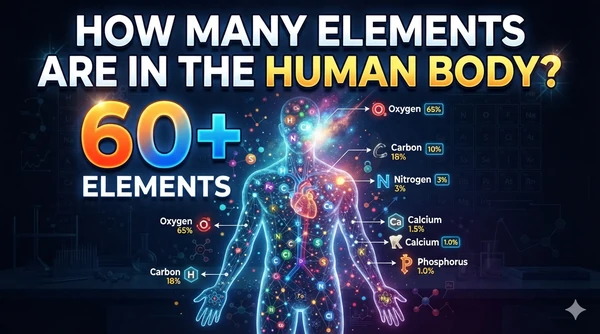
The human body is, at its most basic level, a walking chemistry set. Every heartbeat, thought, and breath depends on a small collection of elements from the periodic table, arranged into the molecules of bone, blood, muscle, and nerve. So exactly how many elements make up a human being — and in what proportions?

Illustration: four elements make up about 96% of your body.
The Short Answer
Scientists have detected around 60 different chemical elements in the human body. Of these, only about 25 are considered essential for life — meaning the body cannot function normally without them. The rest are present in trace amounts, some incidental (absorbed from food, water, or the environment) and some whose biological role is still debated.
The Big Four: 96% of Your Body
Just four elements account for roughly 96% of total body mass:
| Element Symbol % of Body Mass Primary Role | |||
| Oxygen | O | ~65% | Water, cellular respiration |
| Carbon | C | ~18% | Backbone of all organic molecules |
| Hydrogen | H | ~10% | Water, organic compounds |
| Nitrogen | N | ~3% | Proteins, DNA, RNA |
Oxygen dominates mainly because the body is about 60% water (H₂O), and water is roughly 89% oxygen by mass. Carbon, hydrogen, and nitrogen form the structural backbone of proteins, fats, carbohydrates, and nucleic acids.
The Next Layer: Macrominerals
After the "big four," about 3.5% of body mass comes from seven macrominerals — elements the body needs in relatively large quantities (grams per day):
| Element Symbol % of Body Mass Primary Role | |||
| Calcium | Ca | ~1.5% | Bones, teeth, muscle contraction |
| Phosphorus | P | ~1.0% | Bones, teeth, ATP (cellular energy) |
| Potassium | K | ~0.25% | Nerve signals, fluid balance |
| Sulfur | S | ~0.25% | Protein structure |
| Sodium | Na | ~0.15% | Fluid balance, nerve signals |
| Chlorine | Cl | ~0.15% | Fluid balance, digestion |
| Magnesium | Mg | ~0.05% | Enzyme function, bone structure |
Trace Elements: The Remaining 0.5%
The final fraction of body mass is made up of trace elements — needed in tiny amounts (milligrams or even micrograms) but still essential for specific biological functions:
- Iron (Fe) — core of hemoglobin, carries oxygen in red blood cells
- Zinc (Zn) — enzyme function, immune response, wound healing
- Copper (Cu) — enzyme cofactor, connective tissue formation
- Iodine (I) — thyroid hormone production
- Selenium (Se) — antioxidant enzyme function
- Manganese (Mn) — bone formation, metabolism
- Fluorine (F) — tooth enamel strength
- Chromium (Cr) — glucose metabolism
- Molybdenum (Mo) — enzyme cofactor
- Cobalt (Co) — part of vitamin B12
Elements That Are Present but Not Essential
Beyond the roughly 25 essential elements, trace amounts of other elements — such as aluminum, silicon, boron, arsenic, and even small amounts of lead or cadmium — have been detected in human tissue. These typically enter the body through food, water, air, or the environment rather than serving a known biological function. Some, like silicon and boron, are suspected to play minor roles in bone and connective tissue health, though the science isn't fully settled.
Why This Breakdown Matters
Understanding the body's elemental makeup isn't just trivia — it explains a lot of practical health science:
- Nutrition: Deficiencies in iron, iodine, or zinc are among the most common nutritional problems worldwide, precisely because these trace elements, despite being needed in tiny amounts, are critical to core functions like oxygen transport and hormone regulation.
- Medicine: Many diagnostic tests (blood panels, bone density scans) essentially measure whether these elements are present in the right amounts.
- Toxicology: Elements like lead, mercury, and cadmium are dangerous precisely because the body has no essential use for them, yet they can interfere with processes that essential elements normally run.
Quick Summary
- ~60 elements have been detected in the human body
- ~25 elements are considered biologically essential
- 4 elements (oxygen, carbon, hydrogen, nitrogen) make up about 96% of body mass
- The remaining ~4% is made up of macrominerals and trace elements — small in quantity, but often critical in function
In short, the human body is mostly oxygen, carbon, hydrogen, and nitrogen by weight — but its health, function, and even survival often hinge on the tiny fractions of elements that make up the rest.



Comments (0)
Leave a Reply
Log in to post a comment.