

 Feb 01, 2025
 5 min read
How Life Begins: From the First Cells on Earth to a Human Embryo
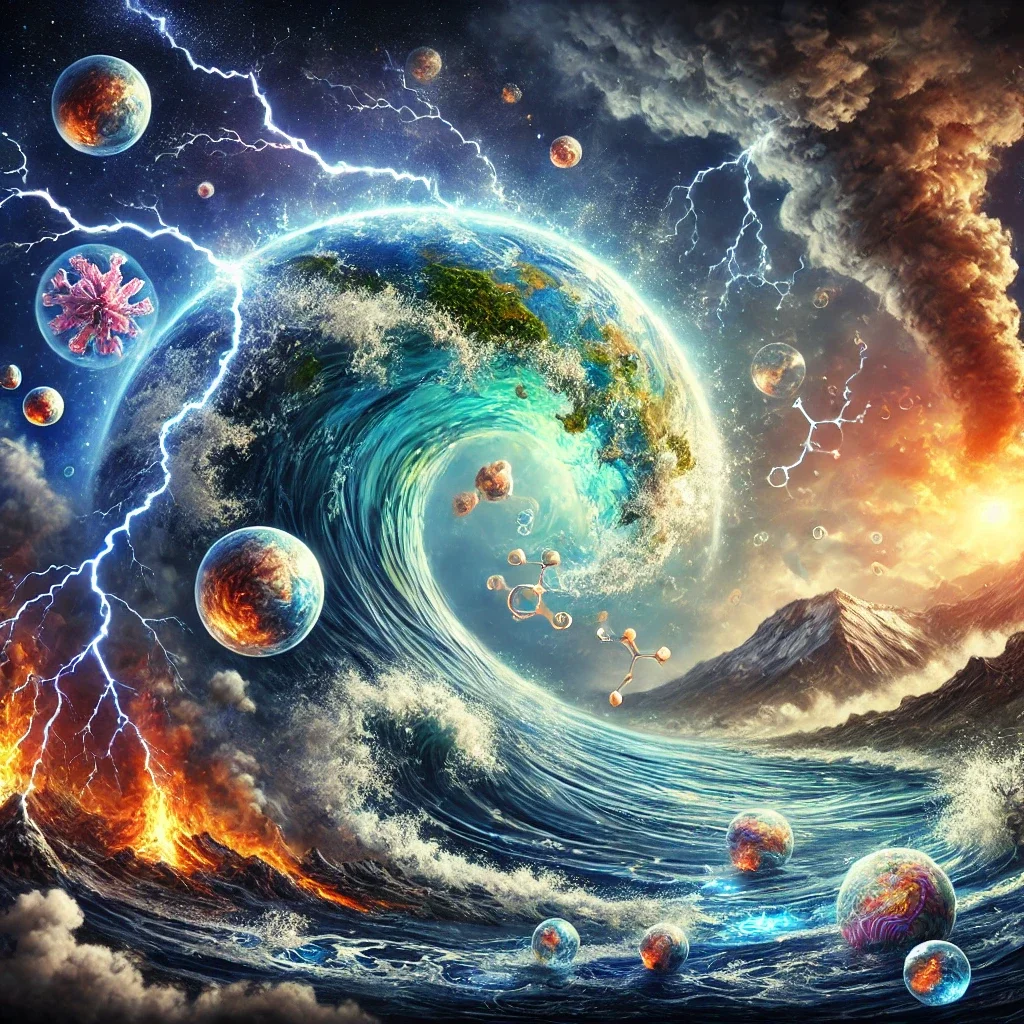
"How does life begin?" has two very different answers. One is about how the first living cells appeared on a lifeless planet about four billion years ago, and it is still an open scientific question. The other is about how each human life starts, and that is now understood in remarkable detail. This article covers both.
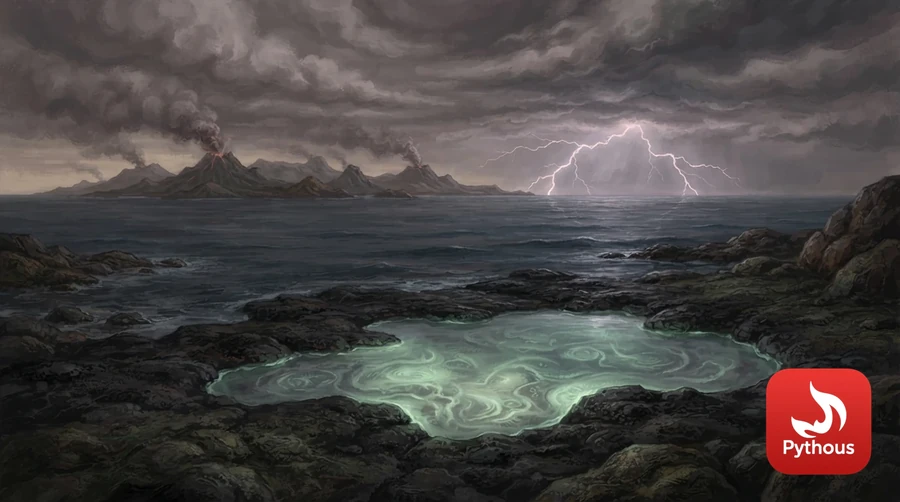
Illustration: early Earth, where life's chemistry may have begun.
The first life on Earth
Earth formed about 4.54 billion years ago. The oldest widely accepted evidence of life comes from fossilised microbial mats (stromatolites) in Western Australia, about 3.5 billion years old. Older signs are debated. A 2024 genetic analysis estimated that the last universal common ancestor of all living things lived about 4.2 billion years ago and was already a fairly complex cell. If that is right, life arose remarkably early, soon after the planet became habitable.
Building blocks are easy to make
In 1952, Stanley Miller, a graduate student working with Harold Urey, passed electric sparks through a flask of water, methane, ammonia and hydrogen to imitate lightning on the young Earth. Within days, the water turned brown and contained amino acids, the building blocks of proteins. Decades later, researchers re-analysed vials from a version of Miller's experiment that imitated a volcanic eruption. They found more than 20 amino acids, more than Miller himself had been able to detect (Science, 2008).
Space also makes these molecules. Samples brought back from the asteroid Bennu by NASA's OSIRIS-REx mission contained 14 of the 20 amino acids used in proteins and all five nucleobases used in DNA and RNA, along with abundant ammonia (Nature Astronomy, 2025). The early Earth was probably well stocked with life's raw materials.
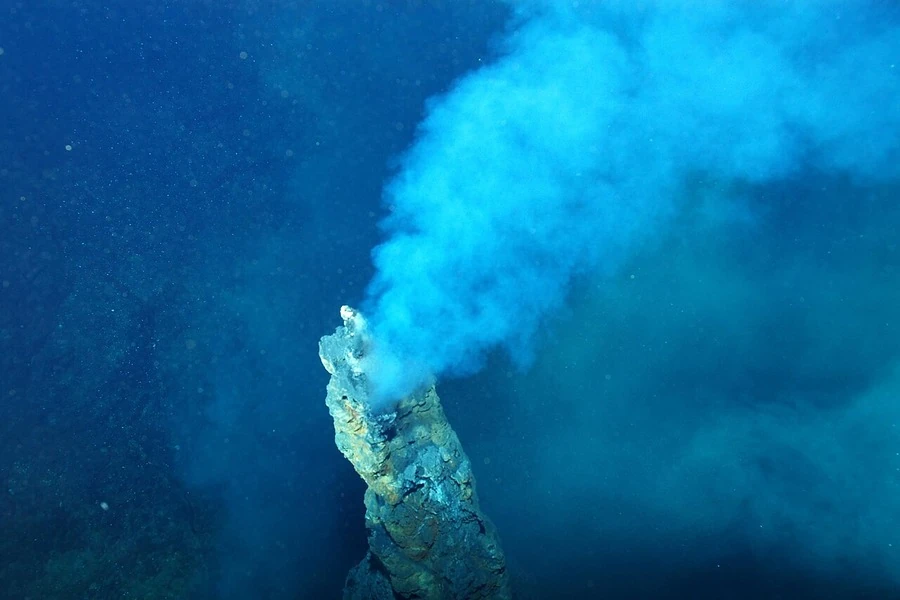
Getting from a soup of molecules to something that copies itself is the hard step. Photo: Ifremer / Wikimedia Commons, CC BY 4.0
The hard part: getting to a cell
The difficult step is going from a soup of molecules to something that copies itself and evolves. Several ideas compete, and they aren't mutually exclusive:
- The RNA world. RNA can both store genetic information and act as an enzyme. In the 1980s, Thomas Cech and Sidney Altman showed that some RNA molecules catalyse chemical reactions, work that earned the 1989 Nobel Prize in Chemistry. Many researchers think early life used RNA for both jobs before DNA and proteins took over.
- Hydrothermal vents. Warm, alkaline vents on the seafloor, such as the Lost City field discovered in the Atlantic in 2000, provide natural energy gradients and mineral surfaces that could drive early chemistry.
- Warm ponds on land, repeatedly drying and wetting, could concentrate molecules and help them link into chains.
- Panspermia, the idea that life arrived from space, is sometimes suggested. Even if it were true, it would only move the question of origin somewhere else.
No one has yet made life from scratch in the lab. Researchers have produced self-copying RNA molecules and simple cell-like membranes that grow and divide, and the gap is narrowing.
How a human life begins
Meeting
A typical ejaculation contains tens to hundreds of millions of sperm. Only a few hundred reach the fallopian tube, where fertilisation usually happens. Sperm can survive in the female reproductive tract for up to five days, but an egg lives only about 12 to 24 hours after ovulation. That is why the fertile window is the five days before ovulation plus the day itself.
When one sperm fuses with the egg, the egg instantly changes its outer coat so that no other sperm can enter. In 2016, researchers filmed human eggs releasing billions of zinc atoms at the moment of activation, a burst of light under the microscope that became known as the "zinc spark" (Scientific Reports, 2016).
The first weeks
- Day 1: the fertilised egg (zygote) has one set of chromosomes from each parent, 46 in total, and begins to divide.
- Days 5 to 6: it has become a hollow ball of about 100 to 200 cells called a blastocyst. An inner cluster will form the embryo, and the outer layer will form the placenta.
- Days 6 to 10: the blastocyst implants in the lining of the womb and begins producing hCG, the hormone detected by pregnancy tests.
- Around day 22: a simple tube that will become the heart begins to beat.
- By day 28: the neural tube, which becomes the brain and spinal cord, has closed. This is why folic acid is advised before conception. The tube closes before many women know they are pregnant.
Not every conception continues. In a careful study of 221 women who measured hormones daily, 31% of pregnancies detected after implantation were lost, most of them so early that the women never knew they had been pregnant. Early losses are mostly caused by chromosome errors and are not caused by anything the mother did.
And the "soul"?
Science can describe when cells divide, when a heartbeat starts and when the brain develops, but not when a person acquires a soul. That is a question for religion and philosophy, and traditions answer it differently. Catholic teaching holds that human life is to be protected from conception. In Islamic tradition, many scholars cite a hadith describing the soul being breathed in after 120 days, while some refer to 40 days. Jewish tradition gives particular significance to the first 40 days. These views shape attitudes to IVF, embryo research and pregnancy loss across the world. They sit alongside the biology rather than in conflict with it.
Sources
- Moody E, Álvarez-Carretero S, Mahendrarajah T, Clark J et al., "The nature of the last universal common ancestor and its impact on the early Earth system", Nature Ecology & Evolution 8 (2024): 1654-1666. https://doi.org/10.1038/s41559-024-02461-1
- Johnson A, Cleaves H, Dworkin J, Glavin D et al., "The Miller Volcanic Spark Discharge Experiment", Science 322 (2008): 404-404. https://doi.org/10.1126/science.1161527
- Glavin D, Dworkin J, Alexander C, Aponte J et al., "Abundant ammonia and nitrogen-rich soluble organic matter in samples from asteroid (101955) Bennu", Nature Astronomy 9 (2025): 199-210. https://doi.org/10.1038/s41550-024-02472-9
- Duncan F, Que E, Zhang N, Feinberg E et al., "The zinc spark is an inorganic signature of human egg activation", Scientific Reports 6 (2016). https://doi.org/10.1038/srep24737
- Wilcox A, Weinberg C, O'Connor J, Baird D et al., "Incidence of Early Loss of Pregnancy", New England Journal of Medicine 319 (1988): 189-194. https://doi.org/10.1056/NEJM198807283190401


Comments (0)
Leave a Reply
Comments are moderated. Please read our Comment Policy before posting.
Log in to post a comment.