

 Aug 17, 2026
 3 min read
Does Man Become Monkey, or Monkey Become Man? Clearing Up a Popular Misconception
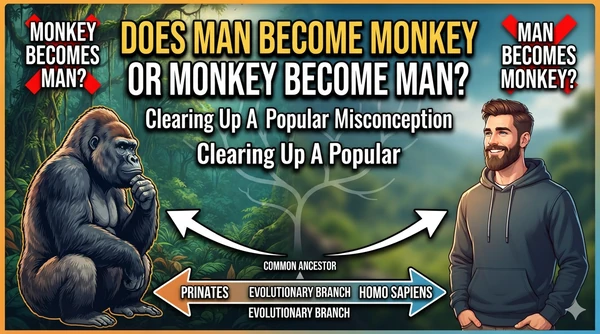
It's one of the most common questions people raise when evolution comes up — often half-joking, half-genuine: "So did man come from monkeys, or did monkeys come from man?"
The honest answer is: neither. The question itself rests on a misunderstanding of what evolution actually claims. Humans did not descend from monkeys, and monkeys are not descended from humans. Instead, both are separate branches that grew from a much older, shared ancestor — much like two cousins don't descend from each other, but both descend from the same grandparents.
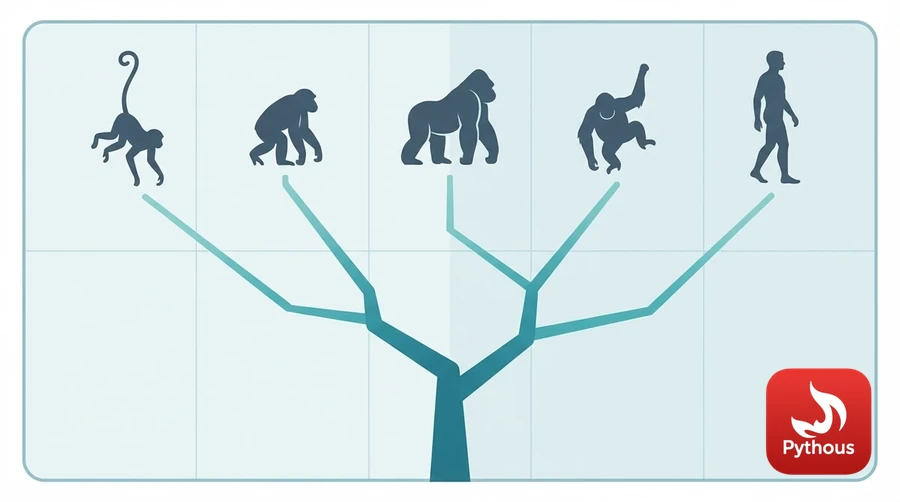
Illustration: humans and other primates are branches of one family tree, not steps on a ladder.
The Family Tree, Not a Ladder
The biggest source of confusion is picturing evolution as a straight line — monkey slowly turning into man, step by step, like a video game character leveling up. That's not how it works.
Evolution is better pictured as a branching tree. Millions of years ago, there existed a common ancestor species — not a monkey, not a human, but something else entirely — that no longer exists today. Over vast stretches of time, different populations of its descendants split off, adapted to different environments, and gradually became distinct species. One branch eventually led toward modern monkeys. A separate branch led toward apes, and much later, toward modern humans.
So humans and monkeys are more like distant cousins on the same family tree, not parent and child.
Humans Didn't Even Evolve From Monkeys — But From Apes
There's a second layer to the confusion: humans are classified as descending from ape-like ancestors, not monkeys specifically. Apes (like chimpanzees, gorillas, and orangutans) and monkeys are different branches of the primate family. Humans share a more recent common ancestor with chimpanzees — estimated at roughly 6 to 7 million years ago — than with any monkey species.
Monkeys and apes themselves split from a shared ancestor much earlier, tens of millions of years before that. So the chain of "man came from monkey" isn't just backwards — it skips several branches of the tree entirely.
Then Why Are There Still Monkeys?
This is usually the next question, and it's a fair one. If humans evolved from a common ancestor with monkeys, why didn't all of that ancestor's descendants become human?
The answer is that evolution isn't a single path toward a "final form" — it's a process where different populations adapt to different pressures and environments. The branch that led to modern monkeys kept adapting successfully to their own niches, while a separate branch, isolated by geography and time, adapted along a different path that eventually led to humans. Neither branch is "ahead" of the other; they simply adapted to different circumstances. Modern monkeys are not our ancestors any more than modern humans are theirs — both are the current endpoints of their own long branches.
Where the Debate Really Sits
Worth noting: the scientific case for common descent — that humans and other primates share ancestry — is supported by converging evidence from fossils, comparative anatomy, and genetics, and is treated as well-established within biology. Where genuine debate continues today is mostly around religious and philosophical interpretation — how (or whether) this fits with different faith traditions' accounts of human origins — rather than within the scientific evidence itself. That's a separate, meaningful conversation, but it's a different question from the biological one addressed here.
The Short Answer
- Man did not come from modern monkeys.
- Monkeys did not come from man.
- Both share a distant common ancestor, and each followed its own evolutionary path from there.
The next time someone poses the question as an either/or, the most accurate answer is: it's neither — it's a shared root, followed by two very different branches.



Comments (0)
Leave a Reply
Log in to post a comment.