

 Aug 31, 2026
 6 min read
Zenobia of Palmyra: The Desert Queen Who Took on Rome
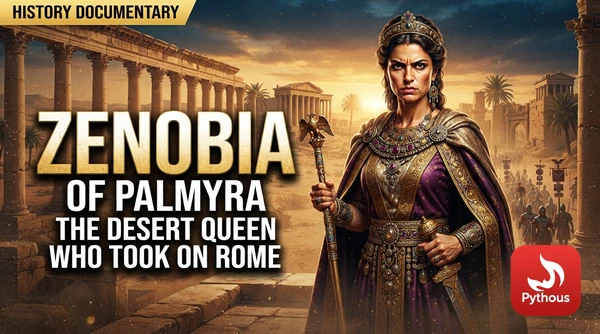
In the summer of 270 CE an army marched into Alexandria and took Egypt, the granary of Rome, from the empire that had ruled it for three hundred years. It was not a Persian army. It came from Palmyra, a caravan city in the Syrian desert, and it acted in the name of a woman who still claimed to be Rome's loyal ally. Her name was Septimia Zenobia; in her own Palmyrene Aramaic, Bat-Zabbai, "daughter of Zabbai". By 271 she ruled the largest breakaway state the Roman east had seen; by the end of 272 she had lost it.
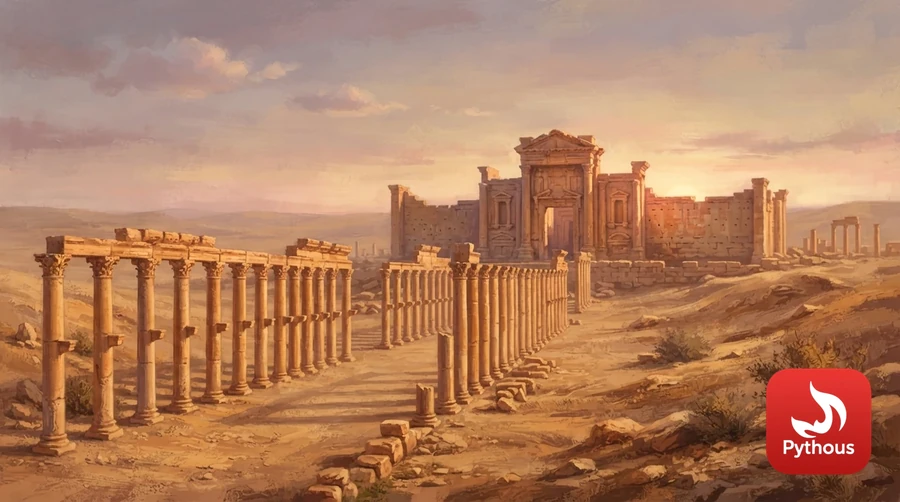
Illustration: Palmyra, Zenobia's desert city.
A city of caravans
Palmyra, Tadmor in Aramaic, stood at an oasis roughly halfway between the Mediterranean coast and the Euphrates. It had little farmland and no mountain pass to guard. What it had was water, in a desert where caravans had nowhere else to stop. Silk, spices, pearls and Indian cotton came up from the Persian Gulf through Palmyrene hands on their way to Antioch, and Palmyrene merchants kept trading posts as far away as Spasinou Charax at the head of the Gulf, protected by Palmyrene archers.
The trade paid for the colonnaded streets and temples whose ruins are now a UNESCO World Heritage Site, and it gave Rome something unusual on its eastern frontier: a self-governing ally with its own army, its own aristocracy, its own language and gods, and Roman citizenship worn alongside them. Zenobia was born into that aristocracy around 240. Almost nothing reliable survives about her early life. The claim that she descended from the Ptolemies and Cleopatra comes from later Roman writers and tells us more about how they wanted to see her than about her family.
Odaenathus
The 250s and 260s were the worst decades the Roman empire had yet experienced. Emperors rose and fell within months, plague spread through the provinces, and in 260, near Edessa, the Sasanian king Shapur I defeated a Roman army and captured the emperor Valerian. Shapur had the scene carved into the cliffs at Naqsh-e Rustam in Iran, where it can still be seen.
Zenobia's husband, Septimius Odaenathus, the leading man of Palmyra, filled the gap. He raised Palmyrene forces, drove the Persians back across the Euphrates and twice campaigned as far as their capital, Ctesiphon. Rome, unable to do it itself, accepted what he had done and gave him authority over the eastern provinces, under titles such as corrector totius Orientis. In Palmyrene inscriptions he went further and called himself King of Kings, a title borrowed from the Persians.
Around 267 or 268 Odaenathus and his eldest son, Herodianus, were murdered. The sources disagree about who was behind it: a quarrel within the family, a resentful relative, Roman agents. They agree about the result. Power passed to Zenobia's young son, Vaballathus (Wahballat), and as he was a child, his mother governed.
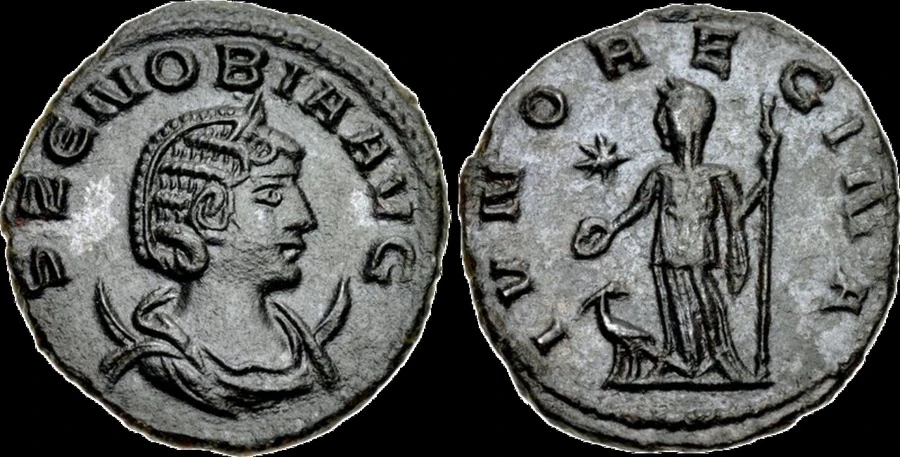
Coins minted at Antioch and Alexandria, part of how Zenobia kept up the look of loyalty to Rome. Photo: Classical Numismatic Group / Wikimedia Commons, CC BY-SA 2.5
Loyal on the coins
For about three years Zenobia ruled the east in her son's name while insisting in every public way that Palmyra remained loyal. Coins struck at Antioch and Alexandria carried the Roman emperor Aurelian on one side and Vaballathus on the other, with his father's Roman titles, not a royal one. Officially, Palmyra was governing the east on Rome's behalf.
Under that cover her armies expanded. In 270 her general Zabdas invaded Egypt and defeated the Roman prefect, Tenagino Probus, who died in the campaign. Other forces pushed through Syria into Anatolia as far as Ankyra, modern Ankara. At its widest, her authority covered Egypt, Syria, Palestine, Arabia and much of Asia Minor. Her court included the Greek scholar Cassius Longinus as an adviser, and she is linked in the sources with Paul of Samosata, the controversial bishop of Antioch whose opponents said he relied on her protection. Whether she cared about Greek philosophy or Christian doctrine is unknowable; that she cultivated the people who mattered in her territories is clear.
In late 271 or early 272 the pretence ended. Vaballathus was proclaimed Augustus and Zenobia Augusta, and new coins left out the Roman emperor altogether. The east now had its own imperial house.
Aurelian's campaign
Aurelian, a career soldier from the Danube provinces, was already putting the empire back together. He marched east in 272. At Immae near Antioch his cavalry drew the heavily armoured Palmyrene cavalry into a long pursuit in the heat, then turned on them when they were exhausted, and he won again with similar tactics at Emesa, modern Homs. Antioch and Emesa fell, and Zenobia withdrew to Palmyra, which Aurelian besieged after a hard march across the desert.
When the city could no longer hold, Zenobia rode east towards the Euphrates, probably hoping for Persian help, and was caught by Roman horsemen at or near the river. Palmyra surrendered. Aurelian spared it, but when it rebelled again in 273 he came back and sacked it. The city never regained its place on the caravan routes.
Her fate, and the legend
The sources disagree about what happened to her, and none of them is strong. The Historia Augusta, a late and often unreliable collection of imperial biographies, describes her walking in Aurelian's triumph in Rome in 274, weighed down with gold chains and jewels, and then living out her life on an estate at Tibur, modern Tivoli, her daughters marrying into Roman families. The Greek historian Zosimus says she died on the way to Rome, of illness or by refusing to eat.
Most of the vivid details about Zenobia, her beauty, her chastity, her hunting, her drinking with her officers, her descent from Cleopatra, come from the same unreliable tradition. They make good reading but poor evidence. The firm facts come from coins, milestones and inscriptions in Palmyrene and Greek, which confirm her titles, the extent of her territory and the timing of the break with Rome.
Her career is a measure of the empire's condition. By the 260s Roman power in the east had weakened so far that an allied city could take Egypt while still claiming to act for Rome. By 272 a capable emperor could reverse it in a single campaigning season, and in 274 Aurelian also ended the breakaway Gallic Empire in the west, earning the title restitutor orbis, restorer of the world. Palmyra paid the price, shrinking to a garrison town. In 2015 its ruins suffered again, when fighters of the Islamic State blew up the temples of Bel and Baalshamin and other monuments, and UNESCO and Syrian archaeologists are still working to document and protect what remains.
Sources
- Historia Augusta, "The Thirty Pretenders" (chapter 30 on Zenobia), translated by David Magie, LacusCurtius. https://penelope.uchicago.edu/Thayer/E/Roman/Texts/Historia_Augusta/Tyranni_XXX*.html
- Zosimus, New History, book 1 (London, 1814 translation), Tertullian Project. https://www.tertullian.org/fathers/zosimus01_book1.htm
- UNESCO World Heritage Centre, "Site of Palmyra". https://whc.unesco.org/en/list/23
- Nathanael J. Andrade, Zenobia: Shooting Star of Palmyra (Oxford University Press, 2018).





Comments (0)
Leave a Reply
Comments are moderated. Please read our Comment Policy before posting.
Log in to post a comment.