

 Aug 27, 2026
 6 min read
The Mystery of Cyrus the Great: What We Actually Know About History's Most Elusive Conqueror
Cyrus II of Persia built the largest empire the world had yet seen, from the Aegean coast to the borders of India, in about twenty years. The Hebrew Bible calls him the Lord's anointed. Greek writers, who had every reason to dislike Persians, made him a model king. Modern Iranians honour him as the founder of their nation. Yet for a figure of his importance, Cyrus is surprisingly hard to see. His origins, his beliefs and even the manner of his death are uncertain, because almost everything about him was written by others, often generations later and for their own purposes.
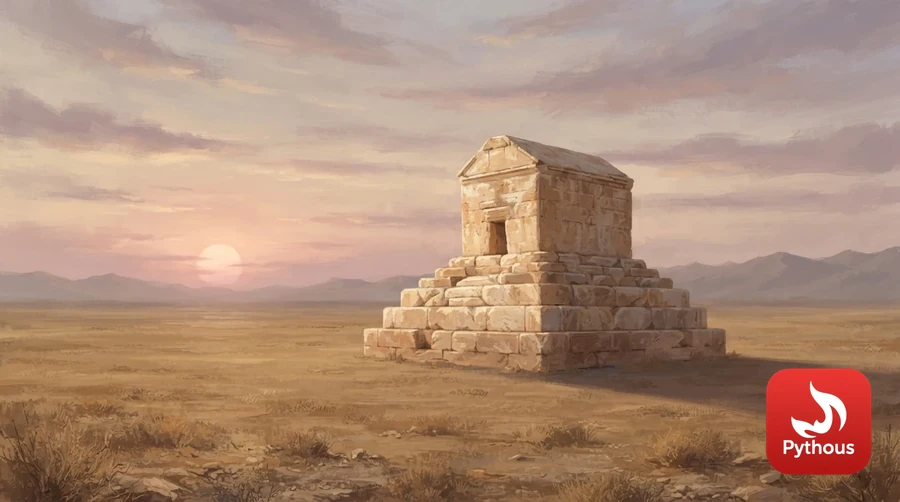
Illustration: the tomb of Cyrus the Great at Pasargadae, Iran.
The sources
Cyrus left no court history. The documents closest to him in time are Babylonian. The Cyrus Cylinder, a clay barrel inscribed in Akkadian and buried in the foundations of a wall in Babylon after he took the city in 539 BCE, is now in the British Museum. The Nabonidus Chronicle, a terse year-by-year record kept by Babylonian scribes, describes the same years from the outside. Both are official texts written in the conventions of Mesopotamian kingship, not biography.
The fullest narratives are Greek and come a century or more later. Herodotus, writing in the 430s BCE, says he knew four different stories of Cyrus's origins and chose the one he found most believable. Xenophon's Cyropaedia, the "education of Cyrus", is a work of political philosophy about the ideal ruler more than a history. Ctesias, a Greek doctor at the Persian court around 400 BCE, gives yet another account, known only in fragments. The third group of sources is the Hebrew Bible: Isaiah, Ezra and Chronicles present Cyrus as the instrument of God who let the exiles of Judah return home. These sources rarely agree on the basics, which is why Cyrus remains elusive.
Persian, Elamite, Achaemenid?
Cyrus is usually called the founder of the Achaemenid dynasty, named after an ancestor, Achaemenes. On the Cyrus Cylinder, though, he lists his own ancestors: he is the son of Cambyses, grandson of Cyrus and great-grandson of Teispes, each called "king of Anshan". Achaemenes does not appear. The link to Achaemenes was made by Darius I, who took the throne in 522 BCE after the death of Cyrus's son Cambyses, and who had every reason to present himself as a member of the same family rather than a usurper.
The title itself is a clue. Anshan was an old city of Elam, a civilisation in southwestern Iran older than the Persians, with its own language and gods. Historians such as Daniel Potts and Matt Waters have argued that Cyrus's family was strongly shaped by Elamite culture, and that the fully "Persian" Cyrus of later tradition was partly created after his death.
The birth story
Herodotus tells how Astyages, king of the Medes, dreamed that his daughter's son would overthrow him, and ordered his courtier Harpagus to kill the newborn Cyrus. Harpagus gave the baby to a herdsman, whose wife, named Spako, the Median word for "dog", had just given birth to a stillborn child. She raised Cyrus as her own. Years later the boy's royal bearing gave him away, and in time he fulfilled the prophecy. The story follows a pattern found in the birth legends of many founders, including Sargon of Akkad, Moses, Romulus and Remus: an infant threatened by a king, exposed, rescued and raised in secret. That doesn't mean Cyrus was invented, but it does mean that within a century his childhood had been rewritten as a legend. What really happened is lost.
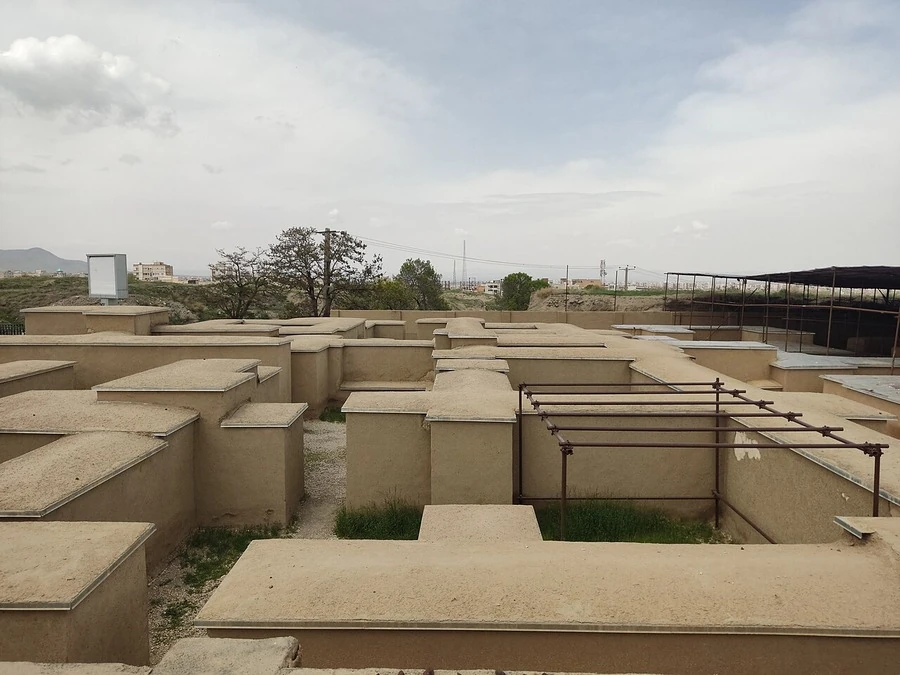
Media's heartland; the earliest record says Astyages' own army handed him over to Cyrus. Photo: Parsa 2au / Wikimedia Commons, CC BY-SA 4.0
How the Medes and Babylon fell
Herodotus describes Cyrus rebelling against Astyages and defeating him in war. The Nabonidus Chronicle, much closer to the events, says that around 550 BCE the Median army mutinied, seized Astyages and handed him over to Cyrus. That was closer to a coup than a conquest, and it helps explain why Medes held high positions in the Persian empire afterwards.
Babylon followed a similar pattern. Herodotus and Xenophon describe a dramatic siege in which the Persians diverted the Euphrates and entered the city along the dry riverbed at night. The chronicle records a real battle at Opis on the Tigris, after which Babylon was taken "without battle" in October 539 BCE and Cyrus entered a few weeks later. Political preparation, and the unpopularity of the last Babylonian king, Nabonidus, did much of the work.
Religion and the Cylinder
There is no direct evidence that Cyrus followed Zoroastrianism; his surviving inscriptions do not mention Ahura Mazda, whom Darius later named constantly. In Babylon the Cylinder presents him as chosen by Marduk, the city's god, to replace Nabonidus, who is accused of neglecting Marduk's worship. In the book of Isaiah (45:1) the God of Israel calls Cyrus his mashiach, his anointed, the only non-Israelite given that title in the Hebrew Bible.
Two readings of this are possible. Cyrus may have pursued an unusually tolerant policy, letting conquered peoples keep and restore their gods and temples. Or he was a skilled ruler who spoke each people's religious language back to them. Both may be true. The Cylinder is sometimes called the world's first charter of human rights, and a replica stands at the United Nations headquarters, but scholars point out that it belongs to a long tradition of Mesopotamian royal inscriptions in which a new king denounces his predecessor, claims divine choice, restores temples and returns displaced people and gods to their homes. It does record real acts of restoration. It does not mention the Jews or Jerusalem, though its policy fits the biblical account of the return from exile.
His death and his tomb
Here the sources diverge most. Herodotus says Cyrus was killed in 530 BCE fighting the Massagetae, nomads east of the Caspian Sea, and that their queen, Tomyris, whose son had died because of him, put his severed head into a skin full of blood. Ctesias says he died of wounds after a battle with the Derbices; the Babylonian priest Berossus says he fell fighting the Dahae. Xenophon gives him a peaceful death in bed, lecturing his sons on virtue. Since three of the four traditions place his death in battle on the northeastern frontier, around 530 BCE, that is the likeliest version.
His tomb at Pasargadae, the capital he built in the plain of Fars, still stands: a gabled stone chamber on six stepped platforms, plain for a man who ruled from the Aegean to Central Asia. When Alexander the Great came there in 324 BCE, his officers found it looted, and Greek writers record an inscription asking the passer-by not to begrudge Cyrus the little earth that covered his body; no inscription survives on the monument now. In the Islamic period local people called it the tomb of the mother of Solomon, and that belief helped protect it. Pasargadae has been a UNESCO World Heritage Site since 2004.
Sources
- Cyrus Cylinder, English translation, Livius.org. https://www.livius.org/sources/content/cyrus-cylinder/cyrus-cylinder-translation/
- Nabonidus Chronicle (ABC 7), translation, Livius.org. https://www.livius.org/sources/content/mesopotamian-chronicles-content/abc-7-nabonidus-chronicle/
- Encyclopaedia Iranica, "Cyrus iii. Cyrus II the Great". https://www.iranicaonline.org/articles/cyrus-iii
- Herodotus, The History, book 1, translated by G. C. Macaulay, Project Gutenberg. https://www.gutenberg.org/ebooks/2707
- Isaiah 45:1, Sefaria. https://www.sefaria.org/Isaiah.45.1
- UNESCO World Heritage Centre, "Pasargadae". https://whc.unesco.org/en/list/1106
- Matt Waters, Ancient Persia: A Concise History of the Achaemenid Empire, 550–330 BCE (Cambridge University Press, 2014).




Comments (0)
Leave a Reply
Comments are moderated. Please read our Comment Policy before posting.
Log in to post a comment.