
 Dec 03, 2025
 4 min read
Do Gemstones Affect Personality? Beliefs, Mineralogy and What Tests Show

In 2001, the psychologist Christopher French and colleagues at Goldsmiths, University of London, ran an experiment with 80 volunteers. Each held a crystal while meditating, and then reported what they felt: tingling, warmth, calm or energy. Half held real quartz crystals. The other half held glass fakes. The sensations were the same in both groups. What mattered was whether people had been told beforehand that crystals produce effects, and whether they believed in them. That result sums up much of the evidence on gemstones and personality. The effects people feel are real experiences, but they come from the mind, not the stone.
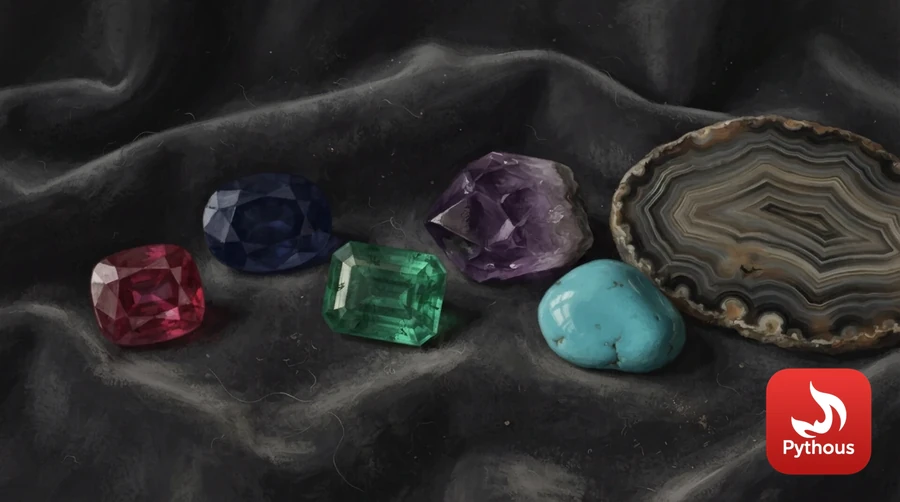
Illustration: the stones covered in this guide.
What gemstones actually are
Gemstones are minerals, or occasionally organic materials such as pearl and amber, valued for colour, clarity, hardness and rarity. Their colours come from small amounts of other elements in the crystal:
- Ruby (manik) and sapphire (neelam, pukhraj) are both corundum, aluminium oxide. Traces of chromium make ruby red. Iron and titanium make sapphire blue. Corundum is 9 on the 10-point Mohs hardness scale, second only to diamond.
- Emerald (panna) is beryl coloured by chromium or vanadium, usually with natural internal flaws.
- Amethyst is quartz coloured purple by iron and natural radiation.
- Turquoise (feroza) is a copper aluminium phosphate. The copper gives it its sky-blue colour.
- Agate (aqeeq) is a banded form of fine-grained quartz.
The Gemological Institute of America's gem encyclopedia has detailed profiles of each.
Where the beliefs come from
In Vedic astrology (Jyotish), each of nine celestial bodies is linked to a stone: ruby for the Sun, pearl for the Moon, red coral for Mars, emerald for Mercury, yellow sapphire for Jupiter, diamond for Venus, blue sapphire for Saturn, hessonite for Rahu and cat's eye for Ketu. Astrologers recommend stones to strengthen or calm a planet's influence. Western traditions have birthstones by month. The modern US list was standardised by jewellers in 1912, partly as a marketing exercise. Agate rings have a long tradition in many Muslim communities, and turquoise has protective meanings from Persia to the American Southwest. Medieval European "lapidaries" assigned medical powers to stones, such as amethyst preventing drunkenness. The name comes from the Greek for "not intoxicated".
What the evidence says
No controlled study has shown that wearing a particular stone changes personality, confidence, luck or health through any physical property of the stone. There is no known mechanism by which a crystal could send energy into the body. Proposed effects disappear when people don't know whether they are wearing the "right" stone, as in the Goldsmiths experiment.
Personality descriptions that come with stones and horoscopes also rely on the Barnum effect. In a classic 1949 classroom experiment, the psychologist Bertram Forer gave students what he said were individual personality profiles. In fact every profile was identical, assembled from vague statements taken from horoscopes. The students rated their "personal" profile as highly accurate, on average 4.3 out of 5. Statements like "you have a great deal of unused potential" feel personal but fit almost everyone.
Why people still feel a difference
Wearing a stone can still influence how someone feels, through psychology:
- Meaning: an heirloom ring from a grandparent, or a stone chosen at an important moment, can be a real source of comfort and confidence.
- Expectation: believing something will help can reduce anxiety. That is the placebo effect, which is real but works through belief.
- Attention: a ring or pendant can act as a reminder of an intention, much like a note on a mirror.
Enjoying gemstones for their beauty, tradition or personal meaning is entirely reasonable. Treating them as a substitute for medical treatment, financial advice or major life decisions is where harm begins.
Practical cautions
- Cost. Astrologers in South Asia sometimes recommend stones costing far more than a family can afford, presented as essential. No evidence supports paying more for "stronger" effects.
- Treated and synthetic stones. Many rubies and sapphires are heat-treated. Some low-cost rubies are filled with lead glass, and lab-grown corundum has been made since 1902. These aren't necessarily bad buys, but they should be priced honestly. For expensive stones, ask for a certificate from an independent gem laboratory.
- Never drink "gem water" or elixirs made by soaking stones. Some minerals sold as healing stones release toxic substances: malachite contains copper, cinnabar contains mercury, and realgar and orpiment contain arsenic.
- Health decisions. If a stone is recommended in place of treatment for an illness, especially a serious one such as cancer, diabetes or epilepsy, get medical advice. Delayed treatment causes real harm.
The science of gemstones, how pressure, heat and trace elements create colour in rock over millions of years, is remarkable in its own right. It just doesn't extend to shaping who we are.
Sources
- Complete List Of Gemstones, "GIA Gem Encyclopedia". https://www.gia.edu/gem-encyclopedia
- Forer B, "The fallacy of personal validation: a classroom demonstration of gullibility", The Journal of Abnormal and Social Psychology 44 (1949): 118-123. https://doi.org/10.1037/h0059240
- Wikipedia, "Crystal healing". https://en.wikipedia.org/wiki/Crystal_healing

Comments (0)
Leave a Reply
Comments are moderated. Please read our Comment Policy before posting.
Log in to post a comment.