

 Aug 24, 2026
 6 min read
Zaynab bint Ali: The Woman Who Carried Karbala Into History

On the tenth of Muharram, 61 AH (10 October 680 CE), the army sent by the Umayyad governor of Kufa won the fighting at Karbala. Husayn ibn Ali, the Prophet's grandson, and the men with him were killed beside the Euphrates, whose water they had been denied for days. By the end of the afternoon the battle was over. The governor, Ubaydullah ibn Ziyad, could reasonably expect the matter to end there. It did not, and one reason was a woman in her fifties who left the battlefield as a prisoner: Husayn's sister, Zaynab bint Ali.
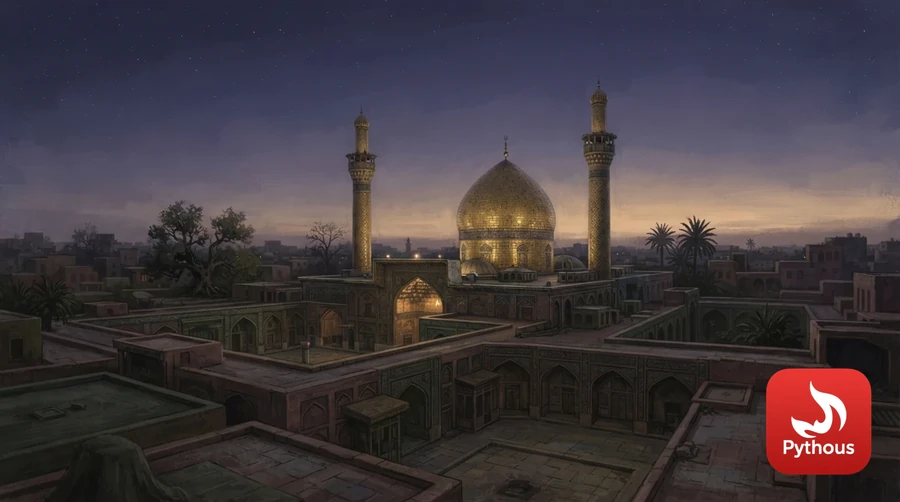
Illustration: the shrine of Sayyida Zaynab near Damascus.
Daughter of the house
Zaynab was born in Medina, most sources say in 5 or 6 AH (626 or 627 CE), the daughter of Ali ibn Abi Talib and Fatima, the Prophet Muhammad's daughter. Her brothers Hasan and Husayn were a year or two older. She was a small child when the Prophet died in 11 AH, and her mother died a few months after him. She grew up in Medina through the caliphates of Abu Bakr, Umar and Uthman, and married her cousin Abdullah ibn Ja'far, son of Ja'far ibn Abi Talib, who had led the early Muslim emigrants to Abyssinia. Among their children were two sons, Awn and Muhammad.
When her father became caliph and moved his capital to Kufa in 36 AH, Zaynab went with the family to Iraq, and she was there when Ali was struck down in the mosque of Kufa in 40 AH. Her brother Hasan died in Medina in about 50 AH. By the crisis of 60 AH, when Mu'awiya died and his son Yazid demanded the allegiance of the leading men of Medina, she had lost her grandfather, her mother, her father and her elder brother.
Karbala
When Husayn refused to give allegiance to Yazid and left Medina for Mecca, and then set out for Kufa in response to letters inviting him to lead the town, Zaynab travelled with him, as did most of the family: his wives, his sisters, his sons and nephews, and small children. It was a family on the move, not an army, and it says something about what Husayn expected to find. By the time the caravan neared Kufa, Ibn Ziyad had taken control of the town, executed Husayn's envoy Muslim ibn Aqil, and frightened his supporters into silence. The caravan was stopped and forced to camp at Karbala.
The events of the following days are among the most fully recorded of early Islamic history, because the Kufan historian Abu Mikhnaf (died 157 AH) collected the accounts of people who had been there, and the great historian al-Tabari preserved much of his work in his History. On the day of Ashura the men were killed one after another. Zaynab's sons Awn and Muhammad were among them. Her half-brother Abbas was killed trying to bring water from the river. Husayn was killed in the afternoon, and the tents were looted and set on fire.
The survivors were women and children, and one young man too ill to fight: Husayn's son Ali, later known as Zayn al-Abidin. When the captives were brought before Ibn Ziyad in Kufa, according to the accounts al-Tabari records, the governor ordered the young man killed, and Zaynab threw her arms around him and said that if they killed him, they would have to kill her with him. Ibn Ziyad let him live. Had she not, the line of Husayn would have ended there. Every later Imam of the Twelver and Ismaili Shia traces his descent through the young man she protected.
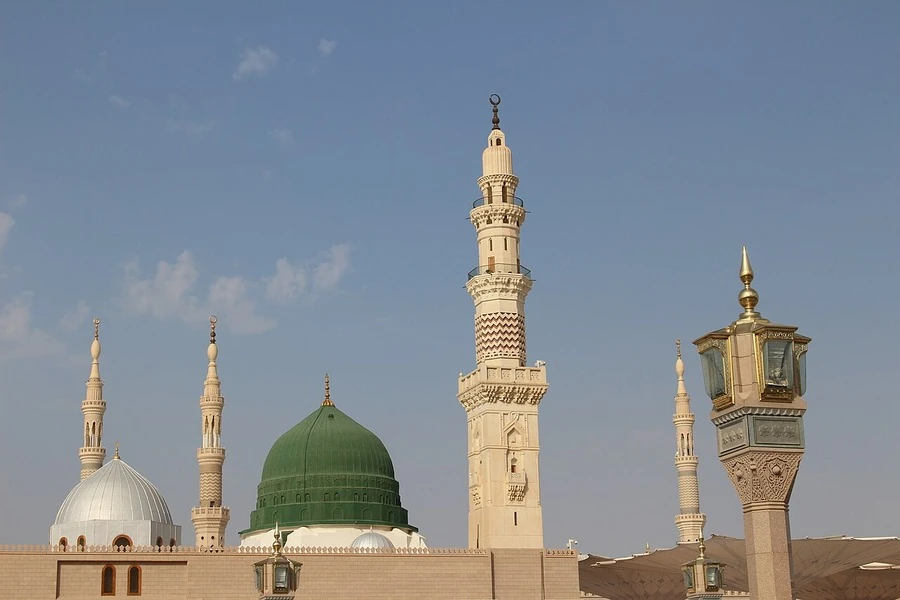
The survivors were released and sent back to Medina. Photo: TheHadiRahim / Wikimedia Commons, CC0
The captivity and the speeches
The prisoners were paraded through Kufa and then taken on the long road to Damascus to be brought before Yazid. The purpose was humiliation. It gave Zaynab an audience.
In Kufa, Ibn Ziyad taunted her, asking how she had found what God had done to her brother and her family. Her reply, as the tradition preserves it, was: "I saw nothing but beauty." These were people, she said, for whom God had decreed death, and they had gone to their resting places; God would gather the governor and them together, and he would see who prevailed on that day. In Damascus, at Yazid's court, she is reported to have given a longer address, reminding Yazid that his family had been among the Prophet's fiercest enemies and owed their freedom to his mercy at the conquest of Mecca, and telling him that he could not erase their memory or kill their message.
How much of the wording goes back to Zaynab herself is a fair question. The basic events, the captivity, the journey, the confrontation with Ibn Ziyad and her protection of Ali ibn al-Husayn, are recorded in early sources such as al-Tabari and al-Baladhuri. The full texts of her two sermons are found mainly in later works, especially Ibn Tawus's al-Luhuf in the thirteenth century and al-Tabrisi's al-Ihtijaj. Historians generally accept that she spoke out and treat the polished wording as shaped by those who handed it down.
What her witness did
Yazid eventually released the survivors and sent them home to Medina with an escort. That was an attempt to limit the damage. The Umayyads had wanted to make an example of the family and had instead put the Prophet's granddaughter on display in two of the largest cities of the empire, speaking against them. Within four years, men in Kufa who had invited Husayn and then abandoned him formed the Tawwabun, the Penitents, and marched against the Umayyad army in 65 AH, knowing they would probably die. Al-Mukhtar's revolt in Kufa followed, and he hunted down many of those who had fought at Karbala. The Abbasids who overthrew the Umayyads seventy years later drew on the same anger.
The mourning gatherings of Muharram, the recitation of the story of Karbala, and the elegies composed for it over the following centuries all depend on the account that the survivors carried back. Shia tradition gives Zaynab a central place in it, and she is remembered by titles such as 'Aqilat Bani Hashim, the wise woman of the Banu Hashim.
Her death and her grave
Zaynab is usually said to have died in 62 AH (682 CE), about a year and a half after Karbala; her death is commonly marked on 15 Rajab. Where she is buried is disputed. The most visited shrine is at Sayyida Zaynab, a town south of Damascus, which became one of the most important Shia pilgrimage sites in the world. Another tradition holds that she went to Egypt in her last months, and the Sayyida Zaynab mosque in Cairo is one of the city's most loved. A third view places her grave in the Baqi cemetery in Medina. Some scholars think the Damascus tomb belongs to another woman of the family, possibly her sister Umm Kulthum. The early sources do not settle the question.
Sources
- al-Tabari, The History of al-Tabari, vol. 19, The Caliphate of Yazid b. Mu'awiyah, translated by I. K. A. Howard (State University of New York Press, 1990), drawing on Abu Mikhnaf.
- Ibn Tawus, al-Luhuf (Lohoof: Sighs of Sorrow), English translation, Al-Islam.org. https://www.al-islam.org/lohoof-sighs-sorrow-sayyid-ibn-tawus
- I. K. A. Howard, "Great Shi'i works: Kitab al-Irshad by al-Mufid", al-Serat 3, no. 3 (1977), Al-Islam.org. https://al-islam.org/al-serat/vol-3-no-3-1977/great-shii-works-kitab-al-irshad-al-mufid-ian-keith-anderson-howard
- Encyclopaedia Iranica, "Ḥosayn b. ʿAli i. Life and significance in Shiʿism". https://www.iranicaonline.org/articles/hosayn-b-ali-i
- Encyclopaedia Iranica, "Karbala". https://www.iranicaonline.org/articles/karbala
- "Zaynab bint Ali", Wikipedia (with references to the burial traditions). https://en.wikipedia.org/wiki/Zaynab_bint_Ali



Comments (0)
Leave a Reply
Comments are moderated. Please read our Comment Policy before posting.
Log in to post a comment.