

 Oct 27, 2025
 5 min read
The History of Atheism: The Journey from Belief to Understanding

Throughout history, humanity has looked up at the stars and asked the same eternal question: “Who made all this?”
For some, the answer came as gods, spirits, or divine forces. But for others — thinkers, philosophers, and quiet observers — the answer was silence.
That silence became the beginning of Atheism — not as rebellion against faith, but as a different way of seeking truth.
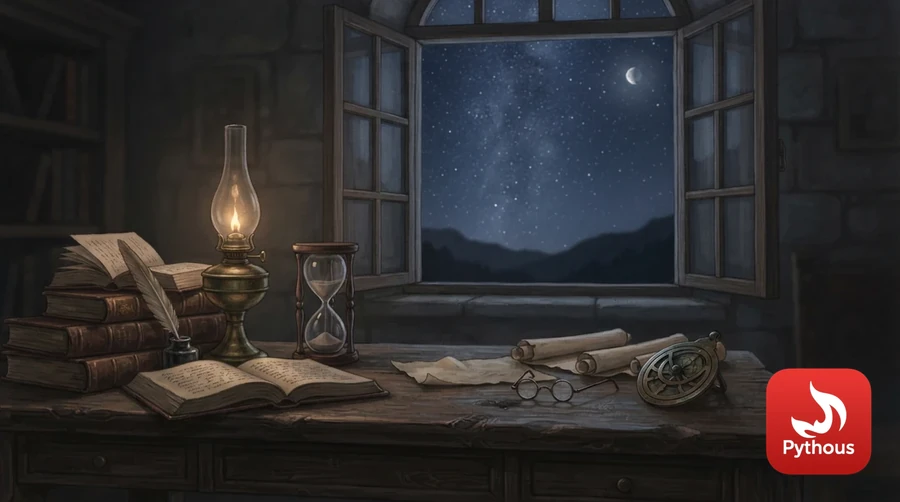
Illustration: centuries of questions asked at desks like this one.
🕰️ The Ancient Roots of Doubt
Atheism, as we know it today, isn’t a modern invention. Its roots stretch far back into ancient civilizations.
In ancient Greece, a few thinkers began to challenge the idea of divine creation. Democritus and Epicurus believed that the universe was made of tiny particles — atoms — that formed everything, including life, without divine control.
Socrates, though spiritual, questioned the blind faith in gods, which cost him his life.
And Protagoras, one of the earliest known agnostics, wrote, “About the gods, I cannot know whether they exist or do not exist.”
This was radical — a spark of rational curiosity in an age of temples and rituals.
In ancient India, early schools like Charvaka (Lokayata) also rejected religious authority. They argued that only what could be seen and proven was real — a scientific mindset long before modern science was born.
Even in China, Confucius and later Mozi emphasized ethics and practical wisdom over divine power.
The seeds of skepticism were planted across the world — quietly, bravely, and thoughtfully.
📜 The Middle Ages: Faith vs. Reason
The rise of major religions — Christianity, Islam, Hinduism, and Buddhism — brought powerful structures of faith and morality.
Questioning god became dangerous. Many early skeptics faced exile or death for expressing disbelief.
Yet even in these dark centuries, the light of curiosity never fully went out.
Islamic philosophers like Averroes (Ibn Rushd) and Al-Razi questioned literal interpretations of scripture.
In Europe, thinkers like Thomas Aquinas tried to bridge faith and logic, using reason to explain God’s existence — and unintentionally opened doors for questioning it.
By the Renaissance, art and science began to challenge religious control over knowledge.
The discoveries of Copernicus, Galileo, and Newton revealed a universe governed by natural laws — not the daily whims of gods.
Faith and reason began their slow, uneasy dance.
⚙️ The Enlightenment: The Birth of Modern Atheism
The 17th and 18th centuries marked the true awakening of modern Atheism.
Europe was flooded with ideas about liberty, science, and human reason.
Philosophers like Voltaire, Diderot, and David Hume dared to question not only religion but the very need for divine explanations.
Baron d’Holbach’s book “The System of Nature” (1770) openly denied the existence of God — one of the first purely atheistic texts in history.
Atheism was no longer whispered; it was written, printed, and debated in salons and universities.
This period also saw the birth of Deism — a belief that a creator might exist but does not intervene. It acted as a bridge between faith and disbelief, easing people into scientific reasoning.
💡 The 19th Century: Science Takes the Stage
The 1800s changed everything.
With Charles Darwin’s “On the Origin of Species” (1859), humanity realized life could evolve through natural processes.
The idea of evolution shook the very foundations of religious thought. If nature could create itself — where did that leave God?
At the same time, philosophers like Friedrich Nietzsche declared, “God is dead” — not as celebration, but as a warning that humanity must now create its own values and morality.
The Industrial Revolution brought rapid progress, and faith in science replaced faith in divine miracles.
For the first time in history, Atheism became a movement, not just an idea.
🌍 The 20th Century: A Global Conversation
The modern age turned Atheism into a global identity.
Scientific discoveries — from the Big Bang to genetic engineering — gave rational explanations for mysteries once attributed to gods.
Thinkers like Bertrand Russell, Jean-Paul Sartre, and Richard Dawkins popularized intellectual Atheism.
Yet, this period wasn’t just about denial — it was about finding meaning in a universe without divine authority.
Some embraced Humanism, focusing on compassion, ethics, and the shared responsibility of humankind.
Others found beauty in the cosmos itself — the idea that existence, though accidental, is still awe-inspiring.
🌅 Atheism Today: Beyond Belief and Disbelief
Today, Atheism is not just rejection — it’s reflection.
It’s the belief that morality, love, and purpose do not depend on divine approval.
In many parts of the world, people identify as secular, agnostic, or spiritual but not religious — blending reason with inner peace.
Atheism continues to evolve, not as opposition to faith, but as another expression of humanity’s eternal search for truth.
Because whether one believes in gods or in none, the journey — the curiosity, the wonder, the courage to ask why — is what truly defines us.
✨ Conclusion: The Freedom to Think
The history of Atheism is not a war against religion — it’s a mirror of human progress.
It shows how far we’ve come from fear and superstition toward understanding and self-awareness.
From ancient philosophers to modern scientists, Atheism has been the quiet companion of truth-seekers — reminding us that faith and doubt are both part of the same human story.
And in that endless story, perhaps the real divinity lies not in the heavens…
but in the human mind that dares to question them.



Comments (0)
Leave a Reply
Log in to post a comment.