

 Sep 02, 2026
 6 min read
How Paper Remade the Abbasid World
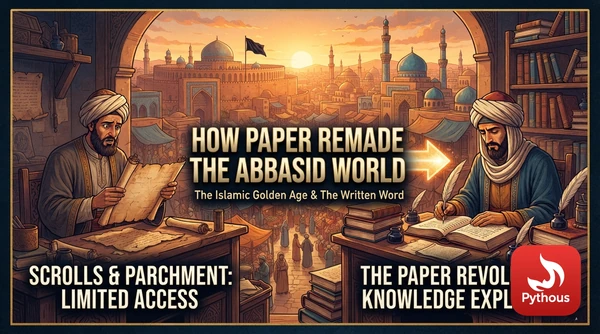
Most accounts of how paper reached the Islamic world begin with a battle. In the summer of 751 an Abbasid army defeated a Tang Chinese force under Gao Xianzhi on the Talas River, near today's border between Kyrgyzstan and Kazakhstan, after the Tang's Karluk Turkish allies changed sides. Among the prisoners taken to Samarkand, the story goes, were Chinese papermakers, who were put to work there, and from Samarkand the craft spread to Baghdad, Cairo, Fez and eventually Europe.
It makes a neat story: one battle in a remote valley and half the world's written culture changes. Historians now doubt it, at least in that form.
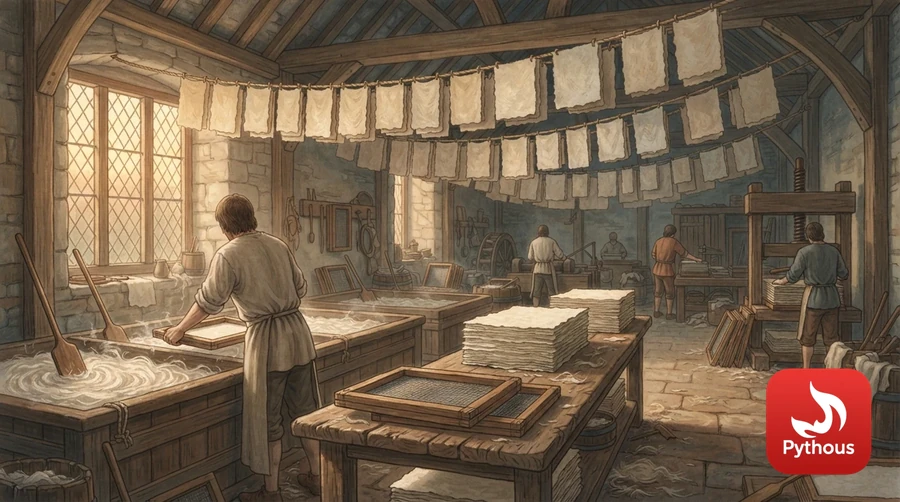
Illustration: a medieval paper workshop, like those that spread from Baghdad.
What the sources say
The earliest surviving link between Talas and paper comes from al-Tha'alibi, a writer from Nishapur who died in 1038, in his Lata'if al-ma'arif, a collection of curiosities about places. He notes that Samarkand's paper was among the best in the world and connects its manufacture to Chinese prisoners. He was writing almost three centuries after the battle, and the anecdote has the look of a story attached later to something already famous.
More decisively, paper was known in Central Asia long before 751. The Sogdian "Ancient Letters", a bundle of merchants' correspondence found in a watchtower near Dunhuang and usually dated to the early fourth century, are written on paper by members of the same Sogdian trading network that was centred on Samarkand. Fragments of paper have been found at many pre-Islamic sites in the Tarim basin and Transoxiana. The art historian Jonathan Bloom, whose Paper Before Print (2001) is the standard study, argues that what changed in the late eighth century was not knowledge but scale. Samarkand had water, flax and hemp, and now sat inside a single vast empire with an enormous demand for writing material.
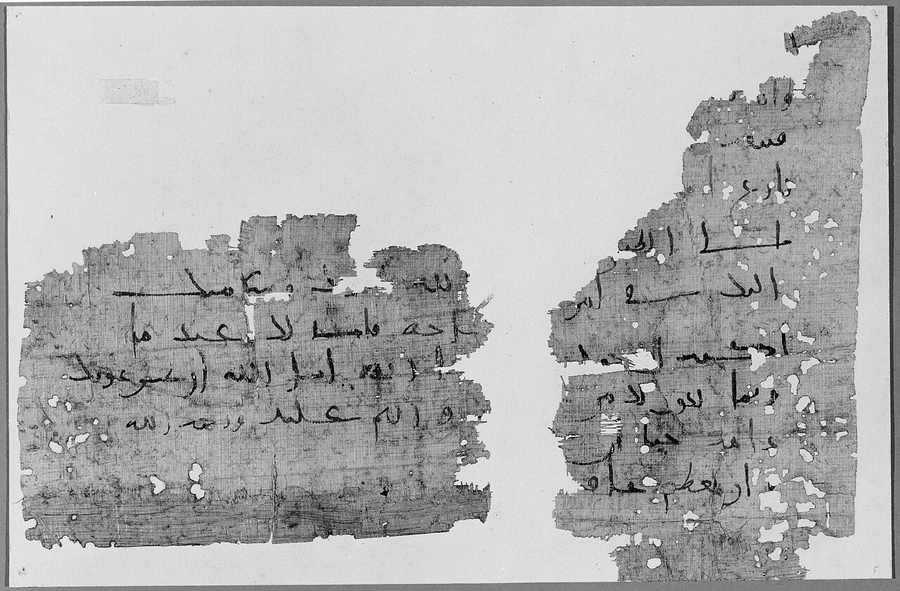
Papyrus, parchment and paper, the three writing surfaces of the eighth-century Middle East. Photo: Metropolitan Museum of Art / Wikimedia Commons, CC0
Why paper won
Scribes in the eighth-century Middle East had two main options. Papyrus, qirtas in Arabic, had been made in Egypt for three thousand years. It was relatively cheap, but brittle, hard to fold and easily damaged by damp, and it could only be produced where the papyrus plant grew. Parchment, raqq, made from animal skins, was durable and took ink beautifully, but it was very expensive; a large book could need the skins of a whole flock. That is why the earliest Qur'an manuscripts are on parchment.
Paper could be made from rags, hemp, flax and linen waste, which every city produced, wherever there was clean running water. It folded well and could be gathered into quires and bound cheaply. Later sources say a paper mill was set up in Baghdad in the 790s under Harun al-Rashid, with encouragement from the powerful Barmakid family of ministers. Those reports were written long afterwards, but the overall picture is clear: by the early ninth century paper was being made in Iraq, and by the tenth it had largely replaced papyrus. Egypt's papyrus industry, which had outlasted the pharaohs, the Ptolemies and Rome, faded away.
The state's paperwork
Government was one of the first big users. The Abbasid caliphate ran on documents: tax registers, land surveys, army pay lists, reports from the postal and intelligence service, the barid, and letters between Baghdad and governors from North Africa to Khurasan. The Egyptian scholar al-Qalqashandi, writing a manual for chancery secretaries in the fifteenth century, recorded the reasoning handed down for the switch: parchment could be scraped clean and rewritten, while erasing ink from paper left visible damage. For a tax record or an official order, a surface that showed tampering was an advantage.
The booksellers of Baghdad
The more visible change was in the book trade. Baghdad grew a stationers' market, the Suq al-Warraqin, and a profession with no real equivalent in the parchment age: the warraq, who sold paper, copied books to order and sold finished volumes from his shop. Books could now be produced for a market, not only on commission for a wealthy patron.
One warraq left a record of that market. In 987 Ibn al-Nadim finished the Fihrist, a catalogue of the books available in Arabic, arranged by subject and author, with notes on translations and on works already lost. It covers Greek philosophy and medicine, Persian and Indian works, grammar, law, hadith, poetry, theology and alchemy, and preserves the names of many authors whose books have not survived. This was also the age of the great compilations: the canonical hadith collections, the vast histories of al-Tabari and al-Mas'udi, and the developing legal literature of the schools of law. Projects of that size were possible on parchment, but practical on paper.
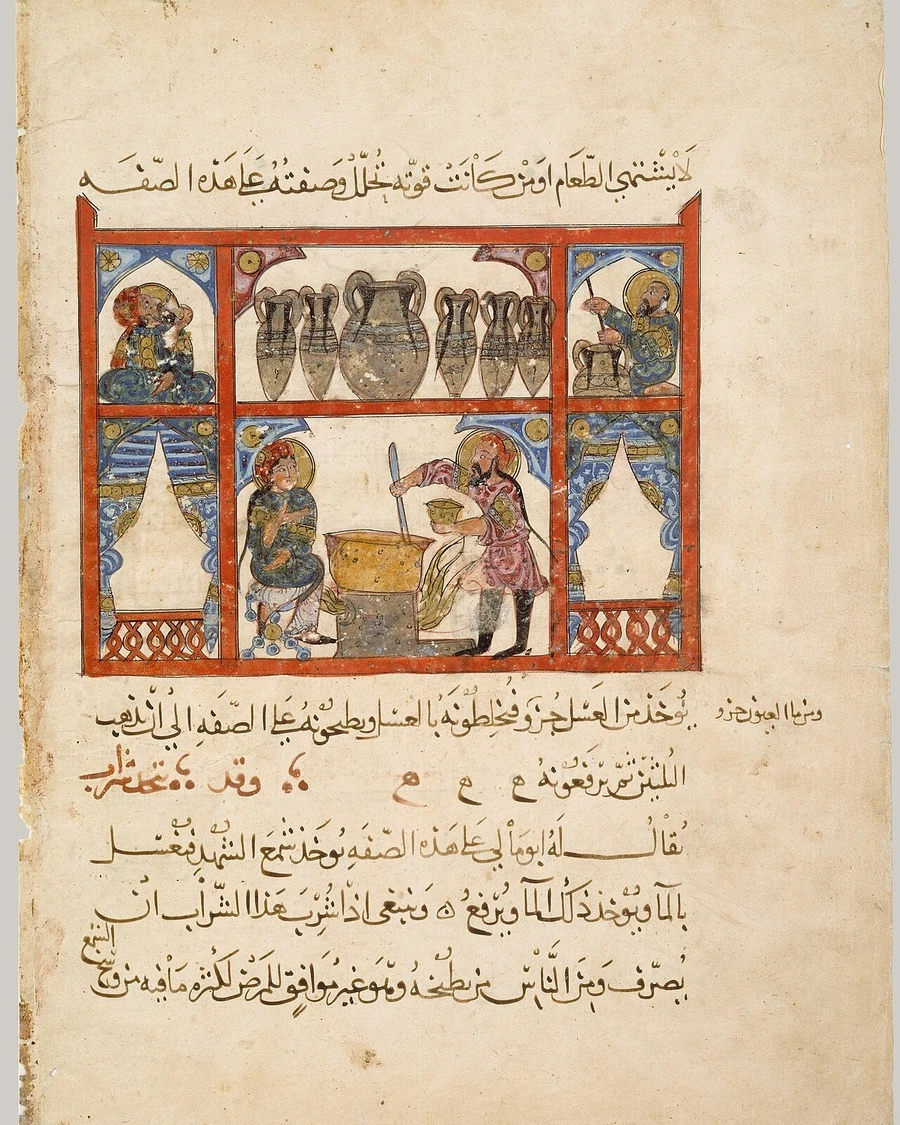
The translation of Greek science into Arabic was already under way before paper became common. Image: Abdallah ibn Abbas ibn al-Fadl / Wikimedia Commons, CC0
What paper did not do
The translation of Greek science and philosophy into Arabic, sponsored by caliphs from al-Mansur to al-Ma'mun, was already under way before paper became common. The historian Dimitri Gutas has argued that its causes were political and cultural: an Abbasid dynasty presenting itself, in part, as the heir to ancient learning, and a society with practical needs in astronomy, medicine and administration. Paper did not start that movement. It made its products cheap enough to reach readers far beyond the court.
Westward
From Iraq, papermaking spread along the trade routes to Damascus, Fustat (old Cairo) and Fez. By the twelfth century it was established in al-Andalus; the geographer al-Idrisi, writing about 1154, praised the paper of Játiva, near Valencia, which was sold across the Mediterranean. From Spain and Sicily it reached Italy, where mills at Fabriano were working by the late thirteenth century and added refinements such as watermarks and harder sizing. When Johannes Gutenberg began printing in Mainz in the 1450s, the cheap material that made printing pay had been moving west for some seven centuries. The Talas story is right that paper came from the east. It arrived, though, through merchants and craftsmen over generations, not as the spoils of a single battle.
Sources
- Jonathan M. Bloom, Paper Before Print: The History and Impact of Paper in the Islamic World (Yale University Press, 2001). https://yalebooks.yale.edu/book/9780300089554/paper-before-print/
- Jonathan M. Bloom, "Revolution by the ream: a history of paper", Saudi Aramco World, May/June 1999. https://archive.aramcoworld.com/issue/199903/revolution.by.the.ream-a.history.of.paper.htm
- Silk Road Seattle, University of Washington, "Sogdian Ancient Letters" (translation by Nicholas Sims-Williams). https://depts.washington.edu/silkroad/texts/sogdlet.html
- Dimitri Gutas, Greek Thought, Arabic Culture: The Graeco-Arabic Translation Movement in Baghdad and Early Abbasid Society (Routledge, 1998).
- Ibn al-Nadim, The Fihrist, translated by Bayard Dodge (Columbia University Press, 1970).





Comments (0)
Leave a Reply
Comments are moderated. Please read our Comment Policy before posting.
Log in to post a comment.